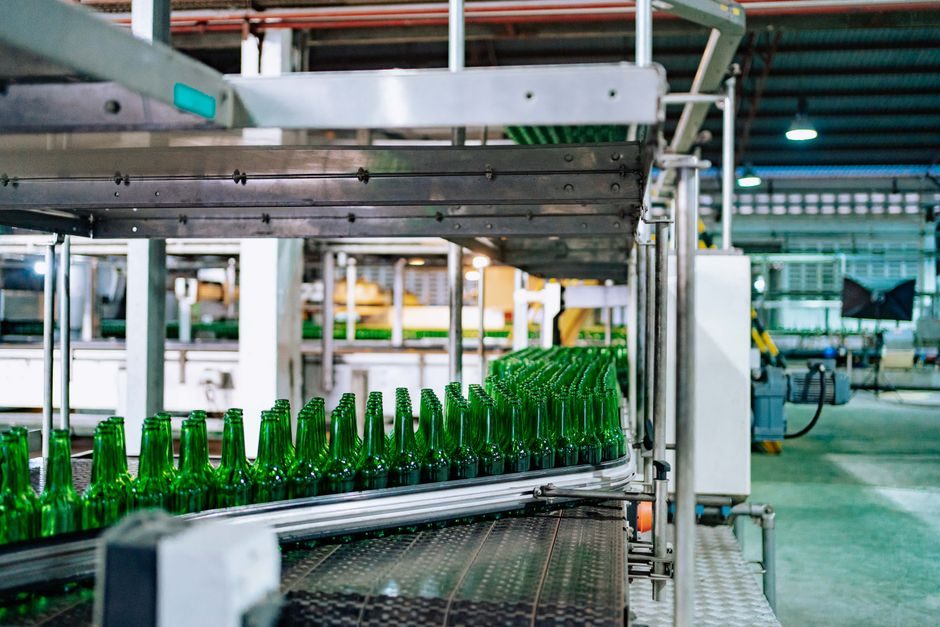
Roller conveyors span the gravity-and-powered spectrum for unit-load handling, with spun-steel tube diameters typically 50–89 mm, axle centres 75–200 mm, and per-roller capacities from ~10 kg on light skate-wheel frames up to 500 kg on heavy-duty galvanized or stainless lines.
They are widely used in parcel handling, pallet accumulation, automotive assembly and cold-store picking, but they cannot start, stop or synchronise a soft, oily, irregular, or flat-bottomed load — and that single limitation decides more projects than any other spec on the line card [S2].
Roller Conveyor Types and Where Each One Actually Pays Off
A straight gravity roller line is the cheapest powered-by-slope form of material handling: install a 2–4% downhill slope, drop cartons onto the spun-steel rollers, and the load moves itself, which is why the format still dominates low-cost parcel hubs and end-of-line accumulation zones [S2]. Skate-wheel versions trade lower load capacity (typically ≤50 kg/m) for tighter axle pitch (often 25–40 mm) and the ability to curve and side-transfer by hand on modular frames.
Powered roller conveyors — chain-driven (CDLR), belt-driven (BDLR), line-shaft (obsolete in most new builds) and the modern motorised-roller (MDR / 24 V DC brushless) variant — add controlled acceleration, zero-pressure accumulation, and reversing, but each carries a maintenance profile: chain drives need weekly lubrication, belt drives need tracking checks, and MDR rollers swap torque density for electronic commissioning that PLC people can no longer ignore [S6].
Roller Bearings and Drive Components: Where the Real Cost Sits
The roller itself is a spun or welded tube mounted on a stationary axle through two pressed-steel or polymer-caged tapered roller bearings, and that sub-assembly decides the line's noise, life and cleaning tolerance far more than the frame does [S6]. Standard 6203 / 6204 deep-groove ball bearings are the default for ambient dry duty; polymer-sleeved or stainless versions raise the usable temperature window and chemical tolerance but cap the dynamic load rating, so a switch from grease-lubricated steel to sealed-for-life polymer must be checked against the roller spacing × carton weight pair on the line.
For curved sections, tapered roller bearings (or eccentric collars on the through-axle) let the conveyor integrator preload the inner race and run a tapered sleeve, which is the standard trick for holding a curved roller conveyor frame square over years of loading; mis-applied here, the curve goes banana-shaped inside 12 months [S6]. A 50 mm tube on 1.5 mm wall at 100 mm pitch is the typical light-roller envelope; a 76 mm tube on 2.0 mm wall at 150 mm pitch covers the 200–500 kg roller range that most pallet-handling buyers actually need.
Load, Slope and Capacity: Numbers That Decide the Build

For a straight gravity line, the empirical rule of thumb is 2–4% slope for cartons on smooth steel rollers and 5–7% on plastic or aluminium rollers; below 2% the carton stalls on minor floor irregularity, above ~7% the load accelerates past the stop and the operator loses the parcel [S2]. The angle is governed by the friction coefficient of the roller surface (μ ≈ 0.05 for hard steel on corrugated, 0.10–0.15 for soft plastic on shrink-wrap) and the diameter of the roller, because a larger diameter lowers the rolling resistance and the required slope.
Powered lines hit a different set of numbers: CDLR accumulators typically run 0.15–0.4 m/s, BDLR zero-pressure zones run 0.3–1.5 m/s, and MDR-driven accumulation lines are commonly capped at ~1.0 m/s to keep the photo-eye logic and the 24 VDC bus stable [S6]. A practical capacity comparison for the same 6 m conveyor section handling 30 kg cartons: a CDLR with a 0.75 kW gearmotor delivers ~120 cartons/min at 0.3 m/s; an MDR equivalent (8–10 drive rollers, 50 W each) delivers ~80 cartons/min at 0.25 m/s with a markedly lower noise floor and zero central drive chain — at the cost of more cards on the PLC rack and more vendor firmware on the network.
Limitations, Failure Modes and Standards a Buyer Has to Check
Roller conveyors fail in predictable ways: roll-tube ovality under point load (visible as a flat-spot bump on every revolution), bearing seizure in washdown or cold-store duty, chain stretch on CDLR after 8,000–15,000 hours, and belt tracking drift on long BDLR runs. Cold-store operation below −20 °C is the classic gotcha — standard nitrile seals go stiff, the grease viscosity climbs, and roller spin-up torque doubles, so the spec sheet has to be read for low-temperature grease and seal compound rather than just the roller diameter [S6].
For safety and integration, CEMA standards cover the conveyor unit (B20.1 for unit handling), ISO 5048 / ISO 5049 covers the broader design methodology for gravity and powered lines, and ISO 12100 is the generic machinery-safety baseline that any CE-marked conveyor build will reference. For unit-handling frames, EN 15512 / EN 15620 / EN 15635 are the racking and storage sides that intersect when a roller conveyor feeds directly into a pallet rack. None of these is a comfort standard — they are the documents a buying engineer cites in the spec so the integrator cannot silently substitute a lighter roller frame at FAT.
Selection Decision Matrix: Gravity vs Skate-Wheel vs CDLR vs BDLR vs MDR
For buyers cross-shopping the main roller conveyor classes against four decision criteria: per-metre installed cost ranks gravity < skate-wheel < BDLR < CDLR < MDR, but the order inverts for control granularity and per-zone accumulation logic. Noise performance is gravity ≈ skate-wheel < BDLR < MDR < CDLR (chain noise is the worst). Maintenance burden per running metre per year is highest on CDLR (lubrication, chain stretch) and lowest on MDR (one drive roller per zone, no central chain). [S1]
Which format fits which job: gravity for low-cost downhill accumulation and truck-loading spurs; skate-wheel for flexible carton-handling turntables and light curve sections; CDLR for heavy pallet or drum lines up to ~5,000 kg/hr; BDLR for cleanroom and food-grade runs where chain oil is unacceptable; MDR for high-mix, low-volume zone-controlled lines where the integrator's PLC team is the binding constraint. For broader materials-handling context, our pneumatic conveyor system price and cost guide 2026 and the pneumatic conveyor selection guide cover the bulk-handling side that roller lines usually feed into or out of.
Use Cases and the Loads Roller Conveyors Refuse to Move
Roller conveyors are an obvious fit for cardboard cartons on a roller pitch at least 1/3 of the carton length, for rigid totes and trays, for tyre handling, for pallet accumulation when framed for 1,200 × 800 / 1,200 × 1,000 mm footprints, and for cold-store picking where the through-frame design avoids moving belts that would glaze over with ice. They are a poor fit for soft bags (the bag deforms between rollers and stalls), oily or waxed bottoms (slip on the roller surface), glass bottles without a sleeve, and any load with a footprint smaller than the roller pitch × 0.33 — which is a ratio most integrators quote but few buyers check. [S2]
For a wider B2B view of how roller lines interact with adjacent industrial equipment, our work bench types and applications spec map covers the workstation side, while the industrial gear selection guide covers the drive-train sizing behind the gearmotor that powers any non-gravity line.
Roller-tube metallurgy is the next decisive node: cold-rolled mild steel with a 12–25 μm zinc coat is the default ambient/dry reference; hot-dip galvanised to ~85 μm for washdown; 304 stainless for food-grade; 316 stainless for chemical and pharmaceutical lines where chloride exposure is expected — and the buyer should pin a coating thickness on the PO, not just a material grade, because a 12 μm zinc coat on a washdown line fails inside 18 months. Watch the FAT test for roller-to-roller height variation (target ≤0.5 mm across the section) and the no-load running current on each MDR zone, because either metric caught early saves a weekend of belt-and-bearing replacement after the line is already producing.
For component-level specifications, see road roller.