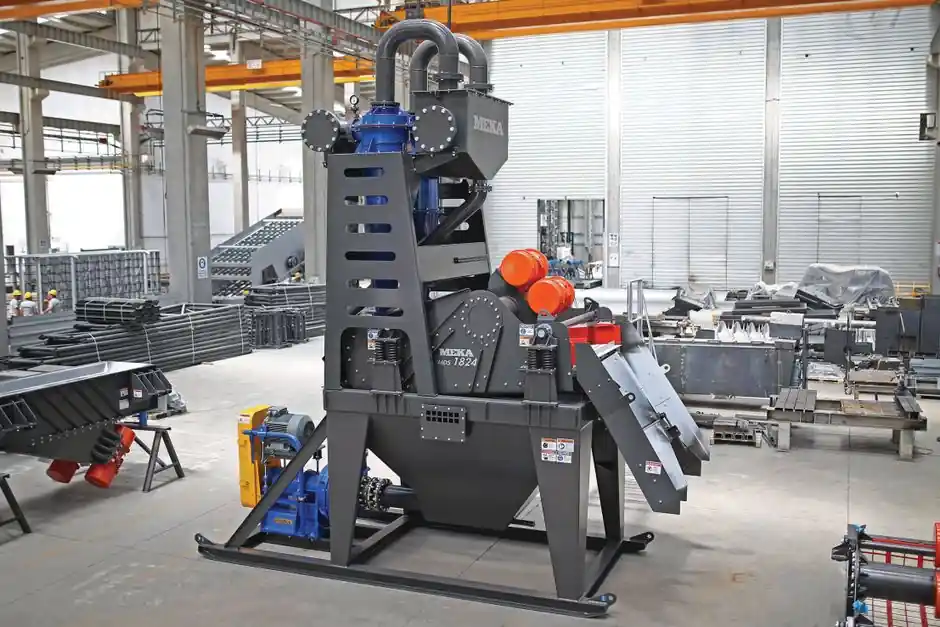
For fine powders, free-flowing mineral additives, food-grade flours, and similar sub-1 mm bulk solids, the engineering decision narrows to two enclosed-handling axes: maximum economic run length and required dust containment. Cement-plant and bulk-powder guide data put the screw conveyor's economical effective length at under 30 m, while belt conveyors extend to hundreds of meters for abrasive, coarse streams [S2].
When the bulk solid is a fine, dry, free-flowing powder such as cement raw meal, fly ash, or finished cement, the screw conveyor in a fully enclosed tubular housing is the specified default; the belt conveyor remains the right call only when the run is long, the material is coarse or hot, and dust can be managed by partial enclosure [S1][S2][S6].
Where Each Conveyor Wins on Conveying Distance and Tonnage
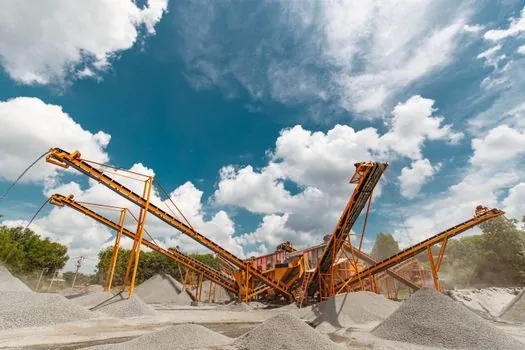
Belt conveyors dominate long-distance, high-capacity, and abrasive-material conveying; screw conveyors are specialized in short-distance, enclosed powder transfer [S2]. For cement raw stone, clinker, and limestone aggregate, the belt's flat continuous surface provides a larger contact area and a higher per-hour tonnage than a screw of comparable diameter [S5]. A belt conveyor handles hundreds of meters continuously and is the lower-energy-per-ton option for long-haul abrasive service [S2].
The screw conveyor, by contrast, is sized for runs under 30 m in cement service, with capacity tied to screw diameter, rotational speed, and trough fill ratio [S2][S4]. For fine powders the limiting factor is not distance alone but the flight-to-trough clearance and the need to keep the powder moving without fluidizing or packing, which is why screw diameters for powder service are typically smaller than for granular or aggregate service at the same plant.
Containment, Dust Control, and Hygiene for Fine Powders
Enclosure and dust control are the deciding axes for fine powders. A screw conveyor uses a fully enclosed tubular or trough-with-cover structure with complete dust-tight performance, zero material leakage, and zero dust emission under normal operation, which lets it meet environmental protection standards for cement, food, and pharmaceutical production [S2]. Powder-specific screw designs add controlled feeding, sealed inlets and outlets, and slow-rotating VFD-driven shafts that prevent the fine particles from fluidizing inside the casing [S4].
Belt conveyors in the same service are open-type or only partially covered, with dust sealing difficult to achieve fully and dust pollution easy to generate in dry working environments [S2]. Where the bulk solid is a fine powder, that open architecture typically disqualifies the belt unless downstream capture (hoods, bag filters, enclosures) is added; that auxiliary equipment erodes the belt's energy and cost advantage at the run lengths typical of powder service [S1][S2].
Comparison: Belt vs Screw on the Four Decision Criteria
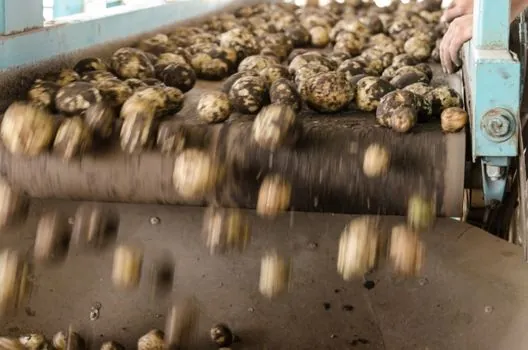
Lining the two options up against the criteria that drive a fine-powder specification gives a clean decision matrix. [S2]
Conveying distance: belt supports hundreds of meters continuously; screw is economical under 30 m [S2].
Applicable material: belt fits coarse, abrasive, high-temperature bulk (hot clinker, limestone, gravel); screw fits fine, dry, free-flowing powders (cement powder, raw meal, fly ash, mineral powder, flour, toner) [S2][S4][S6].
Enclosure and dust control: belt is open or partially covered, dust sealing is hard; screw is fully enclosed tubular, zero leakage, meets dust-emission standards [S2].
Energy and cost per ton: belt has lower energy consumption per ton on long, high-tonnage abrasive runs and lower long-term maintenance; screw has lower upfront cost and simpler installation, but higher wear and maintenance on long abrasive runs and higher energy cost per ton at large volume [S2][S5].
For the typical fine-powder run of 5-20 m at a cement mill, food-pack line, or chemical batching station, the screw wins on three of four criteria; the belt wins only when the same line is rerouted to also handle aggregate, clinker, or granular product in series [S2][S5].
Incline Angle, Layout Fit, and Footprint
Screw conveyors support steep inclines and short vertical lifts, with flexible installation angle and strong adaptability to complex plant layouts; belt conveyors are limited in conveying inclination, and large-angle conveying requires a special customized anti-slip cleated or chevron design, otherwise the material slips back down the belt [S2]. For silo discharge, mill feed, and bag-dump stations where headroom is constrained and the conveyor must angle up into a process vessel, the screw conveyor is the default geometry.
Footprint is a secondary tie-breaker. The screw conveyor is compact and space-efficient, which suits indoor process rooms with limited envelope; the belt conveyor needs a straight, level or shallow-grade run with idler supports along the full length, and that footprint is rarely available in a powder-handling mezzanine [S1][S4].
Selection Criteria: When Screw is the Right Call
Specify a screw conveyor when the bulk solid is fine, dry, and free-flowing, the run is under 30 m, the layout requires a steep incline or compact footprint, and full dust containment is non-negotiable for environmental or hygiene reasons. Powder-duty screw conveyors typically pair a stainless-steel or mild-steel casing, a VFD-driven motor for adjustable flow, a tubular or enclosed trough, and a flight-to-trough clearance sized to the powder's particle size distribution [S3][S4].
Material of construction is the second filter: stainless steel for food, dairy, pharmaceutical, and toner service; mild steel for general industrial and cement service [S4]. Capacity is set in kg/hr or TPH by screw diameter, rotational speed, and trough fill; a screw conveyor used as a screw feeder machine, with controlled discharge into a downstream process vessel, gives the precise feeding that batching and loss-in-weight systems require [S1][S4].
Selection Criteria: When Belt is the Right Call
Specify a belt conveyor when the bulk solid is coarse, abrasive, or hot (clinker, limestone, gravel, raw aggregate), the run is long (tens to hundreds of meters), tonnage per hour is high, and dust capture can be handled by partial enclosure plus hooding. The belt's flat continuous surface provides a large contact area, higher throughput per unit width, lower energy consumption per ton, and lower long-term maintenance than an equivalent screw on the same abrasive duty [S2][S5].
Belt conveyors also win on versatility: they can be specified to transport packaged goods and irregular shapes in addition to bulk solids, while a screw conveyor is limited to free-flowing powders, granules, and semi-solids that move predictably along a helical flight [S3][S5]. For unit-handling and mixed-format lines, that flexibility outweighs the screw's containment advantage.
Limitations, Failure Modes, and Common Mistakes
Screw conveyors in powder service fail in three predictable ways: over-speed rotation that fluidizes the powder and stalls torque, flight-to-trough clearance set too tight so the flight grinds the powder and overheats bearings, and hanger bearings placed at spans that trap powder and pack between the flight and the trough. Each of these is a spec-side decision, not an operating-side decision, and the wrong call on clearance or hanger spacing is the leading cause of unscheduled downtime on fine-powder screw conveyors [S3][S4].
Belt conveyors in fine-powder service fail differently: dust emission from idler junctions and transfer points, belt tracking drift on partially loaded runs, and carry-back on the return side that re-releases dust downstream. The standard mitigations are enclosure, skirting, and dust collection, but each adds capital and pressure drop that erodes the belt's energy and cost edge at short run lengths [S1][S2]. A common procurement mistake is to copy a long-haul aggregate belt spec onto a 10 m cement-powder run, then add dust hoods to fix the resulting emission problem, when a single enclosed screw would have been cheaper to buy and to operate.
Standards, Sourcing, and Trackable Specs
Screw conveyor geometry, hanger spacing, and drive selection are governed by CEMA standards in North America, with CEMA Group classifications for material characteristics driving trough loading, speed, and component selection; for fine powders the relevant groups are typically CEMA Group 2 (whole grains, free-flowing) to Group 5 (abrasive, sluggish) depending on the specific bulk solid. Belt conveyor geometry and idler spacing follow CEMA as well, with belt class and cover compound set by the bulk solid's temperature, abrasiveness, and oil or chemical exposure [S1][S3].
Trackable specs to lock into the purchase order for fine-powder service: screw diameter and rotational speed, flight-to-trough clearance, trough fill percentage at design tonnage, motor power with VFD, material of construction and surface finish (for food and pharma), inlet and outlet sealing arrangement, ATEX or IECEx zone rating for combustible dusts (where applicable), and the equivalent figure for belt service (belt width, belt class, idler spacing, enclosure and dust-collection interface) [S1][S3][S4]. For abrasive bulk solids, the screw conveyor material selection, sectional vs helicoid flighting decision, and shaft-mount vs end-mount drive are the next-tier decisions that follow once the belt-vs-screw call is made; see Screw Conveyor Material Selection for Abrasive Bulk Solids for the downstream spec chain.