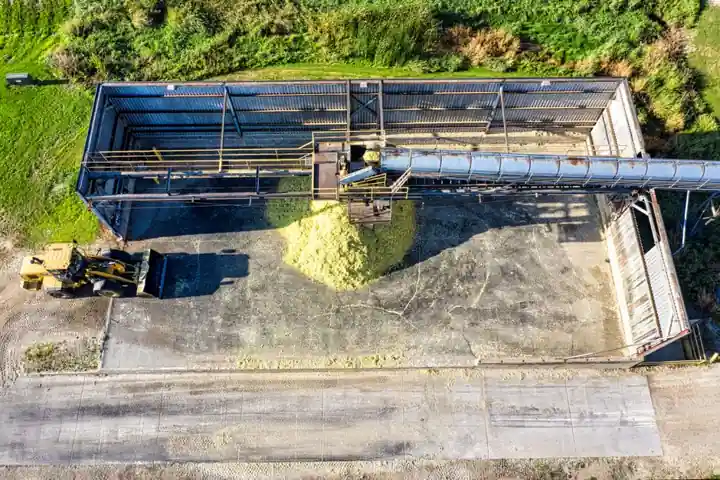
Rubber conveyor belt price per metre in 2026 spans roughly $25–$60/m for general-purpose rubber and PVC belts, climbs past $120/m for textile-reinforced or steel-cord constructions, and reaches several hundred dollars per metre for cleated, sidewall, or high-temperature variants [S8].
That spread is real, not vendor noise: carcass type, cover thickness, rubber grade, edge construction, and roll configuration move the per-metre number by 3–5x for belts of the same nominal width [S1]. For warehouse integrators, the comparison shifts from belt-only cost to installed linear-foot cost, where powered-belt runs at $100–$350/ft and cross-belt sortation hits $1,000–$2,000/ft in 2026 pricing [S3]. A belt conveyor line is therefore a specification decision first and a price decision second.
Why a Single "Price Per Metre" Quote Is Misleading
A request for conveyor belt price per metre hides more than it reveals, because two 1,000 mm belts at the same unit price can differ in carcass strength, top and bottom cover thickness, rubber grade, edge construction, roll length, packing, and Incoterm [S1]. Marketplace listings frequently show a reference price for one construction, one order quantity, or one delivery basis and are routinely misread as a market benchmark for a different mine, cement, or port application [S1].
For 2026 sourcing, the useful question is not "what is the cheapest price per metre" but "what exactly is included in each metre, and what will that belt cost to put into service and keep running" [S1]. A defensible benchmark is a normalized quote: same technical specification, same quantity, same commercial terms, same destination assumptions. Without that normalization, per-metre comparisons produce false savings that show up later as premature wear, splice work, emergency freight, and unplanned shutdowns [S1].
Specification Items That Drive the Per-Metre Number
Five engineering variables move the price more than anything in the negotiation: width, carcass construction, cover thickness, cover grade, and total ordered length [S1]. A wider belt uses more carcass and cover material per linear metre, so cross-width price comparisons are meaningless without the same width basis [S1]. Total order length matters because production setup, roll planning, packing, and logistics are spread differently across a short order and a full production run, and confirmed minimum order quantities for major Asian producers sit around 50 m for made-to-order belts [S1].
Carcass construction is the largest single cost lever. Textile belts and steel-cord belts are not interchangeable price categories, and within textile belts the fabric type (EP nylon, polyester, cotton), rated strength, and ply count shift material content substantially [S1]. The cover grade, including abrasion-resistant, heat-resistant, oil-resistant, fire-resistant, and chemical-resistant compounds, then layers on additional cost: a 2026 India price list shows general-duty rubber belts at ₹700–₹3,200/m, while abrasion-resistant rubber belts run ₹4,000–₹12,000/m, roughly 3–5x higher for the same metre [S2].
2026 Price Bands by Belt Type

General-purpose rubber and PVC belts sit at the low end of the 2026 market. Standard PVC belt pricing for light-duty applications such as electronics manufacturing has been reported at around $25/m, with ESD-safe compound and construction variants reaching $40–$50/m [S4]. A 2026 India rubber-belt price list places plain rubber belts at ₹500–₹2,500/m and flat rubber belts at ₹600–₹2,800/m, while general-duty rubber belts cover ₹700–₹3,200/m [S2].
Specialty and heavy-duty constructions sit several tiers higher. Heat-resistant belts list at ₹3,000–₹9,500/m, fire-resistance belts at ₹3,200–₹10,000/m, oil-resistant belts at ₹3,500–₹10,500/m, and chemical-resistant belts at ₹3,800–₹11,000/m on the same 2026 reference list [S2]. Sidewall and cleated belts, used for steep-incline conveying, run ₹4,500–₹13,000/m and ₹900–₹4,200/m respectively, with chevron belts in between at ₹1,800–₹7,000/m [S2]. Stone-crusher and bucket-elevator constructions sit at ₹1,300–₹5,500/m and ₹2,000–₹7,500/m, reflecting the heavier carcass and cover compounds required for aggregate and vertical handling [S2].
In US-dollar terms, a 2026 industry reference puts regular rubber conveyor belts at $30–$60/m, PVC belts at $45–$120/m, and textile conveyor belts at the upper end of that range depending on reinforcement and cover grade [S8]. Light conveyor belts, defined as the polymer-and-fabric format used in food, logistics, and packaging lines, are the fastest-growing sub-segment, projected to expand at 5.2% annually from USD 2.8 billion in 2026 to USD 4.4 billion in 2035 [S7].
Installed System Cost: Belt Price Is Only Half the Story
For buyers comparing a complete belt conveyor line rather than replacement belting, 2026 installed costs dominate the per-metre economics. Material cost per linear foot ranges from $20–$60 for skate-wheel gravity conveyors, $30–$80 for gravity roller, $100–$350 for powered belt, $150–$400 for line-shaft powered roller, and $200–$500 for motor-driven roller (MDR) conveyors [S3]. Sortation equipment sits in a different tier entirely: sliding-shoe sortation at $800–$1,500/ft and cross-belt sortation at $1,000–$2,000/ft [S3].
Equipment is typically only 50–65% of total project cost, with mechanical installation at $40–$120/linear foot (15–20% of the budget), electrical and controls at $15,000–$80,000 (10–15%), PLC programming at $10,000–$50,000 (5–10%), and WMS/WCS integration at $15,000–$75,000 (5–10%) [S3]. A general rule used by systems integrators is to budget about $1,500 per linear foot of conveyor to capture the full installed scope including structure, drives, and controls [S6].
Total project examples for 2026 warehouse builds illustrate the scale: a gravity pack-to-ship line of 100–200 ft lands at $8,000–$20,000 installed; a powered pick-to-pack system of 300–600 ft at $80,000–$250,000; a sortation system of 500–1,000 ft at $500,000–$1,500,000; and full distribution-centre automation spanning 2,000–5,000 ft at $2M–$8M [S3].
Cost Drivers and Total-Cost-of-Ownership Logic
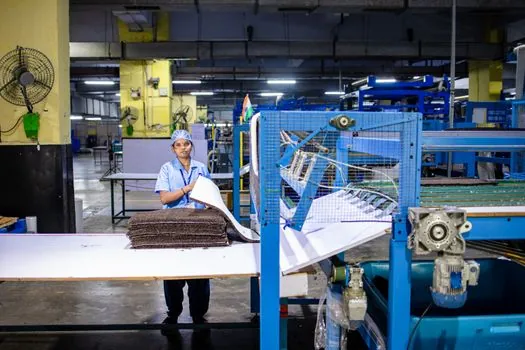
Material content is the primary cost driver, and rubber-grade belts are projected to lead the 2026 global market with around 52.0% value share because mining and cement applications require abrasion resistance [S5]. Medium-duty belts follow at roughly 41.0% share, reflecting the broad manufacturing and logistics workload that does not justify heavy-duty steel-cord pricing [S5]. The global conveyor belt market is estimated at USD 4,658.3 million in 2026 and is forecast to reach USD 6,962.1 million by 2036 at a 4.1% CAGR, while an alternate industry forecast places 2026 spend at USD 5.95 billion versus USD 5.68 billion in 2025 [S5][S9].
Beyond the purchase line, three ownership costs move the real per-metre economics: installation labour, energy, and maintenance. The 2026 warehousing cost guide models payback at 1.8 years for a $350,000 installed system that displaces 5 workers at $20/hr fully burdened, with annual maintenance of roughly 4% of system cost (about $14,000 in the example) [S3]. At 500+ orders/day, basic powered conveyors typically pay back in 18–30 months; at 2,000+ orders/day, sortation becomes viable at 12–24 months; at 5,000+ orders/day, full sort-transport-scan automation is almost always justified at 12–18 months [S3].
Selection Criteria: Who Pays What, and Why
General-light buyers (electronics, parcel handling, light packaging) should anchor on PVC or general-duty rubber belts in the $25–$60/m range and focus on the ESD, food-grade, or low-noise compound variant their line actually needs [S4]. Aggregate, mining, and cement buyers should anchor on abrasion-resistant rubber or steel-cord belts and treat cover thickness, edge construction, and rated carcass strength as the primary specification; the 2026 India reference places abrasion-resistant belts at ₹4,000–₹12,000/m, with stone-crusher and bucket-elevator variants in the ₹1,300–₹7,500/m band [S2][S8].
Warehouse and distribution-centre buyers are not really buying belts; they are buying installed systems, where the per-metre number is governed by throughput requirement, sortation tier, and controls scope rather than by the belt itself [S3]. For steep-incline applications, sidewall, chevron, and cleated constructions command a clear premium, and the spec decision, not the price, should drive the selection between them; the related sidewall cleated belt versus chevron belt decision walks through that comparison in detail. Buyers who anchor on headline per-metre price without normalizing carcass, cover, width, and Incoterm terms will systematically overpay on first cost and underpay on lifecycle cost.
Sourcing Signals to Track
Watch also the India conveyor-belt sub-segment, projected as the fastest-growing geography at 6.1% CAGR through 2036, since that growth is pulling new domestic capacity online and gradually compressing export lead times for standard rubber and PVC grades [S5].