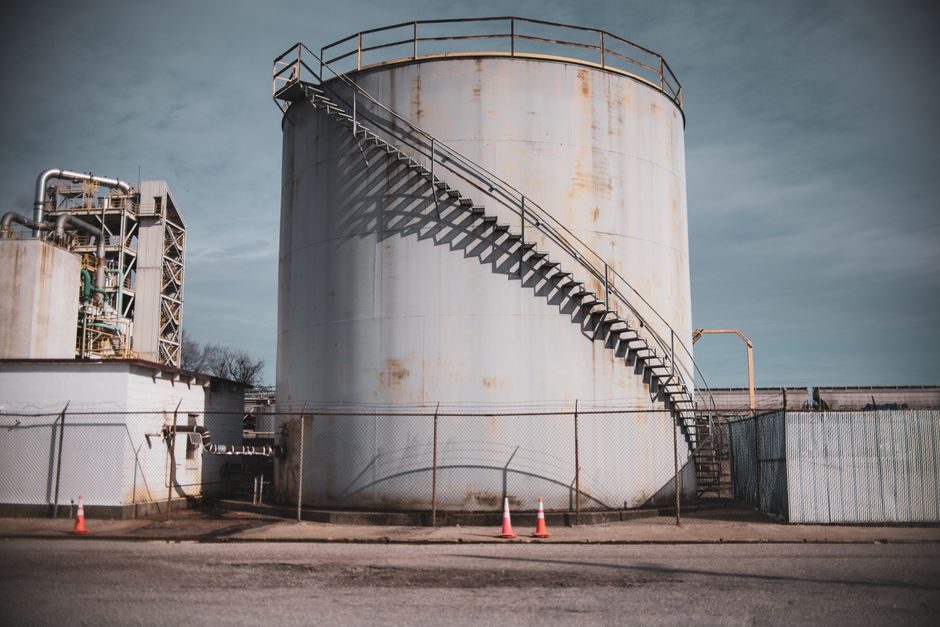
For upstream and midstream concrete — well pads, mud-pit slabs, caisson shafts, tank ring-wall footings, compressor-block foundations — the short answer is ASTM A615 Grade 60 deformed rebar for general structural use, ASTM A706 Grade 60 for weldable seismic zones, and ASTM A955 stainless-clad or solid stainless (e.g. 2304 / 316LN) for chloride- and H2S-exposed elements. Sizing in oil & gas concrete is typically #5 (16 mm) through #11 (36 mm), with #6–#8 dominating well-pad mats at 12 in (305 mm) centers each way [S1].
Selection is driven by three concrete-environment factors: chloride exposure (splash zone, jetty, offshore deck), H2S exposure (sour-service pads, gas-plant slabs, refinery containment), and post-tensioning or welded-splice requirements. Mild-service pads (sweet crude, inland tank farm) can run standard carbon rebar; offshore jackets and sour-service caissons cannot [S2].
Material Grades: A615 vs A706 vs A955 Decision Matrix
ASTM A615 Grade 60 is the default buy for inland oil & gas concrete: minimum yield 60,000 psi (420 MPa), minimum tensile 90,000 psi (620 MPa), elongation in 200 mm typically 9% for #3–#6 and 7% for #7–#11, no mandatory weldability. It is the cheapest deformed rebar per pound and the most common on well-pad BOMs [S1]. ASTM A706 Grade 60 keeps the same 60,000 psi (420 MPa) minimum yield but tightens the chemical envelope — carbon ≤ 0.30%, manganese ≤ 1.50%, CE ≤ 0.55% — and guarantees weldability without preheat in most sizes, which is why it is mandatory on the welded-splice, seismic, and moment-frame foundations specified for LNG and refinery structures [S1].
ASTM A955 covers stainless-steel deformed rebar used in chloride-splash and sour concrete. Grades 60 (420 MPa) and 75 (520 MPa) are both available; common alloys are Type 2304 lean-duplex, Type 316/316L austenitic, and Type 2205 duplex. Carbon-steel A615 has no corrosion allowance beyond concrete cover, so splash-zone and offshore-deck designers default to A955 to keep crack widths acceptable over a 50-year design life [S2]. Plain epoxy-coated A775 is sometimes substituted for splash-zone applications, but it is more vulnerable to coating damage during cage assembly, which has pushed most offshore specs toward solid stainless A955 over the last decade.
Sour-Service and H2S Concrete: NACE MR0175 Boundaries
For downhole, gas-plant, and refinery concrete exposed to H2S, the relevant material limits are NACE MR0175 / ISO 15156 for metallic components, with the rebar choice driven by H2S partial pressure, chloride concentration, pH, and design temperature. Standard A615 carbon rebar is generally acceptable in concrete with adequate cover (typically 50–75 mm) and crack-width control (0.3 mm at the tension face) when H2S partial pressure stays below 0.0003 MPa (0.05 psi) — the classic NACE Region 0 environment [S1]. Above that partial pressure, designers either move to A706 with low-CE chemistry, A955 stainless, or add corrosion-inhibitor admixtures and increase cover to 75–100 mm.
Sour-service pads handling production fluids at 1–10% H2S (NACE Region 2/3, pH 4.5–6.0) routinely specify ASTM A955 Grade 60 in 2304 or 2205 duplex at #5–#8 sizes for mat reinforcement, and #9–#11 for pile caps. The cost premium over A615 is roughly 4–6× per pound, but the service-life extension in chloride + H2S concrete is typically 3–5×, which is why most major EPC specs no longer accept bare carbon rebar for offshore decks, jetty piles, or sour-pad caissons [S1][S2].
Size, Spacing, and Cage Logic for Well-Pad Foundations
Well-pad mat foundations on a 4–6 in (100–150 mm) slab-on-grade typically run #4 (13 mm) at 12 in (305 mm) centers each way for a 4 in slab, and #5 (16 mm) at 12 in centers for a 6 in slab. Thicker mud-pit and rig-base slabs (8–12 in, 200–300 mm) move to #6 (19 mm) at 12 in centers, with #7 (22 mm) used at column-line haunches and pad edges. Deformed-bar development length on a 4,000 psi (28 MPa) mix follows ACI 318 Chapter 25 tables: for #5 Grade 60, tension development is 24 in (610 mm) minimum, compression 16 in (405 mm); for #8 Grade 60, tension 38 in (965 mm) [S1].
Drilled-shaft caissons in oil & gas typically run ASTM A615 Grade 60 #8–#11 cages at 6 in (150 mm) center-to-center verticals with #4 spiral ties at 6 in pitch, full-length. Splices above the fluid-contact zone are usually Class B tension lap splices (1.3 × tension development length) or mechanical rebar couplers when cage congestion or corrosion risk argues against lapping. In splash-zone caissons, the upper 5–10 ft (1.5–3 m) of cage is often upgraded to A706 for weldability to the jacket or pier-cap steel.
Weldable Rebar and Mechanical Splicing on LNG and Refinery Work
When rebar is welded to base plates, embed plates, or moment-frame connections — typical at compressor skids, pipe-rack pedestals, and LNG tank ring walls — the spec almost always calls out ASTM A706 Grade 60. A615 is not guaranteed weldable, and field-welding A615 bars is the single most common cause of rebar-test rejection on refinery and LNG jobs [S1].
Mechanical splicing is the other path off the welder's bench. Rebar couplers sized for A615 Grade 60 #5–#11 routinely hit 125% of specified yield (525 MPa minimum) under ACI 318 Type 2 qualification, and they let the cage builder skip the lap-splice length entirely. Field-cut bars are typically dressed square with a rebar cutter (mechanical shear, not abrasive saw) to keep the deformation pattern intact at the splice.
Coating and Corrosion-Mitigation Options
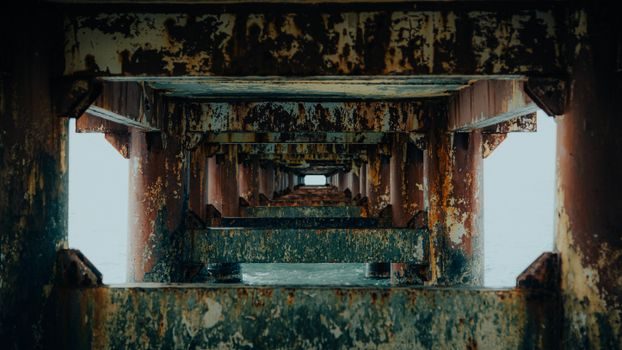
For chloride exposure without full stainless budget, the three common options are epoxy-coated ASTM A775 (fusion-bonded, 7–12 mil / 175–300 µm thickness), ASTM A767 galvanized (zinc, 3.0–3.9 oz/ft²), and ASTM A1094 zinc-clad (continuous-sheet zinc, ~50 µm). Epoxy is the most common on U.S. DOT and refinery work, but the coating is sensitive to job-site handling damage and UV degradation in storage; galvanized handles site abuse better and is standard on many Canadian oil-sands specs. Stainless A955 remains the only option that survives 50+ years in submerged or splash-zone concrete [S1][S2].
Crack-width and cover rules are the simpler lever. ACI 318 limits crack width at the tension face to 0.017 in (0.43 mm) for most exposure classes; tightening to 0.012 in (0.30 mm) lets the engineer hold A615 in moderate chloride service. Cover of 2.5 in (65 mm) for cast-in-place foundations — versus the 1.5–2.0 in minimum for interior concrete — buys another decade of service life at a fraction of the cost of a material upgrade. Where the design still calls for bent bars, a rebar bender sized for the project's largest bar (#11 maximum) keeps bend geometry inside ACI 318 tolerances (90° bend inside diameter ≥ 6 d for #3–#8, ≥ 8 d for #9–#11) [S1].
Procurement Levers: Mill, Stockist, and Field-Fab
For U.S. oil & gas work, the practical mill list is Nucor, Gerdau Ameristeel, Commercial Metals Company (CMC), Steel Dynamics (SDI), and Charter Steel for A615/A716; for A955 stainless, the global capacity sits with Stelax, Valbruna, and Outokumpu. Domestic mill lead time on A615 Grade 60 #5–#8 is 4–8 weeks; A955 2304 or 316LN at the same size runs 14–24 weeks, which is the single largest scheduling risk on offshore and sour-pad packages. Stockists such as high-pressure fittings and manifold distributors familiar with oil & gas BOMs typically carry A615 #4–#8 in 20 ft (6 m) lengths and can cut, bend, and tag to the project rebar placing drawings inside 1–2 weeks [S1].
Project-side, the realistic sourcing math for a 5,000 t well-pad and access-road package in mid-2026 looks like: A615 Grade 60 #5–#8 at USD 0.80–1.10/kg mill base plus 15–25% stockist and fabrication markup; A706 Grade 60 at USD 1.00–1.35/kg; A955 Grade 60 Type 316LN at USD 4.50–6.50/kg; A955 2304 at USD 5.00–7.00/kg. Epoxy-coated A775 carries a 30–50% premium over A615 at most U.S. service centers. Where the project owns its own rebar straightener and rebar cutter, field fabrication of bent and straight stock can absorb schedule slippage from the mill, but most midstream and upstream EPCs still outsource cutting and bending to certified fabrication shops to keep ACI 318 tolerances inside spec [S1][S2].
Where Carbon Rebar Fails: Failure Modes Engineers Should Plan For
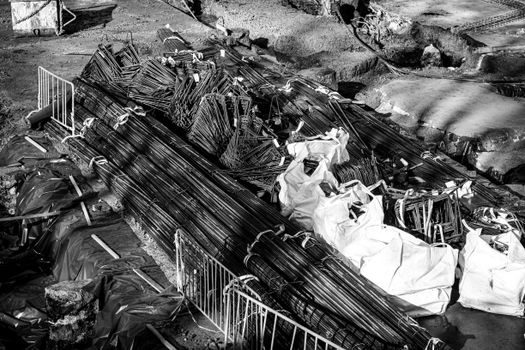
Three failure modes dominate oil & gas rebar service. (1) Chloride-induced pitting under cracked or thin-cover concrete, classic on jetty piles and platform decks, normally shows up as a 0.5–1.5 mm pit depth per year on uncoated A615 once cracks exceed 0.3 mm. (2) Hydrogen-embrittlement cracking at welded splices on A615 bars with high CE, especially in sour-pad concrete, where the H2S partial pressure plus residual stress from welding creates a textbook SSC/SCC environment. (3) Stress-corrosion cracking at the bend point of cold-bent bars that were re-bent in the field — most specs (ACI 318 §26.6.3.1) forbid field re-bending of A615 bars more than 5° once placed, which is why field bend-correction is best done with a rebar bender on a fresh bar [S1].
The decision boundary is simple: sweet crude, inland tank farm, dry concrete cover above 50 mm, no welding → A615 Grade 60, default buy. Welded moment-frame, seismic zone, or LNG containment → A706 Grade 60. Splash, submerged, or sour service → A955 stainless. Epoxy-coated A775 is a defensible mid-cost option for moderate chloride service where A955 is over budget, provided the spec enforces 7–12 mil coating thickness, field-handling protection, and 100% holiday inspection on coated bars before cage closure [S2]. The cost-of-failure model most EPCs use puts a single corroded rebar splice replacement on a live platform at 8–12× the original rebar cost, which is why specifying the right material up front — rather than matching A615 across all exposure classes — is still the cheapest answer in 2026.