
A power plant sees expansion joints in three very different services, and the "best" type is a function of where it sits in the steam and gas path, not a single product line. Fabric joints dominate low-pressure hot exhaust, metal bellows cover high-pressure steam, and rubber/PTFE bodies cover water and chemical lines [S1][S2].
For a combined-cycle plant, the canonical chain is gas-turbine exhaust to transition duct to HRSG to stack, with the expansion joint placed between each transition, sized for thermal growth, axial travel, and flue-gas leakage control. IAFD publishes a turn-key scope covering replacement expansion joints, HRSG pipe penetration seals, and HRSG duct/liner replacement systems for that exact chain [S1].
How the four common types split by service and temperature
Four material families carry the load in power plants: fabric (non-metallic), metal (stainless steel bellows), rubber (elastomeric), and PTFE-lined. The first sentence of any spec should classify by the continuous operating temperature, peak temperature, and internal pressure at the joint, because each family has a hard ceiling on those three parameters [S2].
Fabric expansion joints are the standard for GT exhaust, HRSG inlet/outlet ducts, and baghouse/precipitator connections, where temperatures stay below the limits of coated fiberglass and PTFE laminates. Metal expansion joints (axial, universal, hinged, gimbal, in-line pressure balanced) are the workhorses for high-pressure steam piping and turbine manifolds, where austenitic stainless bellows survive both pressure cycles and thermal cycling [S2]. For a worked example of pressure-class selection in elastomeric bodies, see the plastic pipe selection map referenced for duty-vs-pressure logic. A useful background page on the expansion joint category covers the basic definitions and movement types.
Metal bellows joints for steam and turbine service
Metal expansion joints in power service are typically built from 304 or 316 stainless steel bellows, designed to EJMA-style pressure and movement ratings, and configured as axial, universal, hinged, gimbal, in-line pressure balanced, or dismantling-type. The choice between axial and universal is governed by the pipe guide spacing: axial alone requires rigid guides on both sides; universal is used when the run cannot carry the reaction load [S2].
For GT exhaust and HRSG bypass stacks, single-convolution axial bellows in 304L are common; multi-ply bellows (2-ply, 3-ply) raise the design pressure but reduce cycle life, so designers trade pressure class against movement capability. Rectangular metal bellows are used in large rectangular duct sections where a round bellows cannot be fitted [S2]. Anchors and pipe guides on the run are part of the design, not optional accessories; the expansion anchor reference covers the hardware that constrains the pipe so the bellows absorbs only the intended movement.
Fabric and PTFE joints for GT exhaust, HRSG ducts, and stacks
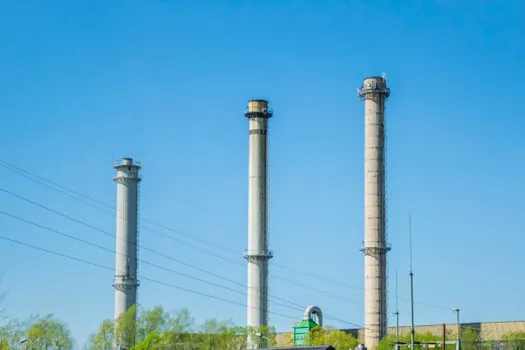
They tolerate large lateral and angular offsets, weigh a fraction of an equivalent metal joint, and tolerate the temperatures seen in exhaust gas streams well above where rubber fails [S1].
IAFD's product scope is built specifically around the gas-path chain that combined-cycle operators fight: GT exhaust to transition duct, transition to HRSG, and HRSG to stack, with HRSG pipe penetration seals and duct liner replacement as the surrounding repair work. The supplier publishes a 25-year service history and describes its fabric joint work as a turn-key engineering, manufacturing, and field installation package, which is the structure most operators want for outage-driven replacement [S1].
PTFE-lined expansion joints (two-convo, three-convo, five-convo, or PTFE-lined rubber and metal hybrids) are specified where the gas stream is wet, acidic, or carries chlorides that would attack stainless bellows, such as in some flue-gas desulfurization tie-ins and waste-heat sections downstream of wet scrubbers [S2].
Rubber and elastomeric joints for water, cooling, and condensate
Rubber expansion joints (single sphere, double sphere, union connector) absorb vibration and thermal growth in cooling water, condensate, and low-pressure auxiliary water lines. They are not used in the hot gas path; the elastomer temperature ceiling is the hard limit. EPDM, NBR, and SBR are the common body materials, with nylon-cord fabric reinforcement and carbon-steel or ductile-iron flanges [S4].
Common published specifications for these bodies include DN32 to DN3000 size range, single-sphere 4-inch units rated to 6.0 MPa burst pressure, and 120 mm stroke vulcanized rubber bellows; the relevant standards for water-side duty bodies are typically EJMA for metallic units and manufacturer-published test data for elastomeric units [S4]. Rubber expansion joints are also the natural choice on chilled-water and HVAC loops around plant buildings, where vibration isolation and noise reduction matter more than temperature [S2][S4].
Selection criteria: temperature, pressure, media, movement

Use the four-axis filter below when comparing options for a specific pipe or duct section: [S1]
Temperature: fabric joints are typical up to about 1000 °F (540 °C) depending on barrier/elastomer, PTFE-lined higher, 304/316 metal bellows higher still, rubber limited to roughly 250 °F (120 °C) on EPDM bodies. Pressure: metal bellows handle class 150 to 600 and above; fabric handles near-atmospheric duct pressure; rubber is typically used at PN10/PN16 water service pressures. Media: flue gas, wet acidic gas, steam, hot water, and chemical all push the answer toward different material families. Movement: axial, lateral, angular, and combinations thereof map directly to single-convolution axial, universal, hinged, gimbal, and pressure-balanced geometries [S2].
For high-temperature duct transitions the choice is essentially fabric or metal; for water and light chemical service it is rubber or PTFE-lined. The expansion joint type map lays out the full set of movement types (axial, lateral, angular, universal) and how each absorbs a specific combination.
Where each type fits, and where it should not be used
Fabric joints are the right answer for low-pressure, high-temperature duct sections where weight, axial/lateral travel, and corrosion resistance matter more than pressure containment. They are not used on high-pressure steam or high-pressure water because the gas barrier is a thin membrane, not a pressure vessel [S1].
Metal bellows are correct for high-pressure steam, turbine manifolds, and anywhere EJMA pressure ratings apply, but they are vulnerable to acid chloride attack and condensate-induced creep fatigue. Rubber joints are correct for cooling water, condensate, and HVAC, but they fail fast in the hot gas path. PTFE-lined joints sit between the fabric and metal options where chemical resistance and a moderate temperature ceiling are both required, and where pure PTFE hose assemblies are inadequate for the movement class [S2].
Universal expansion joints, which allow angular and lateral movement through two bellows on a shared spool, are the standard answer where guides cannot be installed on both sides of the joint; their reference geometry is covered on the universal joint page. Power-distribution cable entries on plant cable trays, while not the same service, follow a similar "match the part to the location" rule, summarized on the power distribution page.
Standards, sourcing, and signal nodes to track

No specific revision dates of governing standards are stated in the available sources, so the safe statement is: metal bellows joints are typically designed to EJMA (Expansion Joint Manufacturers Association) practice, and material selection for flue gas service follows ASME B31.1 Power Piping and B31.3 Process Piping as applicable, with the user verifying the current revision. Rubber and PTFE bodies are usually covered by manufacturer-published burst, vacuum, and cycle data, with ASTM elastomer and lining material standards for the body compounds [S2][S4].
Trackable signals to watch: published EJMA Best Practices updates, operator reports of fabric-joint gas-leakage limits, and combined-cycle outage-window planning cycles, since IAFD and similar fabric-joint specialists run on outage windows rather than on a continuous purchase cycle [S1]. For adjacent plant-spec reading, the plastic pipe sizing map covers the analogous pressure-vs-temperature tradeoff on the water side.