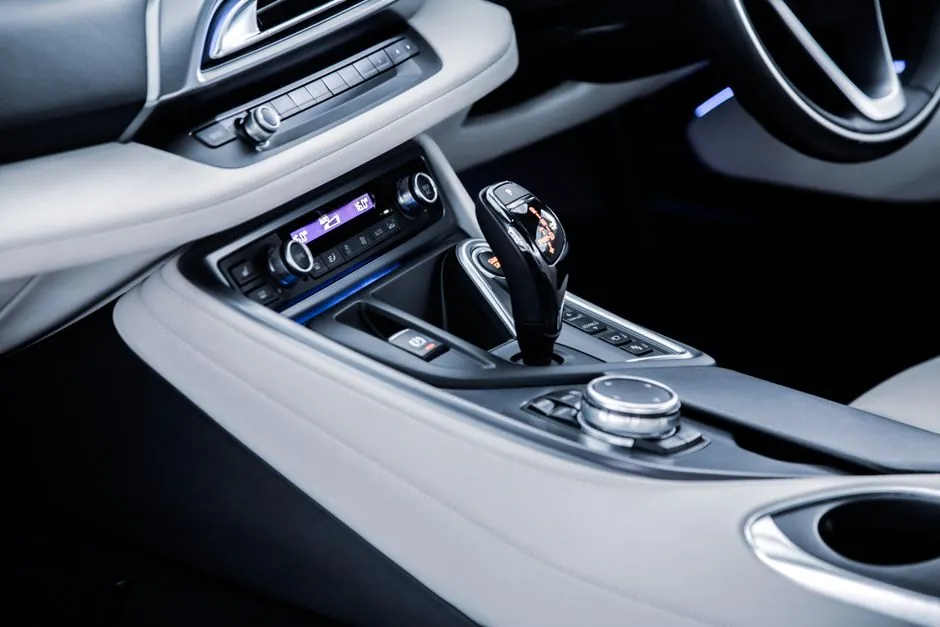
Nd2Fe14B sintered neodymium is the default automotive magnet grade for traction motors, electric power steering, and compact high-force actuators, with each modern EV drivetrain consuming over 2 kg of NdFeB material across more than 80% of shipped platforms [S3].
Automotive magnet selection is not a single-material decision: drivetrains, sensors, ABS rings, fuel-pump couplings, and exterior signage each map to a different chemistry. The four workhorse families of permanent magnet materials used in vehicle systems are sintered NdFeB (Nd2Fe14B), samarium cobalt (SmCo5, Sm2Co17), alnico, and economical ceramic, with flexible magnetic strips also commercially available [S1][S4].
Why Nd2Fe14B dominates traction motors and compact actuators
Nd2Fe14B delivers the highest energy product of any commercialized automotive magnet family, which lets motor designers shrink rotor volume for a given torque target, a critical lever when the motor sits in the axle or transmission housing [S3][S4]. Neodymium magnets concentrate exceptionally high power into a much smaller size of magnet compared to other available magnet materials, and they are an excellent choice for magnetic applications that require a lightweight magnet or a magnet that can fit within limited dimensions [S4]. The trade-off is well documented: NdFeB corrodes in humid salt-spray conditions, so automotive rotors use Dy or Tb grain-boundary diffusion plus Ni-Cu-Ni or epoxide coatings to survive under-hood and underbody exposure. Designers also derate continuous operating temperature to roughly 150-180 °C for standard N-grade NdFeB, beyond which irreversible flux loss and recoil-loop distortion appear.
Where samarium cobalt earns the spec sheet
Samarium cobalt (SmCo5 and Sm2Co17) is the only high-performance commercialized alternative to Nd2FeB in traction motors, holding usable flux density to roughly 250-350 °C without grain-boundary diffusion treatments [S3]. For under-hood sensor rings, EGR actuators, and turbocharger position sensors where ambient can exceed 200 °C continuously, Sm2Co17 is the safer engineering default. The penalty is cost: Sm and Co sit on top of the automotive rare-earth basket, so SmCo is typically reserved for the 10-20% of an EV's magnet mass that absolutely cannot be derated thermally. Alnico (Al-Ni-Co) still shows up in older instrument clusters and some wiper-motor stators because of its near-zero thermal coefficient of remanence, but it cannot match NdFeB or SmCo on energy product per cubic centimetre.
Hard ferrite (ceramic) for ABS, sensors, and cost-driven assemblies
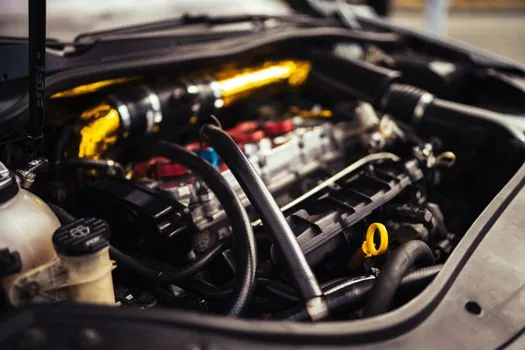
Strontium- and barium-based hard ferrite (ceramic) magnets remain the workhorse for ABS wheel-speed encoder rings, fuel-pump impeller couplings, and dashboard instrument stepper rotors where flux density requirements sit below 0.4 T [S4]. The compromise is size: a ferrite ring of equivalent torque output to a NdFeB rotor is several times larger in volume, so design teams only specify ferrite when the package envelope allows it. The broader family of magnetic material options and their remanence, coercivity, and temperature coefficients are catalogued for cross-comparison.
Flexible ferrite composite for non-structural automotive panels
For car signage, temporary fleet decals, and removable exterior panels, the industry baseline is a flexible strontium-ferrite compound bonded into a nitrile or thermoplastic carrier at 30 mil (0.030 in / 0.76 mm) thickness [S1]. The minimum acceptable thickness for automobile signs is .030 in, also commonly referred to as 30 mil, the level at which hold force on a flat steel body panel survives highway speeds and repeated wash cycles. Flexible composite is not a structural material: it cannot replace sintered NdFeB in any torque or sensing role, and it loses a large fraction of its pull force at temperatures above 80 °C, so spec sheets should mark it for cosmetic, signage, and low-load attachment only.
Selection criteria mapped to the four families

A defensible automotive magnet selection starts with four questions, and the four families answer them differently. Energy product per volume: NdFeB at 200-400 kJ/m3, SmCo at 150-240 kJ/m3, alnico at 40-70 kJ/m3, sintered ferrite at 10-40 kJ/m3, which sets the package size for a given torque or pull-force target [S3][S4]. Maximum continuous operating temperature: ferrite 250 °C plus, SmCo 250-350 °C, NdFeB 150-180 °C standard grades (up to 200 °C with Dy/Tb), alnico 450 °C plus, with flexible ferrite composites derated below 80 °C [S1][S3]. Corrosion and chemical resistance: ferrite and SmCo need no coating for underbody use, NdFeB requires Ni-Cu-Ni plating or an epoxy topcoat, flexible composite needs a UV-stable laminate for exterior panels. Cost per kilogram: ferrite and flexible composite are the cheapest, NdFeB is mid-range, and SmCo is the most expensive, so budget and supply-chain risk should be weighted alongside thermal class.
Sensor-side: where Hall, AMR, and TMR ride on the same magnets
The same magnetic-particles and stray-field principles that drive magnetic sensor ICs for crankshaft, transmission, and steer-by-wire feedback are increasingly built into integrated modules that pair a bias magnet with an ASIC in a single overmoulded package. For a deeper reference on how magnetic flux interacts with non-magnetic test articles, see the magnetic particle tester entry covering NDT inspection of drivetrain components. Related flow-side instrumentation, including how the same materials knowledge feeds into electromagnetic flowmeter design for coolant and fuel-line monitoring, rounds out the cross-discipline picture.
Supply-chain risk and what is shifting in 2026
Rare-earth pricing and Chinese export concentration remain the largest single-variable risk for an NdFeB-heavy automotive BOM, which is why DOE, IEA, and EU CRMA filings all flag Nd, Pr, Dy, and Tb as critical materials [S3]. Mitigation tracks visible in 2025-2026 are diversified NdPr sourcing outside China, increased Dy-free or low-Dy grain-boundary diffusion grades, recycled-magnet feedstock from end-of-life motors, and serious R&D funding into Sm2Fe17N3, Fe16N2, and L10 FeNi as drop-in replacements, though each still has temperature-sensitive processing gaps to close [S3]. For procurement context on how that supply shift plays against competing industrial demand, the Rare Earth Market Share 2026: China Anchors Supply, Diversification Picks Up Pace brief tracks the same reallocation theme across other downstream magnet users. Buyers building 2027 EV programmes should lock NdPr offtake early, dual-source SmCo for the thermal-critical sensor rings, and hold ferrite as the cost-down fallback for non-propulsion assemblies.
Trackable signals for the next review cycle: published DOE Critical Materials Assessment updates, IEA Global Critical Minerals Outlook 2026 revisions, EU CRMA strategic-project milestones, and OEM disclosures of Dy-free or recycled-content NdFeB ratios in next-generation 800-V drive units.