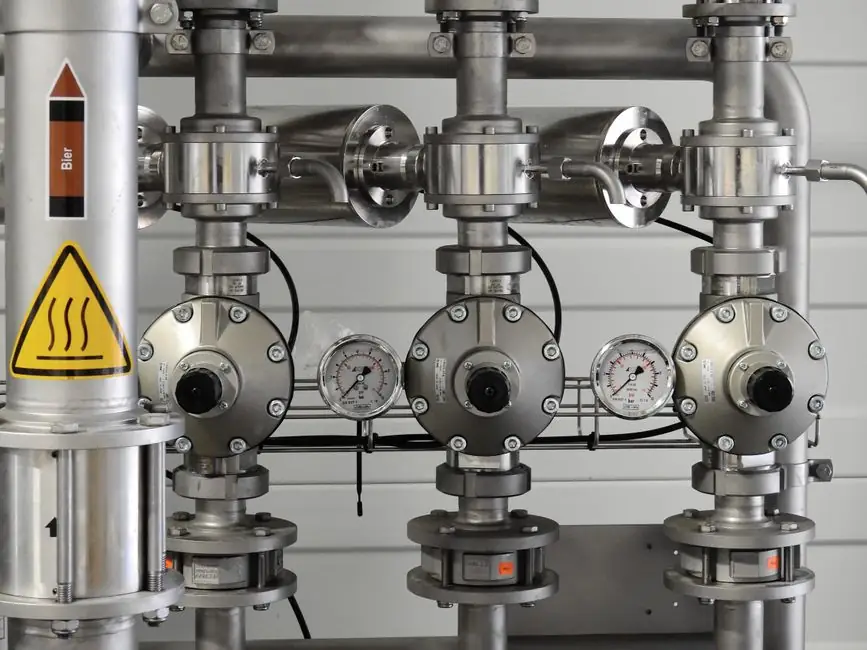
For power generation, the right pressure gauge is application-specific: 100 mm liquid-filled stainless Bourdon gauges dominate steam and feedwater lines, bellows gauges handle low-pressure boiler draft, and digital test gauges (e.g. DPI 104) cover calibration and field verification [S1][S2][S4].
Across coal, combined-cycle gas, nuclear auxiliary, and hydro stations, the most-cited performance envelope in 2026 remains ASME B40.100 Grade 2A at 0.5% of span accuracy, 316L stainless wetted parts, and IP65 minimum enclosure, with 100 mm (4") dial sizes preferred for legibility on the turbine deck [S3][S5].
Steam, Feedwater, and Boiler Drum: Liquid-Filled Bourdon
For saturated and superheated steam at the boiler drum, a 100 mm liquid-filled Bourdon tube gauge in 316L stainless with a case fill of glycerin or silicone remains the default specification in 2026 [S1][S5]. Oil & Air's 2026 selection guide notes digital gauges are faster to read but require a power source and are best for low-pressure hydraulic work, which is why mechanical Bourdon designs still win on the steam side [S2].
Ashcroft's March 2026 product comparison evaluates four industrial pressure gauges in 63 mm (2.5"), 100 mm (3.5") and 100 mm (4") dial sizes, separating standard service from harsh service: the harsh-service 100 mm liquid-filled 316L case survives vibration from turbine skid mounts where a dry case would lose accuracy within months [S5]. A 20 deg C ambient swing shifts a typical C-tube zero by 0.2-0.4% of span, so power-plant installs that swing from night air to day sun should temperature-compensate or zero at process temperature [S3].
Low-Pressure Boiler Draft and Condenser: Bellows and Diaphragm
Bellows pressure gauges are ideal for precise monitoring where minute pressure variations must be detected, and they are often required for applications in the power generation industry, including furnace draft and condenser vacuum service below roughly 0.5 bar [S1]. Their lower hysteresis and tighter linearity versus a C-tube make them the workhorse for flue-gas draft, soot-blower air, and heater drain level reference legs.
Diaphragm-sealed gauges with a welded 316L diaphragm and inert fill (silicone oil or fluorocarbon) handle hot condensate and aggressive boiler-feedwater chemistry where a direct Bourdon would corrode or plug; the diaphragm also protects the bourdon from temperature extremes above roughly 150 deg C [S1][S5]. A 63 mm (2.5") dry case is acceptable for in-cabinet panel mounting, but 100 mm (4") liquid-filled is the safer call on the boiler front where reading distance is 2-3 m.
Hydraulic and Lube-Oil Skids: Shock-Resistant Bourdon
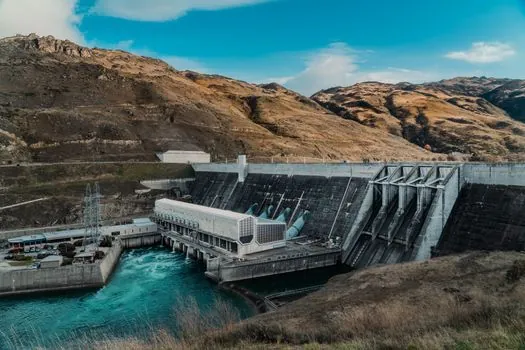
Hydraulic and lube-oil skids on turbine-governor and turning-gear circuits call for a different spec profile: solid-front, blow-out-back case construction, an internal pressure-relief plug, and a 0.5% Grade 2A accuracy class per ASME B40.100 [S3]. Oil & Air's March 2026 sizing guide flags the four most common sizing errors as undersized dial, wrong process connection, ignoring temperature derating, and neglecting pulsation or water-hammer risk on the line [S2].
For continuous pulsation, a snubber or a small-bore restriction upstream of the gauge is the standard mitigation; for intermittent spikes (e.g. pump-discharge), a diaphragm-seal chemical seal with an inert fill protects the element and extends MTBF. A 24-hour recording gauge with a 7-day clock movement is still specified on critical lube-oil headers to provide a defensible time-stamped chart for root-cause analysis after a trip event [S3].
Calibration, Field Verification, and Digital Test Gauges
The DPI 104 is a microprocessor-controlled digital pressure gauge that combines precision and functionality in a compact, robust, and simple-to-use package, and it is one of the field-reference units commonly carried into power-plant instrument shops for verification [S4]. For higher accuracy, the DPI620G modular multifunction calibrator and PACE6000 E dual-channel pressure controller cover shop and bench work, with the PV62X pressure-generating station ATEX approved for stand-alone use in hazardous areas [S4].
Calibration traceability on power-plant gauges should run back to a deadweight tester, not against another gauge, and the recording gauge accuracy class is typically Grade A (1% of span) or Grade 2A (0.5%), verified on a deadweight tester rather than cross-compared [S3]. Field practice: verify the working gauge quarterly against a reference with at least 4x better accuracy, log the as-found and as-left values, and replace any unit reading outside plus/minus its accuracy class.
Material, Enclosure, and Standardization Map
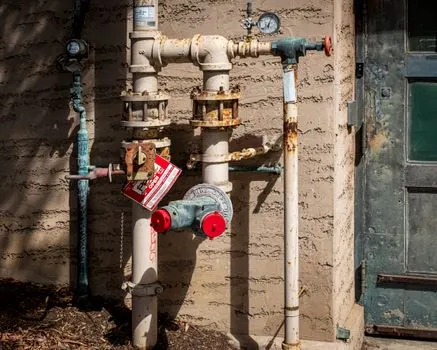
Material choice follows the service fluid. For steam, feedwater, and condensate, 316L stainless wetted parts are the safe default; for lube oil and hydraulics, alloy steel or brass wetted parts are acceptable where the fluid is clean and non-corrosive. Enclosure rating tracks location: IP54 for indoor panel rooms, IP65 for outdoor turbine decks, and explosion-proof or IS-rated enclosures (Druck UNIK5800/5900 family, ATEX/IECEx certified) for hydrogen-cooled generator stators and confined-space battery rooms [S4].
Process connection is overwhelmingly 1/2" NPT male on the power-generation side, with 1/4" NPT reserved for instrument-panel work; lower-mount and back-mount configurations are both common, but a lower-mount with a syphon or pigtail siphon stays the rule on steam service to keep condensate out of the Bourdon [S1][S5]. The IQS Directory's June 2026 reference groups the selection logic into three buckets: hydrostatic gauges for liquid-column head, mechanical gauges (Bourdon, bellows, diaphragm) for direct sensing, and digital gauges for read-out and calibration, which mirrors how power-plant spec sheets are actually written [S1].
Comparison: Gauge Type vs. Power-Plant Service
The four most common gauge styles, lined up against typical power-generation service and accuracy class: (1) 100 mm liquid-filled 316L Bourdon suits boiler drum, steam, and feedwater at Grade 2A (0.5% of span) and is the default harsh-service choice [S5]; (2) Bellows gauge suits furnace draft and condenser vacuum below 0.5 bar with tighter linearity [S1]; (3) Diaphragm-sealed gauge suits corrosive condensate, hot water, and slurry at Grade 2A with a remote-mounted seal [S1][S5]; (4) Digital test gauge (DPI 104 class) suits calibration, leak testing, and field verification, not permanent process mounting [S4].
Selection flowchart in two lines: if the line is steam, hot water, or feedwater above 60 deg C, default to 100 mm liquid-filled 316L Bourdon; if the line is low-pressure gas below 0.5 bar, default to bellows; if the fluid is corrosive or hot beyond 150 deg C, add a diaphragm seal; if the question is "is this gauge still accurate?", use a digital reference against a deadweight rather than swapping in another mechanical gauge [S1][S2][S3][S4]. For an in-depth walk-through of the seven spec gates behind these choices, see the pressure gauge selection gate map.
Known Failure Modes and Limits
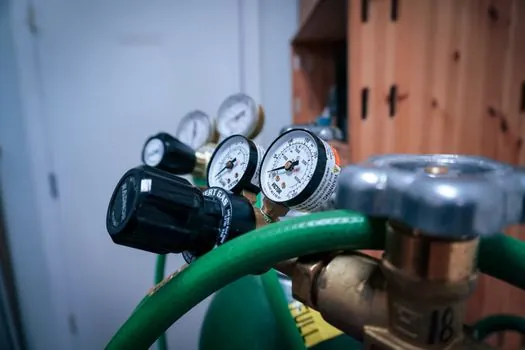
Common failure modes on power-plant gauges are predictable: pen friction on a recording gauge drags the trace 1-2% low on rising pressure and then snaps up; dried ink starves the pen on slow chart speeds; clock drift on mechanical movements that haven't been wound undermines the timestamp; and a Bourdon tube out of temperature compensation reads off-zero by 0.2-0.4% of span per 20 deg C ambient swing [S3]. Liquid-filled cases mask some pulsation but introduce their own leak path at the fill plug and can crack if the ambient drops below the fill's pour point.
Digital gauges fail differently: they need a power source, are best for low-pressure applications, and cannot survive the same over-range or vibration envelope as a liquid-filled mechanical gauge, so they belong on the calibration bench, not on the turbine deck [S2]. For a broader spec map on switching devices that pair with these gauges, the automotive pressure switch 2026 spec map covers the electromechanical set-point side, and the pressure gauge fundamentals entry is the canonical reference for sensing-element theory. The wider pressure measurement overview covers how a mechanical gauge differs from a transmitter-class sensor on a Foundation Fieldbus or HART loop, which matters when the same plant standardises on 4-20 mA with HART for the control system.
Trackable next signals: watch for any 2026 spec-sheet revision from the major OEMs (Ashcroft, WIKA, Druck) that re-derates 316L wetted parts on amine-treated feedwater circuits, and any update to ASME B40.100's accuracy-class table that tightens Grade 2A below 0.5% of span for new nuclear auxiliary builds. The Druck UNIK5900 SIL variant already pairs the UNIK5000 sensing platform with SIL certification plus ATEX/IECEx hazardous-area ratings, so it is a live data point on where safety-rated pressure sensing is heading inside the power-generation enclosure market [S4].
Spec-level background on the components involved: pressure calibrator.