
A pressure gauge lives or dies on whether its range, accuracy, wetted material, and connection match the real duty, not the catalog headline. Buyers who skip the dial-midpoint rule on range, or who pick a brass wetted part for a chemical service, are the ones generating warranty claims, per field guidance from Carotek's 9-page selection guide [S5].
For most process plants, HVAC panels, and hydraulic skids, the realistic decision is between four mechanical grades (commercial, industrial, critical process, calibration) and one digital option. The material covered here is anchored in guidance published March to June 2026 by Oilair, Bola Systems, IQS Directory, NT Pressure Gauge, DY Pressure Gauge, and e Instruments [S1][S2][S3][S4][S6][S7], and a 2025 baseline document from Carotek [S5].
Range, Dial Midpoint, and Why the 2x Rule Exists
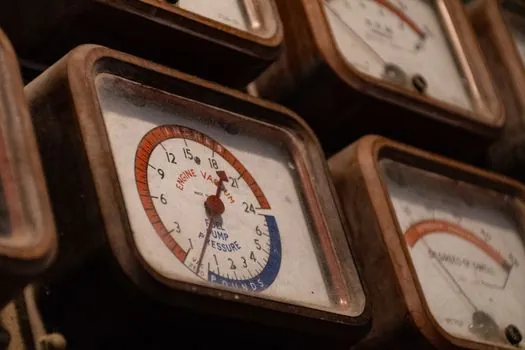
Normal operating pressure should sit roughly in the middle of the dial, with the upper end of the selected range typically near twice the working pressure for steady duties, per DY Pressure Gauge and Oilair field guidance [S1][S6]. A 0 to 30 psi gauge with 1/4 NPT, the common low-pressure utility pattern, is sized so a 10 to 15 psi running pressure points the needle into the readable third quadrant rather than the bottom 10% of the dial [S6].
If the chosen range is too small, the gauge runs near full-scale under normal load, which accelerates Bourdon-tube fatigue and shortens service life [S4]. If the range is oversized, operators lose resolution: a 0 to 5000 psi gauge reading 400 psi covers less than 10% of the dial, and small fluctuations become invisible [S4]. NT Pressure Gauge's buying guide restates the same rule from a different angle: range matching is a key step in pressure gauge selection [S4].
Four Mechanical Grades, by Accuracy, Range, and Cost
Mechanical pressure gauges fall into four practical tiers per the Carotek guide: commercial grade at roughly $10 to $30 with about +2 to 3% of span accuracy, dial 1.5 to 4.5 inches, range typically 0 to 100 psi in brass or bronze wetted; industrial grade at $30 to $120 with +1 to 2% of span, dial 2.5 to 4.5 inches, range up to 3000 psi; critical process at $100 to $1500 with +0.5 to 1% of span, dial 4.5 inches and up, range up to 15000 psi in chemical-resistant wetted materials; and calibration gauges at $300 to $1000 with +0.1 to 0.25% of span, used as test standards for instrumentation testing and calibration [S5].
The standard rule on calibration: a test gauge must be roughly four times more accurate than the device under test, which is why +0.1 to 0.25% calibration instruments exist as a separate category rather than as a high-end process gauge [S5]. For an analog pressure gauge on a hydraulic power unit, industrial grade with a liquid-filled case is the usual floor; for a refinery or water-treatment header, only critical process survives the duty cycle.
Mechanical vs Digital: When the Extra Money Buys Something

Digital pressure gauges contain sensors whose signal is digitised and processed by a microprocessor, then displayed on a screen, per e Instruments' 2026 technical guide [S7]. Against mechanical Bourdon designs, digital units offer higher accuracy and measurement stability, switchable units (bar, Pa, psi), datalogging, peak hold for maximum and minimum values, and remote communications on higher-end models [S2][S7].
Mechanical gauges remain the standard on process systems because they are not subject to power or network outages, and a good-quality mechanical gauge is more durable than an electronic one, per Carotek [S5]. For sites where the process must remain observable during a plant-wide power dip, that single point keeps the analog Bourdon in the spec.
Hydraulic-system buyers in particular should treat the choice as a tradeoff matrix rather than a brand preference. A mechanical gauge on a vibrating pump skid is usually liquid-filled, glycerine or silicone, for damping; a digital gauge is usually specified only where datalogging or unit switching is required, or where the readout feeds into a wider pressure measurement loop. For gauge-only local indication, the mechanical option still wins on robustness and total cost of ownership [S1][S5].
Wetted Material, Process Media, and the Connection Decision
Wetted material must match the medium. Brass and bronze are typical for air, water, and inert gas on the commercial and industrial grades; stainless steel (often 316L) and specialty alloys appear on critical process gauges that see chemical service, sour hydrocarbons, or steam [S3][S5]. The Bola Systems technical brief notes the common mechanical sensing elements: Bourdon tube (brass or steel, often liquid-filled), diaphragm, and bellows, each chosen by media compatibility and pressure class [S2].
Connection type and size are the most common source of procurement mistakes: NPT, BSP, flare, and weld-neck are all in active use, and a thread mismatch stops the install cold [S4]. Buyers should confirm the thread standard, size (1/4 inch, 1/2 inch, 3/8 inch are typical), male or female, and the orientation (bottom, back, side) before ordering, otherwise a perfectly good gauge sits on a shelf [S2][S4].
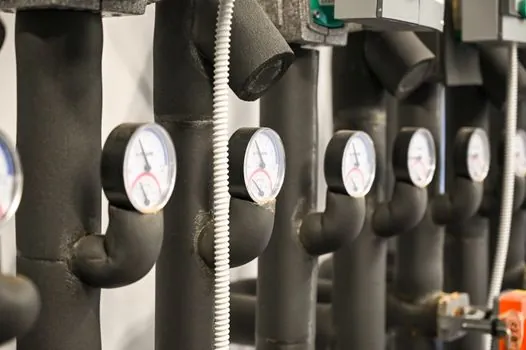
Dial size and mounting location are linked. A 1.5 to 2.5 inch dial fits a local panel; a 4.5 inch or larger dial is the floor for a back-of-room or yard reading distance, and critical-process gauges are typically 4.5 inches and up [S1][S5]. For vibrating locations like reciprocating pumps or compressor discharge headers, a liquid-filled case plus a snubber or isolation ring is standard, not optional, and accessories like diaphragm seals and pressure-limiting valves can cost more than the gauge itself [S1][S5].
Accuracy Class, Vibration, and Hazardous-Area Fit
Accuracy class is the single most skipped line item in utility-gauge procurement, and the one most often blamed later for bad readings, per NT Pressure Gauge's field guide [S4]. For ordinary monitoring of an air receiver, the standard 1 to 2.5% class is fine. For process control, equipment testing, or any application where the reading drives a setpoint, the class must move to 0.5% or better, and that step usually forces a jump from industrial to critical process [S4][S5].
Vibration resistance is a separate decision from accuracy. Liquid-filled cases, glycerine or silicone, are the standard answer for pumps, hydraulic skids, and any gauge mounted within a few feet of a reciprocating source [S1][S2]. If the medium is also a problem, a diaphragm seal isolates the Bourdon tube entirely, at the cost of extra budget and a small temperature error from the fill fluid [S5].
For hazardous-area service, the spec moves up the chain into instrumentation territory. Where the same loop also feeds a pressure transmitter into the DCS, the gauge is a local indicator, but it still needs the right hazardous-area rating for the zone, and buyers often pair the gauge with a pressure switch for trip functions rather than overloading the gauge. For sites where the duty is purely local read, no electronics, and no power, mechanical remains the right call.
Selection Comparison: 4 Gauge Types on 4 Decision Criteria
Below is a side-by-side on the four practical gauge types against the criteria that actually drive a buy. Numbers are taken from the Carotek guide and cross-checked against the Bola Systems and e Instruments briefs [S2][S5][S7].
Commercial grade: typical cost $10 to $30, accuracy +2 to 3% of span, wetted material brass or bronze, best fit is light-duty, pool filters, tire pressure, sprinklers, and residential air or water. Limit: not for chemical media, not for sustained high-cycle vibration, range usually capped near 100 psi [S5].
Industrial grade: $30 to $120, +1 to 2% of span, brass or bronze, 2.5 to 4.5 inch dial, range up to 3000 psi, the right call for small panels, HVAC, hydraulics, and residential natural gas distribution [S5]. Limit: accuracy and chemical resistance are not enough for refinery or process-control service [S4][S5].
Critical process: $100 to $1500, +0.5 to 1% of span, chemical-resistant wetted, 4.5 inch and up, range up to 15000 psi, fitted to water treatment, refineries, power and nuclear plants [S5]. Limit: budget, and overkill for a simple utility line. For a pressure calibrator duty on the same plant, do not reuse a critical-process gauge; the accuracy is not high enough to act as a transfer standard [S5].
Calibration gauge: $300 to $1000, +0.1 to 0.25% of span, used as a test standard for instrumentation testing and calibration in aerospace, military, laboratory, and field service work [S5]. Limit: not a working process gauge; four-times-better accuracy than the device under test is the rule, and the price reflects it [S5].
Digital gauge: variable cost, accuracy typically 0.05 to 0.1% of span or better on mid-range models, switchable units, datalogging, peak hold, optional remote output, the right call when data capture, multiple units, or remote reading is part of the job [S2][S7]. Limit: needs power, electronics failure modes, and a higher unit cost than mechanical industrial gauges [S5][S7].
Who Should Not Pick the Cheap Option, and Why
If the application is process control, equipment testing, or any duty where the reading drives a setpoint, the commercial grade is the wrong pick, regardless of price [S4][S5]. The +2 to 3% accuracy class will produce errors that look like process drift and force unnecessary calibration work [S5].
If the medium is anything beyond air, water, or inert gas at modest temperature, a brass or bronze wetted gauge is the wrong pick, regardless of pressure class. Sour service, acidic condensate, ammonia, chlorine-bearing water, and most hydrocarbons demand stainless or alloy wetted parts and a diaphragm seal in many cases [S3][S5]. For sites already buying smart instrumentation, a pressure sensor on the same tap may carry the load and let the local gauge be a simple industrial-grade mechanical.
If the gauge is mounted within reach of a reciprocating pump, compressor, or hydraulic pulsation source, an unfilled industrial gauge is the wrong pick; the Bourdon tube will fail early from vibration fatigue, and the pointer will be unreadable [S1][S2]. Liquid-fill or remote-mount via a line and a snubber is the standard fix [S1][S5].
Trackable Signals for the Next 6 Months
Two signals are worth watching. First, digital gauge accuracy continues to fall into the same class as mid-range pressure calibrators, which is pushing mechanical calibration gauges toward specialist-only duty and opening room for hybrid gauges that pair a mechanical dial with electronic output [S7]. Second, diaphragm-seal pricing remains high enough that adding a seal to a critical-process gauge can roughly double the line item, so buyers who can co-locate the gauge close to the tap, and avoid a long impulse line, will save real money on the next project [S5].
For a more detailed look at how the same selection logic plays out on the smart side of the loop, see the field spec map on pressure transmitter sizing and selection, range, output, and hazardous-area fit.