
Semiconductor fabs run three pressure regimes at once: rough vacuum down to 1e-3 mbar in load locks, near-atmospheric cleanroom ductwork, and high-pressure specialty-gas lines up to 10 MPa, so a single transmitter model rarely covers all three [S1][S2].
The 2026 spec map from Sino-Inst, IQS Directory, and Winsen-published product lines points to piezoresistive silicon or ceramic elements with oil-filled 316L isolation diaphragms, IP67 stainless housings, and configurable 4-20 mA plus I²C output as the default build for fab service [S2][S3][S5].
Why semiconductor lines break generic pressure transmitters
Piezoresistive pressure elements use the resistance change of a semiconductor diaphragm under strain, which delivers the millivolt-per-volt sensitivity needed for sub-mbar resolution in vacuum load locks [S2][S3].
That same sensitivity is also why a bare sensor drifts in a fab: chlorine, HCl, and HF specialty gases attack exposed silicon, and moisture plus temperature cycling on a fab rooftop chiller pushes thermal errors past 0.5% FS without compensation [S3][S5]. The fix in 2026 builds is an oil-filled isolation film with a 316L stainless diaphragm, which keeps the semiconductor die sealed and pushes the wetted surface to a corrosion-resistant alloy, a construction used in WPAK63-class isolation-film sensors rated from -100 kPa vacuum to 4 MPa on one body [S5].
Three pressure regimes, three sensor choices
Vacuum service below 1e-3 mbar belongs to capacitance or Pirani-class gauges, not to piezoresistive transmitters, but the roughing-line band from atmospheric down to 1e-2 mbar is a clean fit for ceramic-capacitive or MEMS piezoresistive cells [S1][S2].
For 1-10 bar cleanroom make-up air and HEPA plenum monitoring, gauge pressure transmitters with 1/4 NPT or VCR fittings and 0.1% FS accuracy are the workhorse spec, with 4-20 mA plus HART overlay still the dominant analog output in 2026 OEM datasheets [S4][S5]. Specialty-gas cabinets at 5-10 MPa need 2x rated overload and a 316L welded diaphragm, the envelope the WPAH31 ceramic sensor family covers at 2/5/10/20/40/50/100 bar options with laser-trimmed calibration [S5].
Spec comparison: piezoresistive silicon vs ceramic capacitive vs MEMS plastic
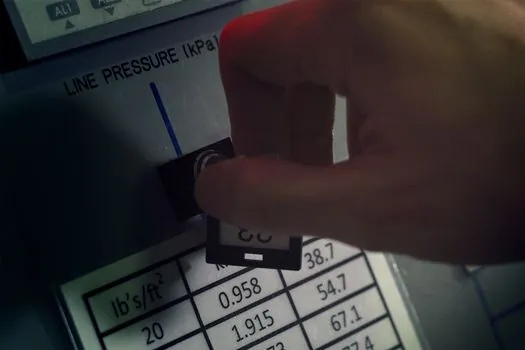
Piezoresistive silicon gives the highest mV/V sensitivity and the best sub-mbar resolution, but it demands an isolation diaphragm and tighter thermal compensation, with typical compensated ranges of -40 to 125°C in the published 2026 datasheets [S2][S3][S5].
Ceramic capacitive cells trade raw sensitivity for chemical resistance, with Al2O3 diaphragms handling corrosive gas and water condensate without an isolation fill, and they survive 2x rated overload in the WPAH01/WPAH31 lines covering 2-400 bar at -40 to 125°C [S5]. MEMS plastic-package sensors like the WPAS01 (SOP8) and WPAS02 (SOP6) hit 1 ms response and stay under 1.7 MPa, which makes them the pick for OEM-internal dry-air and N2 purge panels rather than wet or corrosive fab service [S5]. For the broader definition of how these classes map to transmitters, see the pressure transmitter reference and the absolute pressure transmitter entry for sealed-reference vacuum work.
Wetted materials, fittings, and cleanliness
316L stainless with electropolish to Ra under 0.4 micrometer is the de facto wetted standard for fab gas panels, and dual-ferrule VCR or face-seal fittings dominate new builds to eliminate dead legs that trap moisture [S3][S5].
For wet processes such as CMP slurry lines and ultra-pure water (UPW) branches, an oil-filled isolation film is mandatory to keep the sensing die out of direct contact with the media, and the WPAK63 316L diaphragm design with silicone oil fill is the published reference for that construction [S5]. Where the measurement is a vacuum or sealed-reference value, the absolute pressure transmitter and differential pressure transmitter pages lay out the reference-side wiring differences that fab DCS teams need to specify up front. Enclosure rating matters on the fab floor too: IP67 stainless heads are the published 2026 default on ceramic-capacitive transmitter modules such as the WPCH01, which lists current, voltage, and I²C outputs as configurable options [S5].
Output protocols and integration into the fab DCS
4-20 mA with HART remains the dominant analog protocol for new fab transmitters in 2026, while RS-485 Modbus and I²C show up on OEM-internal boards and on some compact ceramic modules like the WPCH01, which lists current, voltage, and I²C as customizable outputs [S4][S5].
Wiring distance drives the protocol choice: cable runs past 100 m on a fab tool usually push designers toward 4-20 mA plus HART, while short jumpers inside an OEM gas-panel enclosure can use I²C directly off a plastic MEMS sensor [S4][S5]. Process engineers comparing the analog-versus-digital split should read the pressure transmitter primer alongside the temperature transmitter entry, since many fab tool PLCs now read both on the same HART multidrop trunk. Where the measurement is liquid level in a UPW tank or a chemical bath, the level transmitter and capacitance level transmitter references cover the hydrostatic and RF-Cap alternatives that show up next to the pressure taps.
Acceptance criteria and field failures to spec against
The 2026 published selection criteria for fab pressure transmitters collapse to five numbers buyers can audit on a datasheet: pressure range and reference type, accuracy as a percentage of full scale, wetted material list, output protocol, and enclosure or IP rating [S3][S4][S5].
Field failures in published OEM write-ups trace to three patterns: long analog cable runs without proper shielding, corrosion at the diaphragm from unlisted media, and BOM pressure that pushes the integrator to a raw sensor when a conditioned module was the correct integration level [S5]. Buyers should treat any 0.1% FS accuracy claim as meaning the compensated range, not -40 to 125°C unconditionally, and should require a documented test for 2x overload survival on ceramic-capacitive cells used in gas-cabinet service [S5]. For a broader valve-and-instrument context, the Pressure Reducing Valve Installation: Sizing, Setpoint, and Acceptance Test piece covers the upstream setpoint discipline that keeps a pressure transmitter inside its linear band, which is the most common fab-side cause of out-of-spec drift.
Track two signals over the next 6-12 months: (1) I²C and RS-485 output growth on ceramic-capacitive OEM modules, which would push 4-20 mA plus HART toward legacy status in fab greenfield builds, and (2) any published revision to piezoresistive sensor compensated temperature ranges past 125°C, which would let transmitters ride directly on hot process gas lines without a remote seal.