
Paper production is heat-intensive from digester to dryer, and the right thermocouple for pulp and paper is not a single part number but a materials-and-geometry decision tied to each process zone [S1]. Across cooking, bleaching, recovery boilers, and dryer cans, the mill-side winners are Type K and Type N MgO-insulated probes in Inconel 600 or Hastelloy sheaths, mounted inside stainless or ceramic thermowells [S1][S3].
Surface profiling of paper webs, laminates, and coated board is a different problem: there, thin leaf-type (foil) thermocouples in the 0.05-0.25 mm thickness range with PFA jackets dominate, with a maximum service ceiling of 215°C (420°F) on standard K and E calibrations [S2]. This article walks through which probe geometry, sheath alloy, and calibration fits each pulp-and-paper zone, where each fails, and how a plant engineer should match sensor to application.
Process Zones and Why They Drive Thermocouple Choice
Kraft pulping runs through burners, kilns, recovery boilers, and biomass/hazardous-waste incinerators, with high-heat assemblies routinely rated up to 2,900°F (~1,600°C) and built around heat-resistant steel or ceramic thermowells with gas-tight process connections at 14.5 psi / 1 bar [S1]. Below the boiler, the digester and cooking-liquor circuits are chemically aggressive: white liquor (NaOH + Na2S) and acidic bleach filtrates attack standard 304/316 stainless, which is why corrosion-resistant sheaths such as Hastelloy or Inconel are the default rather than the exception in this industry [S4][S5].
The dryer section is the third distinct zone. After the sheet is formed, drying temperature is a quality gate: too high and the batch is ruined, too low and the drying is incomplete or slow [S1]. That sensitivity, combined with a relatively modest 100-200°C operating window, is what opens the door to surface and near-surface contact probes rather than immersion thermowells.
Calibration and Sheath Materials: K, N, J, and E Compared
For immersion service in digesters, blow tanks, and liquor lines, Type K (NiCr-NiAl) is the workhorse up to about 1,260°C and is the calibration most commonly stocked in MgO-packed industrial assemblies, including spring-loaded replacement elements with hex fittings used in head-mounted industrial thermocouples [S3]. Type N (Nicrosil-Nisil) offers improved drift resistance over K in oxidizing atmospheres above 1,000°C, which matters in recovery boiler furnace sections where sulphur-bearing flue gases can shorten K-element life.
Type J (Fe-CuNi) is cheaper but limited to roughly 760°C and is vulnerable to sulphur attack, so it sees little use in pulp-mill liquor service. Type E (NiCr-CuNi) has the highest EMF output per degree of the common calibrations, which is why it appears in low-temperature surface profiling probes such as the thin leaf-type series rated to 215°C (420°F) [S2]. Sheath selection tracks calibration: Inconel 600 is the standard match for Type K up to ~1,150°C, while Hastelloy C276 is preferred for chloride-bearing bleach-plant liquors where Inconel can suffer pitting and stress-corrosion cracking [S4][S5].
Probe Geometry: Immersion Sheath, Multipoint, and Surface Foil
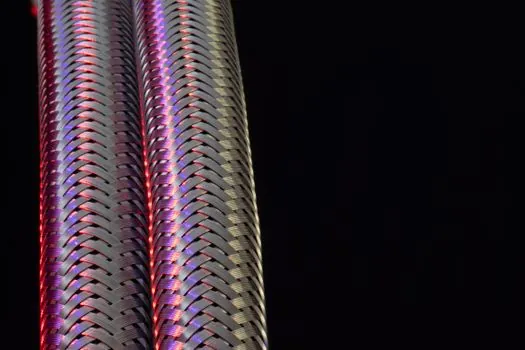
Three physical forms cover almost every pulp-and-paper measurement. First, the MgO-packed immersion probe in a metal or ceramic thermowell: rigid, head-mounted, and built to survive digester pressures and liquor chemistry, as in the standard industrial thermocouple with connection head and the spring-loaded replacement element pattern [S3]. Second, the miniature multipoint thermocouple (such as the TC97-style assembly), in which several sensors at different heights share a single protection tube, useful where space is limited and a full temperature profile along the digester or boiler is needed [S1].
Third, the thin leaf-type foil probe for surface and interlayer measurement. The 0.15 mm (0.006") thick, 0.8 mm (0.032") PFA-jacketed 88304-style design reaches 50 mm (2") of bare junction at the measurement end, with a 19-inch overall length for reaching between laminations, while the 0.05 mm (0.002") fast-response 88309 pattern is intended for transient surface work up to 210°C (410°F) [S2]. For permanently mounted surface measurement, the smaller-transition 88302 is supplied with a TAS-3 adaptor, and for long-term contact-pressure applications, magnetized probes (88401 rated to 250°C / 480°F, 88402 rated to 400°C / 750°F) are specified, with a 10-minute thermal equalization time noted by the manufacturer [S2].
Corrosion Resistance: What Actually Happens in the Mill
A standard 304/316 stainless sheath will fail quickly in white-liquor and bleach filtrate service because the protective chromium oxide layer is attacked by both strong alkali and residual chlorine dioxide, leading to drifting readings and premature burnout [S4]. Corrosion-resistant sheaths work because the alloy itself forms a more stable passive layer; in a digester, a Hastelloy-sheathed probe can stay accurate in the cooking liquor and steam circuits that would consume a stainless probe in a single campaign [S4].
Beyond alloy, two more design layers matter. A chemically inert coating (ceramic is the common choice) acts as a barrier between the sheath and the wet paper slurry or chemical stock, while tight seals and water-resistant connections keep steam and condensate from migrating into the junction box during the high-humidity steam-drying phase [S5]. The trade-off is thermal response: thicker ceramic barriers slow the time constant, so coating thickness must be tuned to the mill's tolerance for measurement lag versus sheath life.
Electronics: Transmitters, HART, and SIL Ratings
An immersion thermocouple is only as useful as its signal conditioning. Head-mounted and rail-mounted digital transmitters (T32.1S and T32.3S patterns) with HART communication are commonly paired with pulp-and-paper temperature sensors, and are rated for SIL 2 operation standalone or SIL 3 in a redundant configuration, with signaling per NAMUR NE43, sensor-break monitoring per NE89, and EMC per NE21 [S1]. This combination allows a single pair of wires to carry the mV signal, digital process variable, and diagnostics into the DCS, and it is the configuration most retrofits converge on.
For local readback where power is unreliable, gas-actuated stainless-steel thermometers (TGT73 pattern) provide a mechanical dial plus an electrical output, so operators still see the process value if the transmitter loop is lost [S1]. Pairing this kind of mechanical backup with a HART thermocouple transmitter is a common mill practice for digester and boiler circuits where a blind failure would mean a cooked batch or a damaged tube.
Selection Criteria: Matching Sensor to Service
A practical spec matrix for paper-mill engineers reads as follows. For digester and liquor-line immersion up to 1,100°C in oxidizing alkaline service, specify a Type K or Type N MgO-packed probe in an Inconel 600 or Hastelloy C276 sheath inside a stainless thermowell, with a HART head transmitter [S1][S3][S4]. For recovery boiler furnace and superheater tubes, consider a multipoint thermocouple assembly in a ceramic or heat-resistant steel protection tube rated to 1,600°C, with optional intrinsic-safety approval for hazardous-area mounting [S1].
For paper-sheet, laminate, and coated-board surface profiling below 215°C, specify a thin leaf-type foil probe, 0.05-0.25 mm thick, PFA-jacketed, Type E or Type K, with a TAS or OST connector matched to a TEC extension cable [S2]. For long-term surface contact on dryer cans or press rolls, specify a magnetized foil probe (88401/88402 pattern), accepting the 10-minute thermal equalization time in exchange for stable mounting [S2].
For broad process-temperature guidance and reference architecture on how thermocouples and thermocouple standards fit into the wider instrumentation picture, the SourceBySpec encyclopedia entry is the natural starting point; for upstream fluid handling adjacent to these temperature loops, the flow meter and pressure transmitter reference pages round out the loop. Engineers mapping out transmitter selection alongside sensor selection can also cross-reference the recent Temperature Transmitter Suppliers: 2026 Spec Map and Sourcing Map for HART and SIL-rated hardware.
Limits, Failure Modes, and Standards Discipline
Every choice above has a hard edge. Thin foil probes are not immersion devices; their 0.05-0.25 mm profile and PFA jacket cannot survive a digester, and their 210-215°C ceiling rules out any dryer section that runs higher [S2]. Type K sheath life in sulphur-bearing recovery-boiler flue gas is well known to drift, which is why Type N is increasingly specified for those zones. Hastelloy and Inconel are not interchangeable: Inconel 600 is more oxidation-resistant at high temperature, while Hastelloy C276 is the safer pick for chloride-bearing bleach-plant streams [S4][S5].
Compliance posture is also worth pinning down. Pulp-mill recovery boilers are typically classified hazardous areas, so any probe installed in or near the boiler must be specified for the relevant explosion-protection method (intrinsic safety is one option offered in the high-temperature assembly family) and paired with a transmitter whose SIL rating matches the safety-instrumented function it supports [S1]. For wet-end chemistry and pH-adjacent loops, the same lamps and light fittings and plant-area classification rules often govern inspection-room and analyzer-house instrumentation, even though they are not the primary sensor here.
Track the following two signals as the spec evolves: the shift from Type K to Type N as the default recovery-boiler calibration in retrofits, and the growing use of multipoint thermocouple bundles in digester profile control, both of which are now visible in mill-instrumentation supplier catalogues and will shape 2027 spec revisions [S1].