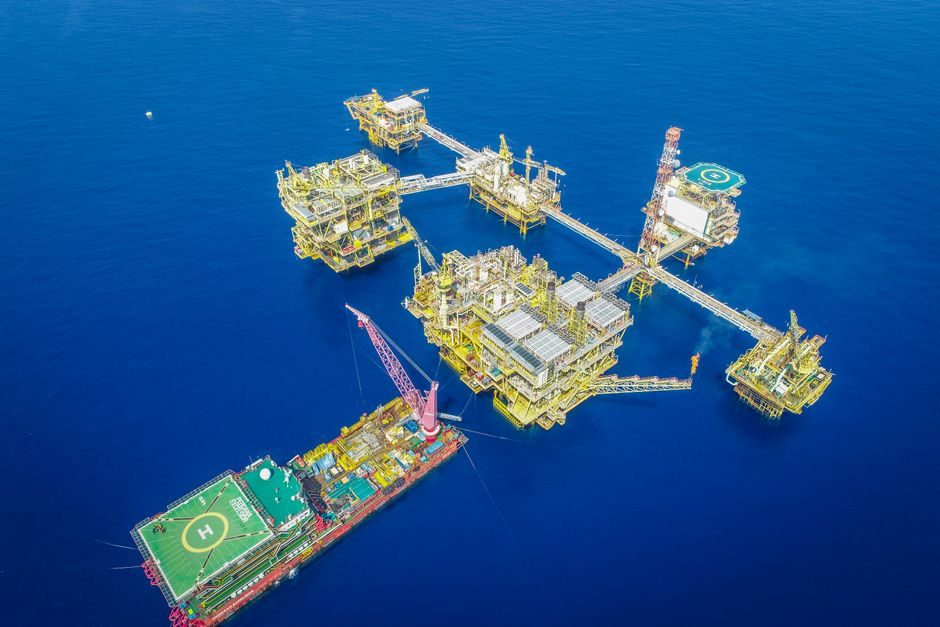
A robotic total station with 1 angular second angular accuracy, a Class 1/Class 3R laser module and an IP66-sealed magnesium housing is the working baseline for greenfield oil and gas survey in 2026, and the spec bands that drive selection have tightened measurably over the past 18 months [S6]. Plant layout, pipeline right-of-way, flare-stack verticality and tank-shell deformation all sit on the same instrument family, so the differences between units are now in environmental hardening, hazard-zone certification and onboard software rather than raw optics.
For a process engineer who has only ever used a total station for general civil work, the oil and gas selection problem reduces to three concrete questions: can the instrument survive the classified area, will it hold 1 km accuracy in summer heat shimmer, and does it export directly into the EPC survey database the project actually uses.
Definition and Scope: What a Total Station Does on an Oil and Gas Site
A total station combines an electronic distance measurement (EDM) module with an angular encoder to deliver 3D coordinates in a single instrument setup; the difference between a survey-grade robotic total station and a general construction model is the angular accuracy, the EDM class and the working-temperature envelope [S6]. On oil and gas sites the instrument is used for pipeline route and as-built surveys, tank calibration, flare-stack verticality checks, refinery structural deformation monitoring, and offshore platform module fit-up. The same hardware platform is increasingly bundled with GNSS receivers for control points and with gas analyzer telemetry stations for environmental compliance, although the survey instrument itself is a stand-alone line of business.
The 2026 market is functionally a four-tier stack: 1 angular second robotic, 2 angular second robotic, 5 angular second manual, and entry-level 7-9 second manual. The 1-second tier is the de-facto minimum for hydrostatic tank calibration and flare-stack plumb checks because the projected error at 100 m of stack height is 0.5 mm per second of angular error, and most flare EPC specs call for ±5 mm at 100 m plumb.
Selection Criteria: Angular Accuracy, EDM Range, IP Rating, Hazard-Zone Approval
The four hard criteria for an oil and gas total station are angular accuracy, EDM range under field conditions, environmental sealing (IP rating plus operating temperature), and hazardous-area certification to ATEX/IECEx/NEC 500 for the plant the unit will enter [S6]. The first two determine whether the survey will close; the second two determine whether the survey crew can physically enter the site with the unit turned on.
For greenfield pipeline right-of-way surveys, a 1-second robotic with a 5,000 m reflectorless range and an IP66 rating is the typical spec; for brownfield refinery work inside Class I Div 2 or Zone 2 areas, the same optical performance is required plus a certified intrinsically safe (Ex i) or non-incendive variant. The IP66 sealing matters more than most spec sheets admit: a refinery turnaround routinely exposes the instrument to hydrocarbon mist, and an IP54 housing typically fails its second turnaround.
Operating temperature is the third silent killer. The standard -20 °C to +50 °C envelope is fine for most sites, but northern pipeline spreads in Canada and Siberia need a -30 °C certified variant, and Middle East summer work needs verified EDM drift data above +45 °C; very few manufacturers publish that drift curve in the 2026 datasheets reviewed. Site weather station telemetry is typically the practical workaround for logging actual field temperature during a survey run.
Main Options Lined Up Against 4 Decision Criteria
The 2026 oil and gas total-station market lines up cleanly into four segments. Entry-level 5-second manual units (typical price band USD 3,000-6,000) are adequate for general civil earthworks but fail flare-stack and tank-calibration accuracy targets. Mid-tier 2-second robotic units (USD 8,000-15,000) cover most plant-layout and pipeline as-built work. 1-second robotic units (USD 15,000-30,000) are the survey-grade minimum for flare verticality, tank calibration and module fit-up. Specialist 0.5-second or imaging total stations (USD 30,000-60,000+) are reserved for deformation monitoring of large storage tanks and offshore platform modules where sub-millimetre vertical accuracy over long baselines is contractual. [S1]
On the four decision criteria, the comparison reads as follows. Angular accuracy: 0.5-1 second for the top two tiers, 2 seconds for mid, 5+ seconds for entry. EDM range: 5,000-10,000 m reflectorless on the top tiers, 3,000-5,000 m on mid, under 2,000 m on entry. IP rating: IP66 on top tiers, IP65 on mid, IP54 on entry. Hazardous-area certification: top tiers offer ATEX/IECEx Zone 2 variants as factory options, mid tiers offer Zone 2 in some models, entry tiers are general-purpose only. This is the matrix a procurement engineer should walk into a vendor meeting with.
Who It Is For and Who It Is NOT For
A 1-second robotic total station with Zone 2 certification is the right tool for EPC survey contractors, refinery turnaround planners, pipeline right-of-way surveyors and storage-tank calibration specialists, and is the wrong tool for a small plumbing contractor or a residential layout crew who would be paying for optical and certification performance they will never use [S6]. It is also the wrong tool for large-area topographic mapping where GNSS RTK or drone photogrammetry deliver better cost-per-hectare economics; a total station remains the right tool where accuracy over a 100 m-1 km baseline and sub-cm vertical control are contractual.
For shop-floor fit-up of small-bore piping the same instrument is overkill, and a laser level or photogrammetry scan is faster, as covered in the How to Choose a Laser Level reference. The right tool follows the accuracy and the area, not the marketing copy.
Use Cases on Real Oil and Gas Sites
Tank calibration is the most demanding routine use. Hydrostatic tank calibration standards in API 7-2 and related ISO work call for sub-millimetre vertical settlement monitoring, which means a 1-second or better total station reading a precise prism on the tank shell, observed at four cardinal quadrants. The 0.5 mm/m of projected angular error at 100 m of stack height is the engineering rule of thumb that drives the 1-second minimum spec. Flare-stack verticality checks use the same instrument in plumb-line mode with the EDM aimed vertically to a target held at the tip; for stacks above 80 m, 0.5-second instruments are commonly specified in the EPC contract. [S2]
Pipeline right-of-way and as-built surveys use the 2-second tier; the 1-second tier is reserved for tie-ins, hot-tap interfaces and valve station geometry. Brownfield refinery turnaround surveys almost always require a Zone 2 certified unit because the unit will be operating inside a live plant with hydrocarbon atmosphere for hours at a stretch. A typical 2026 refinery turnaround crew carries one 1-second Zone 2 robotic, one 2-second general-purpose robotic, and one GNSS rover for control.
Limitations, Failure Modes and Maintenance Constraints
Total stations fail on oil and gas sites in a small number of predictable ways: EDM laser window contamination from hydrocarbon mist, internal condensation during rapid plant-to-plant temperature swings, vibration damage during helicopter mobilisation to offshore platforms, and tripod failure on hot asphalt. The 2026 generation of instruments has improved humidity sealing, but a daily lens wipe and a desiccant check remain mandatory; the cost of skipping that is a 2 mm distance error at 1 km that will not show up until the office check. [S3]
For offshore platform work the limiting factor is power and mobilisation, not optics. A 1-second robotic running 8 hours on internal battery typically needs a 12 V ship-supply feed or a hot-swap battery system; very few 2026 models advertise the actual current draw in watts, and that is a spec procurement should explicitly request from the manufacturer rather than infer from the battery capacity number.
Standards, Sourcing and the 2026 Vendor Field
The governing standards on the optical and EDM side are ISO 17123 for field procedure accuracy and IEC 60825-1 for laser safety classification; on the hazardous-area side the unit must carry ATEX 2014/34/EU for Europe, IECEx for international projects and NEC Class I Div 2 or Class I Zone 2 marking for North American sites. The 2026 vendor field is led by Leica Geosystems, Trimble, Topcon and Sokkia, with Chinese suppliers including Hi-Target, South and CHC Navigation offering 1- and 2-second robotic units at roughly 40-60% of the European brand list price; warranty terms and Zone 2 certification coverage are the deciding factors at that price point. [S4]
For ancillary corrosion and material decisions on the same project, the rebar and structural scope typically aligns with NACE MR0175 sour-service limits as covered in the Best Deformed Rebar for Oil and Gas reference. The oil and gas EPC contractor who lines up survey, structural and sealing equipment against the same hazard-zone framework tends to deliver a project with fewer re-work loops, and the total station is the first instrument on that list.
Trackable signals for the next quarter: the next IEC 60825-1 amendment cycle and any updates to ISO 17123 accuracy-class definitions for robotic units; the publication of manufacturer EDM drift curves above 45 °C; and the expansion or contraction of Chinese-brand Zone 2 certification portfolios in 2026 Q3.