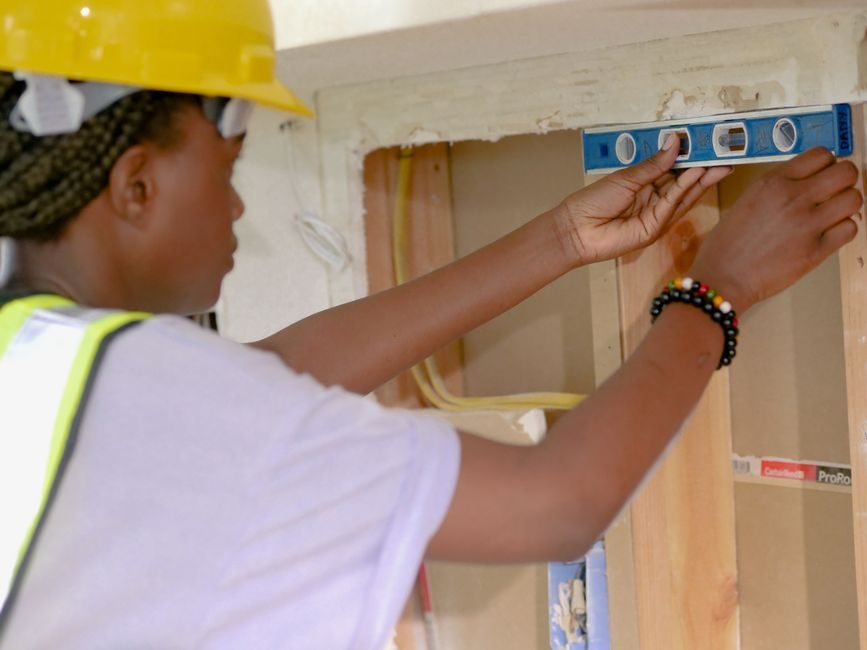
Specifying a laser level is a 4-axis decision: beam color (red 635-670 nm vs green 510-530 nm), line/plane count (2-line dot, 3×360°, 4D), accuracy band (typically ±2-3 mm at 10 m, with high-grade rotary units reaching ±0.5 mm at 30 m), and ingress protection (IP54-IP65) tied to jobsite dust and rain exposure [S1][S2][S4].
The reference 2026-07-08 jobsite budget currently runs from sub-$60 DIY 2-line red units through to 3×360° green kits (16-line "4D" Huepar-class instruments) and ±0.5 mm/30 m rotary lasers used by survey crews, with self-leveling pendulums ±3°-±5° being the most common automatic range [S1][S2][S4].
Beam Color: Red 635-670 nm vs Green 510-530 nm
Red diode modules at 635-670 nm remain the cost-default for indoor framing, drywall, cabinet and ceiling work where ambient light is low; the lower diode cost and lower current draw typically deliver 20-40% longer continuous runtime on the same battery pack compared to a green unit of equivalent class [S1]. Green modules at 510-530 nm are the de-facto outdoor choice because the human eye's photopic response to 520-530 nm is roughly 4× higher than to 635 nm, which is why green remains visible in bright daylight where red fades, and why the same internal power class reads 30-50 m usable range green vs 10-15 m red on a plain reflective target [S1][S2].
Pick red when the work is enclosed (drywall, interior partitions, MEP rough-in at ≤15 m), when budget is tight, and when shift length matters more than beam visibility. Pick green for exterior concrete layout, foundation batter boards, fencing, deck post alignment, and any daytime work past 20 m; budget 1.5-3× the price of an equivalent red unit [S1][S2]. A useful outdoor workaround on a red beam is a Class-3R detector / line receiver, which can extend effective range to 50-80 m on a rotary red unit; the same receiver also works on green, but with diminishing marginal gain since the green beam is already visible [S1].
Line Count, Plane Count, and Optical Schemes
Entry 2-line cross (1H/1V) units cover hanger layout and basic squaring; 3-line (1H/2V) adds two vertical planes 90° apart for partitions; the 3×360° class adds a second horizontal plane (floor + ceiling) and is the workhorse for full-room interior fit-out because one setup lays out floor, walls and ceiling simultaneously [S1][S2]. The 4D / 16-line optical scheme (4 vertical + 4 horizontal plane intersections, as on the HILDA 4D 16 Lines and the Huepar S04CG-class "2H/2V + plumb") is the current 2026 ceiling for consumer-grade layout, useful for tilt-up formwork, partition corners and ceiling-grid installations [S2].
For long-baseline site grading, slope work, and concrete-pour elevation control, a rotary laser with a spinning head (typically 300-600 rpm) plus a detector is still the right tool, because a single high-speed beam gives 200-500 m diameter coverage when paired with a Class-3R receiver, well beyond any static-line unit's usable radius [S3][S4].
Accuracy Bands and Self-Leveling Range
Most self-leveling pendulum units in the 2-line to 4×360° class publish accuracy in the ±2 mm / 10 m to ±3 mm / 10 m band, which scales to roughly ±6-9 mm at 30 m — adequate for interior fit-out and most residential concrete flatwork but marginal for industrial floor flatness (FF/FL) specs [S1][S2]. The professional tier (rotary and premium cross-line) tightens to ±1.5 mm / 20 m and below; Fluke's building-infrastructure range, for example, is rated at "accuracy up to 2.2 mm at 30 meters" for its self-leveling laser line, and rotary detectors push working radius out to 200-300 m on surveyed baselines [S4].
Self-leveling range is the second number to read: ±3° is the common pendulum window for cross-line instruments, ±5° is typical for rotaries, and pulse / manual modes let you set deliberate slopes for drainage, ramp, and pipe-laser fall work — without those modes the unit will refuse to level out of range and alarm instead [S1][S2][S3].
IP Rating, Drop Rating, and Power Source
IP54 is the practical floor for any site instrument — protected against dust ingress and splashing water from any direction; the current 2026 mid-tier sits at IP54-IP65, with IP65 (dust-tight + jet-wash) now common on the Huepar-class and HILDA 4D green units that get used on concrete decks and in light rain [S1][S2]. Battery chemistry has split: dry-cell AA packs (4×AA or 8×AA) are still standard for cost-tier instruments because the user can swap on a long shift; lithium-ion with USB-C PD recharge is now default on premium cross-line and rotary units because one 4000-5200 mAh pack gives 8-15 hours on a green 3×360° at full brightness [S1][S2][S3].
Field feedback consistently flags three failure modes: (1) dropped units with no rubber over-mold cracking the pendulum gimbal, (2) dead NiMH cells after 18-24 months because users leave the unit on a charger, and (3) receiver / detector damage from wrong-frequency pairing — make sure the detector and laser share the same pulse rate, typically 5-10 kHz, otherwise the detector will not pick up the beam at outdoor range [S1][S2].
Comparison: Choosing by Jobsite Scenario
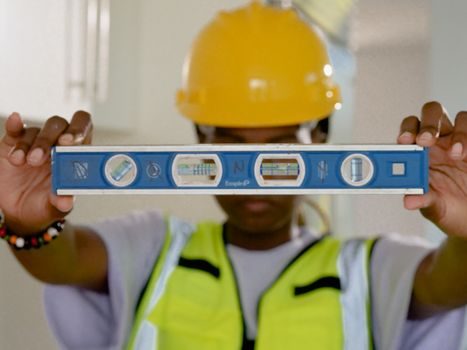
Decision matrix for the four common 2026 scenarios: (1) Interior fit-out ≤20 m in lit rooms — red 2-line or 3×360° self-leveling, ±3 mm/10 m, IP54, AA-powered, detector optional; (2) Exterior concrete / fence / deck, 20-60 m daylight — green 3×360° or 4D 16-line, ±2-3 mm/10 m, IP54-IP65, Li-ion, no detector needed below 30 m; (3) Long-baseline grading, 60-300 m — rotary (red or green) + matched pulse detector, ±1.5 mm/30 m, IP65, Li-ion or D-cell; (4) Slope / drainage / pipe — rotary with manual / single-axis slope mode and a digital-grade detector, IP65, otherwise range and accuracy are wasted because the auto-level lock will refuse the deliberate tilt [S1][S2][S3][S4].
Two more gates before purchase: confirm the published accuracy is in mm-per-distance (not arc-seconds, which is a surveying theodolite metric), and check the receiver is in the box or available as a matched accessory — buying a green beam without a detector caps you to 30-50 m, and buying a rotary without one wastes the unit's 200+ m range [S1][S4].
Use Cases and Cross-Reference to Site Equipment
For concrete-pour elevation on slab-on-grade or deck work, the green 3×360° unit is normally paired with a [concrete pump truck](concrete-pump-truck) boom and a screed pass — the laser sets the elevation target that the screed operator chases across the slab. For foundation layout and batter-board work, the green 4D 16-line class is paired with a transit-and-stake workflow and shares a layout grid with the [concrete mixer truck](concrete-mixer-truck) pour sequence, so the laser is set once and read by multiple trades. Inside MEP rough-in, the red 2-line or 3×360° unit runs alongside the [first-aid kit](first-aid-kit) compliance gate on the same site, and a single Li-ion green rotary is the right tool for outdoor utility trenching and pipe-laser fall work [S1][S2][S4].
Final spec-sheet rules that 2026-07-08 stock-keeping practice keeps tripping on: do not trust a "±1 mm" headline without the working distance it is measured at (1 mm at 5 m and 1 mm at 30 m are very different instruments), do not pair a 510 nm green beam with a 635 nm-only detector, and check the pendulum lock for transport — a unit shipped across a site without a pendulum lock is the single most common cause of a dead-on-arrival gimbal.
For component-level specifications, see laser level, laser marker, and laser profiler.
For related coverage, see First Aid Kit Selection: Class, Hazard, and Compliance Gates.