Bimetal thermometers are mechanical dial instruments whose sensing element is a spiral or helix wound from two bonded metals with different thermal expansion coefficients; the helix unwinds proportionally to temperature, rotating a pointer across a graduated scale [S2]. In 2026 commercial supply they cover roughly -80 °C to +600 °C process spans, with 2.5 / 3 / 4 inch dials, 100–600 mm immersion stems, 1/2"NPT process threads as the default, and 316/316L stainless wetted parts for sanitary and chemical service [S4][S3][S6].
They remain the lowest-cost local temperature indicator on the market, with current factory-direct entries from Chinese audited suppliers showing OEM pricing in the US$ 4–10 range at 100-piece MOQ for general industrial dials, and US$ 15–20 for bottom-connection and sanitary variants [S4][S1]. For buyers weighing a bimetal thermometer against electronic alternatives, the engineering question is never "is bimetal obsolete" — it is which jobs genuinely still belong on a mechanical dial.
Stem length, dial size and immersion — the geometry that drives accuracy
Stem length must be sized so the active helix sits inside the process stream, not in the thermowell air gap; standard commercial lengths run 2.5" up to 15" (≈ 65–380 mm) for sanitary Tri-Clamp units, and 100 / 150 / 200 / 300 / 400 / 500 / 600 mm for industrial NPT dials [S3][S4]. Dial diameters of 2.5", 3" and 4" are the mainstream catalog offerings in 2026, with 4" or 5" adjustable-angle dials specified for limited-space skid installs [S4].
Reading error is dominated by stem conduction and helix position, not by dial resolution, so a 5" dial with a 100 mm stem immersed into a hot pipe is usually a worse measurement than a 3" dial with a 300 mm stem fully wetted. For general mechanical-spec context, linear guide selection follows the same logic — geometry of the engaged surface drives accuracy more than nominal size.
Wetted material and process compatibility
Current catalog data shows three default wetted-material tiers: carbon steel stems for utility / HVAC and oil service, 304 SS for general chemical and food, and 316 / 316L SS with all-welded construction and 32 Ra max wetted surfaces for sanitary, pharmaceutical and clean-in-place loops [S3][S4]. Sanitary units ship on 1½" Tri-Grip / Tri-Clamp compatible ferrules as the standard connection, with hermetically sealed cases to keep wash-down water out of the helix [S3].
For sour service and NACE environments, buyers still need to confirm with the mill that the wetted material, welding procedure and case fill meet the project specification — the Made-in-China catalog listings do not state NACE MR0175 compliance in the product feature lines, so treat the 316L default as a starting point, not a certification [S4]. Where a permanent electronic output is also required, the practical pattern is bimetal local indicator + pressure transmitter-style 4-20 mA probe on the same thermowell, not a bimetal-with-electronics hybrid.
Process connection: NPT, BSP, flanged, sanitary
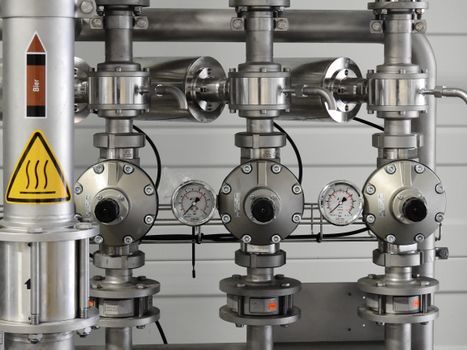
1/2"NPT male is the default process thread on the 2026 industrial supply base, with 3/4"NPT, 1"NPT and G1/2 BSP offered as options; bottom, back and every-angle adjustable connections are all in catalog, and back-connection stainless units are widely stocked for skid and panel builds [S4][S6]. Sanitary lines run 1½" Tri-Grip / Tri-Clamp, while high-pressure or pipeline work moves to flanged or welded thermowells in the same form factor family.
Connection choice is locked in by the thermowell, not the bimetal: the thermometer is a replaceable insert, and the thermowell defines the pressure rating, material and inspection regime. Reusing an existing thermowell is a perfectly valid buy decision — it often overrides all other selection criteria, because re-machining the nozzle is the expensive part of a change.
Comparison: bimetal vs glass-stem vs infrared vs RTD at the same point
For the same process point, the four workhorse options line up against decision criteria roughly as follows. A bimetal dial gives the cheapest local reading, no power, and survives vibration, but offers only ±1–2 % of full-scale accuracy and slow response [S2][S4]. A glass-stem thermometer (mercury-in-glass or organic-fill) is similarly passive, more accurate in lab service, and is the preferred referee for field-checking a bimetal, but it is fragile and not networked.
An infrared pyrometer adds non-contact measurement of moving or hazardous targets, but it sees surface emissivity, not bulk fluid temperature, and needs optical access. A Pt100 RTD such as those covered in the Pt100 RTD selection guide 2026 is the only one of the four that gives a calibrated 4-wire signal into a control system, and it pairs with a pressure transmitter on the same cable run. For non-contact spot checks on energized cabinets and motor housings, an IR unit is complementary, not competing — see the infrared thermometer buying guide 2026 for the optics and emissivity side.
Who bimetal is for — and who it is not for

Bimetal is for: local indication on pumps, compressors, tanks and bearing housings; skid and OEM builds where cost and mechanical ruggedness matter; sanitary loops where an all-316L hermetically sealed dial is acceptable as the only readout; and as a redundancy / mechanical backup on thermowells that also carry an electronic probe. It is not for: control loops requiring a 4-20 mA or fieldbus input, custody-transfer measurement, sub-±1 °C lab accuracy, intrinsically safe hazardous-area transmission (use a certified electronic probe — relevant selection logic in the pressure transmitter buying guide 2026 carries over to temperature), or any point where the operator cannot read the dial directly. [S1]
For high-cycle vibration service, specify a hermetically sealed liquid-filled case, a reset screw for re-zeroing in the field, and a 6 mm (¼") heavy stem rather than a 4 mm economy stem [S3]. For clean-in-place verification on food and pharma lines, pair the dial with a portable turbidity check per the turbidity meter selection criteria for clean-in-place verification.
Failure modes and specification traps
The three common 2026 spec traps, based on catalog offerings, are: (1) buying a 100 mm stem for a 6" pipe because the catalog lists it as "standard", (2) specifying 316 SS when the process is actually chloride-bearing hot water where 316L with controlled ferrite and a proper gasket is the real requirement, and (3) overlooking the calibration reset screw — without it, shipping shock and case flex will move the zero and the dial will read systematically wrong until the next shop recal [S3].
Mechanical failure modes in service are helix fatigue from vibration, case leakage at the lens gasket, and pointer drift after thermal cycling. Hermetically sealed 316/316L SS cases with welded stems and a glass lens address the first two; the third is intrinsic to the design and is why bimetals are indicators, not standards. For absolute process safety, the dial should be backed by an electronic transmitter on the same thermowell, not replaced by it.
Standards, calibration and sourcing
Industrial bimetal dials in current supply are typically ordered against manufacturer datasheets covering dial accuracy class, stem diameter, immersion length, wetted material and case IP rating; ASTM and EN thermometer standards govern dimensional interchangeability rather than performance class, and buyers should pin the specific revision on the PO rather than rely on the word "standard" in a catalog line [S3][S4]. Sanitary units should reference 3-A and EHEDG documentation where the project requires it, not just a "sanitary" marketing label [S3].
Factory-direct sourcing out of Jiangsu and Zhejiang (Yangzhou Huifeng, Yuyao Gongchuang and similar audited Diamond Members on Made-in-China) is the dominant 2026 supply route for 2.5/3/4 inch industrial dials, with MOQ commonly 50–100 pieces and FOB pricing negotiable in the US$ 4–20 range depending on material and connection [S1][S4][S6]. Trackable signals for the next buying cycle: stable 316L / Tri-Clamp pricing, continued migration of 1/2"NPT adjustable-angle dials into 5" case sizes for skid OEMs, and incremental displacement of low-end dials by Bluetooth-enabled digital probes in retrofit rather than new-build applications [S4][S6].