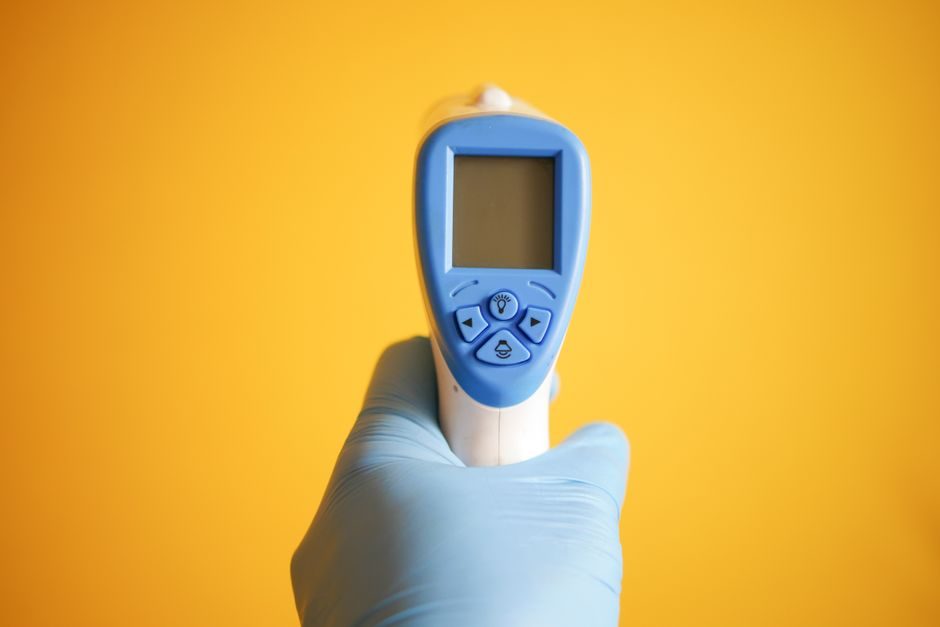
Hand-held industrial infrared thermometers in current production cover object temperatures from roughly -50 °C to 550 °C, with mid-range units like the MTP 1329 specifying -50 °C minimum and 550 °C maximum and emissivity digitally adjustable from 0.10 to 1.0 [S1].
The category is broad: HVAC-focused units such as the GANN Hydromette BL Compact TF-IR are limited to -20 °C to 70 °C and built for surface scans in building-diagnostics work [S2], while consumer-grade IR thermometers listed in the 2026 review round-up — including the Etekcity Lasergrip — are positioned for kitchen and BBQ use [S3]. Industrial buyers should treat those as different instruments, not substitutes.
How a non-contact pyrometer works and where it fits
Non-contact infrared thermometers infer surface temperature from thermal radiation emitted in a defined waveband, with the indicated temperature depending on the user-set emissivity value (0.10 to 1.0 on adjustable industrial models such as the MTP 1329 [S1]) and the distance-to-spot ratio of the optics. For an overview of the device class and its variants, see the infrared thermometer reference page.
Because the sensor reads emitted radiation only, the instrument cannot see through glass, steam, or transparent films, and it averages the field of view rather than measuring a single point. That is the reason industrial buyers pair a hand-held IR thermometer with a contact probe such as a PT100 RTD when a calibrated reference temperature is required for a critical asset.
Selection criteria: range, optics, emissivity, distance-to-spot
The first filter is temperature range: an HVAC instrument limited to 70 °C maximum, like the GANN BL Compact TF-IR [S2], cannot be used on a 300 °C motor housing, and a 550 °C industrial hand-held such as the MTP 1329 [S1] will saturate on cryogenic lines. Match the published min/max to the worst-case asset temperature with margin.
The second filter is the distance-to-spot (D:S) ratio, which defines the measurement field at a given stand-off distance. Hand-held industrial units typically target a small spot at close range; longer-range industrial pyrometers require narrower optics to read a single target. The third filter is emissivity control — fixed-emissivity units are only safe on a known surface (e.g. painted metal, matte paper), while variable emissivity from 0.10 to 1.0 is mandatory on shiny, oxidized, or mixed surfaces [S1].
Aim-assist matters in practice: dual-laser sighting, as on the MTP 1329 [S1], or single-laser pointer, as on the GANN BL Compact TF-IR [S2], defines the optical axis the spot is centered on. Without it, the user is guessing where the cone of view is landing, especially at long stand-off.
Industrial vs medical vs consumer IR thermometers

Industrial hand-held pyrometers (MTP 1329, Fluke 59 MAX) specify wide ranges, adjustable emissivity, and rugged housings for panels, motors, breakers, ducts, and vents (2024-12) [S1]. They are specified for maintenance troubleshooting, not for clinical use.
Medical/hybrid units such as the Sentry ST643 are sold as "professional" body-temperature devices with contact and non-contact modes [S6]. Consumer body thermometers sourced via Made-in-China listings in 2026-05 trade at FOB price points of roughly US$0.80–1.50 for entry-level units and US$6.00–10.00 for higher-spec models such as the Contec TP500 [S5]. Those price tiers confirm why industrial buyers should not use consumer-grade body thermometers for plant work: the optics, range, and calibration discipline are different.
Calibration discipline and ASTM E2847
Fluke's published step-by-step calibration procedure is built around ASTM E2847, "Standard Practice for Calibration and Accuracy Verification of Wideband Infrared Thermometers," and lists sources of uncertainty that must be controlled for a traceable reading (2026-04) [S4]. The dominant sources are target emissivity, target size relative to the field of view, ambient temperature drift along the optical path, and the cleanliness of the lens.
For shop-floor work, the practical minimum is a three-point check against a blackbody source at low, mid, and high range, repeated annually with the certificate filed against the instrument serial number. The same approach that applies to contact sensors — for example, the loop discipline covered in temperature transmitter vs RTD Pt100 wiring — applies in spirit: documented traceability, not a sticker.
Decision matrix: matching IR thermometer type to the job
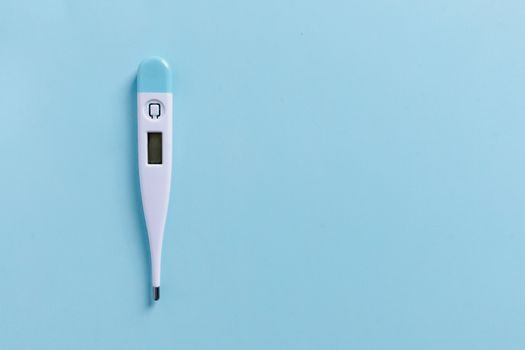
Three options dominate 2026 buying lists: industrial hand-held (e.g. MTP 1329, Fluke 59 MAX), building-services hand-held (e.g. GANN BL Compact TF-IR), and consumer/medical body units (e.g. Sentry ST643, Contec TP500, Etekcity Lasergrip). [S1]
On temperature range, the industrial hand-held leads with -50 °C to 550 °C [S1]; the building-services unit is narrow at -20 °C to 70 °C [S2]; consumer/medical body units are limited to roughly 32 °C to 43 °C forehead/temporal ranges [S5][S6]. On emissivity control, only the industrial hand-held is digitally adjustable over 0.10 to 1.0 [S1]; the others are typically fixed near 0.95. On aim-assist, the industrial hand-held offers dual-laser [S1], the building-services unit uses a single laser pointer [S2], and the body unit usually has a guided-distance LED or no aimer. On environment, the industrial hand-held is rated for plant panels, motors, breakers, ducts and vents (2024-12); the other two are indoor/light-duty. The match is therefore: industrial for plant maintenance, building-services for HVAC and moisture surveys, body/medical only for clinical screening.
Who an industrial IR thermometer is — and is not — for
Industrial hand-held IR thermometers are for electricians, condition-monitoring technicians, and process operators who need a fast, non-contact reading on energized panels, rotating equipment, or hard-to-reach surfaces where a contact probe is unsafe or slow. They are not for verifying the temperature of a calibrated reactor vessel, a sterilizer load, or a pharmaceutical batch record; for those, a validated temperature recorder with a calibrated probe is the correct instrument. [S2]
They are also not for liquid-level or surface-level imaging tasks, which require a different sensor family; for that, see the infrared level meter reference. Misapplying an IR thermometer to a level task is one of the most common specification errors in small skid design.
Common failure modes and what to check on receipt

On a new unit, verify four items before putting it on the shelf: (1) the emissivity setting actually moves through the full 0.10 to 1.0 range as advertised [S1]; (2) the laser(s) or pointer coincide with the measured spot at typical stand-off distance; (3) the high/low alarm thresholds can be set and latched, as on the MTP 1329 [S1]; (4) the °C/°F switch, data hold, and auto power-off behave as documented [S1].
In service, the recurring failure modes are scratched lenses (replace, do not polish), drifted calibration (re-check against a blackbody per ASTM E2847 [S4]), and dead batteries during a survey (carry spares). For facilities that already standardize on a linear guide or crossed-roller guide supplier, the practical move is to align the IR thermometer vendor list with the same calibration provider, so traceability flows through one system.
Trackable signals for the next buying cycle: (a) ASTM E2847 revisions and any new uncertainty-budget guidance Fluke publishes against that standard [S4]; (b) tightening of CE/RED documentation on consumer IR body thermometers shipped from Made-in-China and HKTDC suppliers [S5][S6]; (c) any move by industrial vendors to push the upper range above 550 °C on hand-held units, since current 2026 listings cluster at that ceiling [S1].