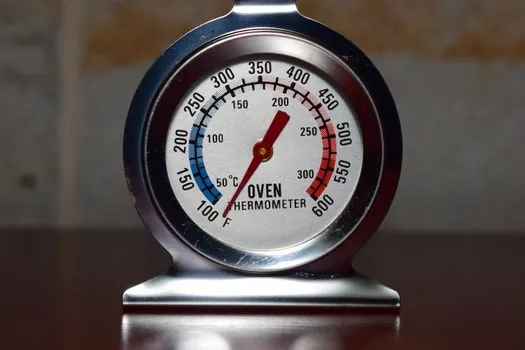
A bimetal thermometer is a dial indicator that converts the differential thermal expansion of two bonded metal strips into pointer rotation, and it remains the lowest-cost local temperature readout for non-hazardous process lines in 2026 [S2]. The sensing element is a helical bimetallic coil: one end is fixed, the other drives the indicator shaft, and the angular displacement is approximately proportional to temperature across the calibrated span [S2].
The mainstream industrial catalog sits in a tight band: -50 to 500 °C span, ±1.5% of full-scale accuracy, 304 stainless steel case and stem, 1/2 NPT back or bottom connection, and 63 mm (2.5") to 150 mm (6") dial sizes [S3]. Within that envelope, the engineering decision is not whether to buy a bimetal, but which connection geometry, immersion length, and wetted-material option matches the pipe, the medium, and the readability distance.
How the sensing element actually works
The bimetallic strip is a clad pair of alloys with deliberately mismatched thermal expansion coefficients, normally Invar bonded to a high-expansion nickel-chrome or manganese-copper alloy; the active coil is then wound into a spiral so the small linear tip deflection becomes usable pointer rotation [S2]. Because the deformation is approximately linear with temperature, the scale on the dial is evenly divided, which is why even an inexpensive 2.5" dial thermometer can resolve 2 °C divisions across most of its range [S4].
This is a purely mechanical device: no excitation voltage, no cold-junction compensation, no 4-20 mA loop, and no digital protocol. That is also its hard limit. If the duty requires remote transmission, asset-management data, or SIL-rated switching, a bimetal thermometer cannot meet the spec, and the buyer should step up to an RTD or thermocouple with a transmitter instead.
Selection criteria that actually drive the right variant
Five parameters decide 90% of bimetal thermometer orders in 2026: range, accuracy class, dial size, process connection, and wetted-parts material [S1][S3]. A typical sourcing entry in Chinese export channels lists the EXACT Type 213AB as -50 to 500 °C, ±1.5% accuracy, 304 SS case and stem, 1/2 NPT back connection, and 2.5"/3"/4"/5"/6" dial options in a single SKU family [S3].
For sanitary or hygienic service, the spec shifts to 316/316L wetted parts, hermetically sealed case, 32 Ra maximum surface finish, and Tri-Clamp connections in 1½" size; Omega's AA/BB/JJ/LL sanitary bimetal series sits exactly in this configuration, with 6 mm (¼") standard stem diameter and standard lengths from 2½" to 15" [S4]. Where you sit in this five-axis decision space determines whether a $4 industrial dial or a $880 engineered sanitary instrument is the correct answer.
Side-by-side comparison of the main options

Three bimetal thermometer variants dominate 2026 procurement, and the selection map is a clean four-criteria tradeoff [S3][S4][S5].
Back-connection industrial (e.g. EXACT 213AB class): 304 SS wetted parts, 1/2 NPT back, ±1.5% accuracy, -50 to 500 °C, polycarbonate or tempered-glass window, US$ 3.58-4.19 per piece at 1-piece MOQ [S3]. Best for tank-wall, compressor, and skid panels where readability is read from behind the pipe.
Every-angle adjustable industrial: stainless steel wetted parts, 1/2 NPT bottom connection, adjustable stem so the case can be rotated to the operator's sight line, US$ 3.68-8.68 per piece [S3]. Best where the pipe orientation and the operator's viewing position are not aligned, common on heat-exchanger headers and small-bore branch lines.
Sanitary Tri-Clamp (Omega AA/BB/JJ/LL): all 316/316L wetted parts, 32 Ra hygienic finish, hermetically sealed, 1½" Tri-Grip standard, glass lens, ¥97,048-¥138,930 list in the Japanese channel, six-week lead time [S4]. Best for pharmaceutical, food, beverage, and biotech skids where CIP/SIP and cleanability outweigh first cost.
Pricing benchmarks and MOQ bands in 2026
Entry-level stainless steel industrial bimetal thermometers on Made-in-China.com and GoldSupplier cluster in the US$ 2.68-20.90 per-piece band as of July 2026, with MOQs of 1 to 100 pieces depending on supplier [S3][S5]. The Shanghai Qualitywell "Bimetal Surface Contact Dial Thermometer with Fahrenheit and Celsius Scales" lists at US$ 18.41-20.90 at a 100-piece MOQ; Hangzhou Wanxing's "Electric Contact Manometer Bimetal Thermometer" lists at US$ 20.00 at a 20-piece MOQ [S5].
For context against neighboring instruments on a process-skid BOM, a pressure gauge selection typically lands in the same $5-30 band for industrial dial type, while a sanitary bimetal at the Omega spec tier runs 10-30x that on a single-piece basis, mostly because of 316L wetted material, hygienic surface finish, and the hermetic seal rather than the bimetal coil itself [S4]. Freight terms on the Chinese export channels are FOB Shanghai or Ningbo, with delivery time quoted as a function of order quantity rather than as a fixed lead time [S3].
When a bimetal is the wrong tool
Three duty profiles kill a bimetal thermometer as a stand-alone solution: high vibration above roughly 10 g RMS at the mounting point, applications needing switch action, and any line where the case is in a hazardous area requiring ATEX or IECEx certification [S1]. A magnetic snap-action contact variant, for example the WIKA 608425 series, exists for switching duties from -50 to 500 °C, but it is a hybrid device: still a bimetal indicator, with the snap contact added for control, not a replacement for a proper temperature transmitter on a SIL loop [S1].
Buyers who need a 4-20 mA output, HART or Foundation Fieldbus data, or a SIL-rated safety function should not stretch a bimetal into that role. A temperature transmitter selection guide walks the RTD/TC/HART/form-factor decision, and a temperature sensor selection guide covers the upstream sensor choice; both go well past the bimetallic coil's mechanical envelope. Likewise, a thermocouple probe pricing reference is the right read when high-temperature, fast-response, or remote-mounted sensing is the real problem.
Installation and reading-distance rules of thumb
Two engineering habits separate a clean bimetal install from a misread one: correct immersion depth and dial size matched to viewing distance. The Omega sanitary datasheet ties minimum stem length to dial size, with 4" minimum stem at the longer lengths, and pairs 3" dials with the -40 to 160 °F and 0 to 250 °F ranges used most often in food and pharma lines [S4]. On the industrial side, the EXACT 213AB family exposes 2.5", 3", 4", 5", and 6" dial sizes on a common -50 to 500 °C element, so the same process connection covers panel-mount through deck-mount readability [S3].
Readability rule of thumb in process plants: 1 m per inch of dial diameter for comfortable reading under shop lighting. A 100 mm (≈4") dial is the practical minimum for a 5 m aisle, which is also why the WIKA TGT73 and 73-series gas-actuated thermometers default to 100 mm and 160 mm dials for process-industry use [S1]. Window material also matters: polycarbonate is the cheap default and is fine indoors; tempered glass is preferred outdoors or where solvent wipe-downs would haze a plastic lens over time [S3].
Standards, materials, and traceability signals to verify
The relevant European product standard for industrial dial thermometers, including bimetallic types, is EN 13190, which is the document WIKA cites for its 73-series gas-actuated thermometer design and which is the closest harmonized reference for case construction, dial marking, and accuracy class on bimetallic units [S1]. Buyers should still confirm wetted-parts certificates, material test reports, and calibration data on a per-shipment basis, since 304 vs 316L wetted material changes the corrosion envelope significantly in chloride, sour, or clean-in-place service.
On the sourcing side, the EXACT 213AB spec sheet states 304 SS case, ring, stem, and connection, with aluminum pointer and dial, ±1.5% accuracy, and -50 to 500 °C span as the headline numbers, and lists the seller as ISO 14001-attested [S3]. Sanitary instruments should additionally carry 3-A, EHEDG, or equivalent cleanability documentation depending on the end market; the Omega AA/BB/JJ/LL datasheet declares 32 Ra maximum on wetted surfaces, hermetic seal, and 1½" Tri-Clamp compatibility as the field-installation standard [S4].
Shortlist logic for a 2026 order
For a non-hazardous, local-reading, general-service line under 500 °C, order a back-connection 304 SS dial thermometer in the 100 mm size with 1/2 NPT, in the 0 to 200 °C or 0 to 250 °C span, at 1.5% accuracy; this is the $3-5 baseline available from multiple Chinese suppliers on 1-piece MOQ [S3][S5]. If the operator must read the gauge from the side or below the pipe, switch to an every-angle adjustable stem at the modest $4-9 price step [S3].
For hygienic, pharmaceutical, food, or biotech service, skip the 304 industrial catalog entirely and go straight to a 316/316L sanitary Tri-Clamp unit with 32 Ra finish, hermetic seal, and a documented calibration certificate; expect ¥97,000-¥140,000 list and a 2-6 week lead time on the Omega AA/BB/JJ/LL family or its equivalents [S4]. For anything that needs a 4-20 mA signal, a switch contact, or hazardous-area certification, escalate to the temperature transmitter or contact-thermometer catalogs in [S1] and the related transmitter-selection references.
For component-level specifications, see infrared thermometer, and linear guide.