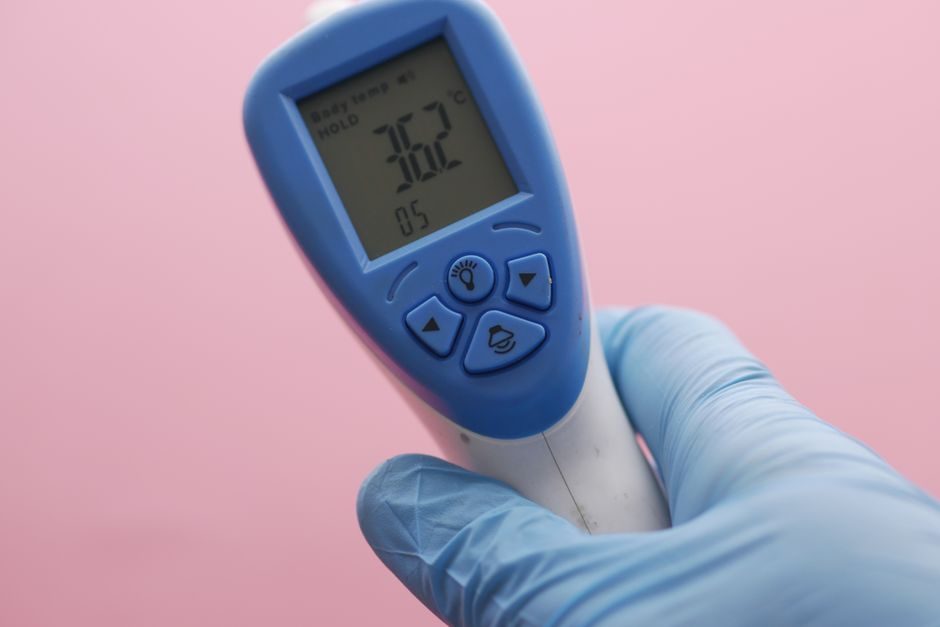
A bimetal thermometer is a self-contained mechanical indicator that converts the differential expansion of two bonded metal strips into a rotary dial read-out, with no power supply and no signal output to the control system [S1]. An electronic temperature sensor — typically a Pt100/Pt1000 RTD or a thermocouple — produces an electrical signal (resistance or mV) that a transmitter conditions into 4-20 mA, HART, IO-Link, or Foundation Fieldbus for the DCS/PLC.
The two families overlap in the -50 to +500 °C range, which is exactly where most spec fights on the purchasing desk happen. Bimetals are local-indication-only devices (no remote signal); electronic sensors are signal-only devices (no built-in dial) unless you add a digital indicator in the head [S2]. For an on-site operator glance at a pump bearing, a bimetal dial at the coupling is hard to beat; for a SIL alarm loop fed into a flow sensor compensation block, only an electronic sensor delivers the signal the controller needs.
Operating principle and what each device physically is
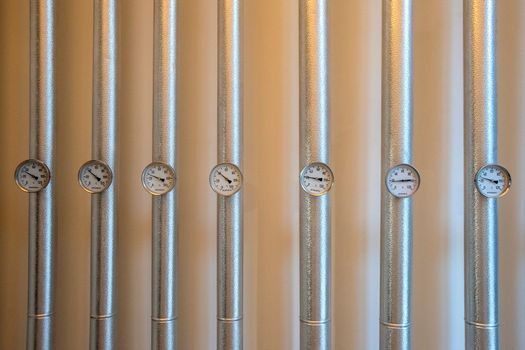
A bimetal thermometer works by bonding two metals with different thermal expansion coefficients into a flat strip, then rolling that strip into a spiral. Temperature change winds or unwinds the spiral and rotates a pointer on the dial — purely mechanical, with no electrical output [S1][S2]. The sensing element is the coil itself; the stem is a sealed metal tube protecting the coil from the process media.
Standard case diameters catalogued by Asian and US manufacturers run 2", 3", 4", 5", 6" (50–150 mm), with stem diameters around 6.4 mm (¼") standard and 8/10 mm as options, accuracy class typically ±1 % of span [S4][S5]. Process connection is overwhelmingly ½" NPT in industrial offerings, with thermowells specified wherever the process is corrosive, abrasive, or above the elastomer/seal rating of the bare stem [S4].
What an electronic temperature sensor is, and how it differs
An electronic temperature sensor is a resistive or thermoelectric element packaged in a probe: Pt100 / Pt1000 (RTD, resistance changes with temperature per IEC 60751), Type K / J / T / E / N / S thermocouples (mV per ASTM E230 / IEC 60584 tables), or semiconductor/band-gap ICs in lower ranges. The element sits in a sheath, with a head-mounted or rail-mounted transmitter converting the raw signal into 4-20 mA + HART, IO-Link, PROFIBUS PA, or Foundation Fieldbus. [S1]
Two functional consequences follow. First, the sensor can be installed hundreds of metres from the readout, with the indicator on the control room panel. The trade-off: every loop needs power, wiring, a transmitter, and SIL/SIS engineering if it's in a safety function.
Selection criteria side-by-side: 4 decision axes

Spec engineering boils down to four axes — accuracy, indication, environment, and total cost of ownership. Comparing on those axes gives a clean, citable structure: [S2]
1. Accuracy. A bimetal thermometer is a Class ±1 % device by typical catalogue spec [S4]; mid-grade Pt100 Class A probes with a 4-wire transmitter reach ±(0.15 + 0.002|t|) °C per IEC 60751. For custody transfer, batch reactor endpoint control, or energy metering on steam, the electronic sensor wins by a factor of 5–10.
2. Local indication. The bimetal dial is intrinsically safe (no power, no electronics) and is readable in any lighting, even during a plant-wide power outage. An electronic sensor has no dial unless you bolt a loop-powered digital indicator to the head — extra cost, extra failure mode.
3. Hazardous area and remote monitoring. Where ATEX/IECEx zone 1 is in play, a certified electronic head with Ex d / Ex i is mandatory for a 4-20 mA loop into the DCS; a bimetal is a local read only and cannot participate in a safety instrumented function. For bearing-temperature alarms on rotating equipment, the architecture is usually bimetal at the coupling for the operator plus an RTD into the inductive sensor speed-signal trip chain for the SIS.
4. TCO. A 4" dial bimetal with thermowell lists around US$ 6.90–19.90 in OEM-tier Asian trade channels in 2026 [S5]; US distributor pricing for an equivalent Ashcroft-pattern bimetal is around US$ 150 (C-600B-05-BS, 4-¼", 18" stem, 0-120 °C) [S3]. A Pt100 head assembly + HART transmitter + thermowell is typically 3–8× the dial cost, but the running saving comes from one probe feeding many systems instead of operators walking the line.
Where a bimetal thermometer is the right tool
Use a bimetal when the answer to "where is the operator going to look?" is "at the pipe". Boiler rooms, HVAC headers, lube-oil consoles on reciprocating compressors, and any place where the local reading is part of the operator's normal round are textbook bimetal jobs [S1]. They tolerate vibration, dirt, and condensation that would fog a glass-stem thermometer, and unlike a glass thermometer they cannot burst and release mercury (a key reason many plants have retired glass stems for tank-side level and temperature service).
For field maintenance, the bimetal coil and the dial mechanism are field-replaceable on most industrial models, and a 5-week factory lead time on common ranges is realistic based on 2026 distributor stock posture. See also the comparative spec match against infrared in our Infrared vs Bimetal Thermometer: Spec Match for Process Jobs note — the short version: bimetal is contact, IR is non-contact, and the two rarely substitute for each other on a real process.
Where the electronic temperature sensor is the right tool
Use an electronic sensor whenever the temperature value has to leave the local environment: control loops, safety trips, energy metering, batch records, and remote tank farms. RTD-vs-thermocouple selection is its own engineering exercise covered in our Pt100 RTD Selection Criteria: 2026 Spec Engineering Field Guide and the bearing-trip variant in Selecting PT100 RTDs for Bearing Temperature Alarm Loops. [S3]
Two specific cases where the electronic sensor is the only acceptable answer. First, custody transfer and fiscal metering on steam, natural gas, and hydrocarbon liquids — the accuracy and stability of a calibrated RTD with HART diagnostics is non-negotiable. Second, any hazardous-area Zone 0/1 with a SIL-rated safety function — there is no credible way to put a bimetal dial into a safety PLC without a transmitter in the loop, and at that point you are already paying for the electronic architecture.
Limitations, failure modes, and common spec mistakes
Bimetal failure modes are mostly mechanical: coil fatigue after long thermal cycling, stem corrosion if the wrong stainless is specified (304 vs 316 is a routine plant-failure cause in chloride service), and dial fogging when the case seal fails. Liquid-filled cases reduce pointer vibration on reciprocating equipment, but the fill fluid itself has an upper temperature limit — exceeding it cooks the dial. [S4]
Electronic sensor failure modes are different. RTD self-heating errors in still air at low flow, lead-resistance error in 2-wire installations over long runs, cold-junction compensation drift in thermocouples, and moisture ingress in the head terminating a 4-20 mA loop to ground. The most common spec mistake I see in 2026 is still specifying a 2-wire Pt100 for a run longer than about 5 m — use 3-wire minimum, 4-wire for any Class A accuracy work.
Sourcing, standards, and what to verify in 2026

For bimetal dials, the 2026 OEM landscape includes WIKA as the European reference [S1], Ashcroft and Trerice on the US side (Trerice-style part numbers like R-50-300F on Omega Sea distribution), and a long tail of Asian OEM/ODM suppliers on Made-in-China and Alibaba channels with case diameters from 2" to 6", 304/316 case material, and ±1 % accuracy class as the catalogue baseline [S4][S5][S6]. For high-volume Asian trade purchases, the verification step is to confirm whether the case is liquid-fillable and whether the stem-to-case seal is welded or gasketed, because that is the single biggest determinant of field life.
For electronic sensors, pin the procurement spec to the standards that actually govern the application: IEC 60751 for Pt100 resistance tables, ASTM E230 or IEC 60584 for thermocouple limits, ATEX 2014/34/EU and IECEx for hazardous-area certification, and ISA 84 / IEC 61511 for SIL loops. The supplier paperwork must name those standards by number, not by vague phrases like "industrial grade". For an internal cross-check on adjacent process measurement, see the Pressure Gauge vs Differential Pressure Transmitter: 2026 Selection Criteria note — the engineering logic is the same: local mechanical vs remote electronic is a recurring decision across the instrument sheet, not unique to temperature.
Bottom line for the spec engineer: if the only thing the plant needs is a number on a dial an operator can read with a flashlight during a power outage, specify a 4" or 5" 316SS-case liquid-fillable bimetal in a thermowell, expect ±1 %, and source against a 5-week distributor lead-time [S5]. If the temperature value has to enter any kind of control, alarm, energy, or historian system, the bimetal is a complement (operator glance) but not a substitute for an RTD or thermocouple with a properly certified transmitter.