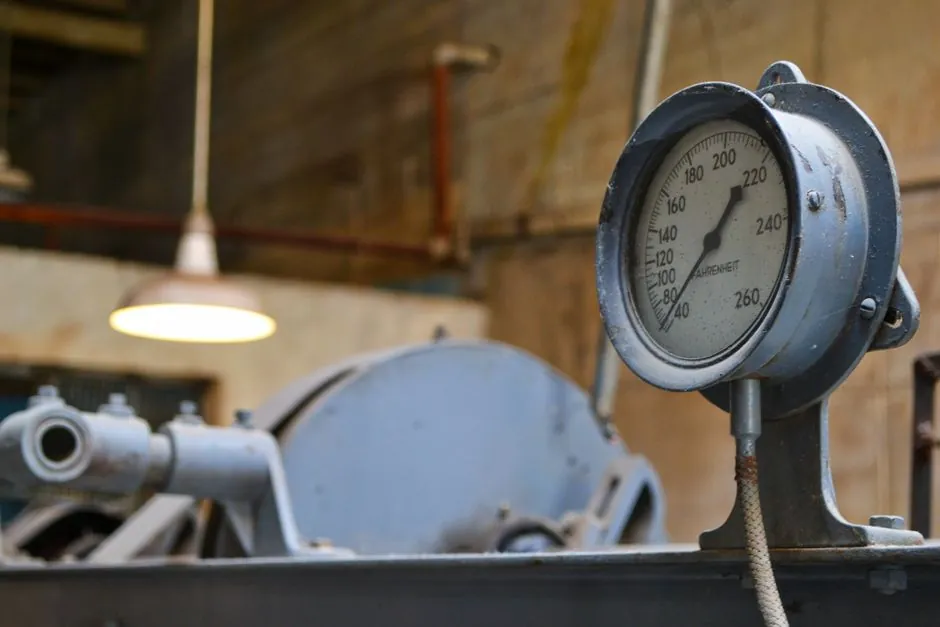
A bimetal thermometer is a mechanical local indicator that reads process temperature by differential thermal expansion of two bonded metal strips, with a standard industrial range of -80 to +500 °C and a typical accuracy class of 1.0 to 2.5 [S1][S2].
A temperature transmitter is an electronic head- or rail-mounted device that digitises a resistance-temperature-detector (RTD) or thermocouple (TC) signal and outputs a 4-20 mA loop (or digital HART, FOUNDATION Fieldbus, PROFIBUS PA) for a control system. It has no dial and exists only to deliver the temperature to the control room, not to be read at the pipe.
Why Response Time Differs by an Order of Magnitude
The sensing element in a bimetal thermometer is a coiled strip of two metals with different expansion coefficients, immersed with the entire stem mass and housing in the ambient air around the pipe; the thermal mass and the air gap between bulb and process fluid make the time constant (T63) typically 15-60 s for an air-installed unit, slower than a properly thermowelled RTD in a flowing process [S1].
A transmitter adds only the loop update delay (typically 100-500 ms for a HART device at the standard 4 Hz update rate), so the total loop step response is dominated by the sensor, not the transmitter electronics [S1].
Selection Criteria: 4 Decision Axes
Axis 1 - Output type: a bimetal thermometer gives a direct mechanical dial readout readable without power, which is the right answer for local sight-glass verification, ATEX/IECEx Ex i loop-powered passive dials, and skid skids where a walk-around operator needs to see the value; a transmitter gives a 4-20 mA current loop (HART, FOUNDATION Fieldbus, or PROFIBUS PA as options) and is the only choice when the value must drive a control loop, a safety interlock, or a historian [S1].
Axis 2 - Response time: a bimetal dial in air typically settles in 30-90 s for a 50 % step (the moving mass of the coil and the friction in the linkage cap the speed); an RTD-in-thermowell combination in a flowing liquid settles in under 10 s, and a bare-bead TC in gas can hit sub-second response, so any control loop with a process time constant shorter than 30 s should be a transmitter, not a bimetal dial.
Axis 3 - Accuracy: bimetal dial accuracy class is normally 1.0 or 2.5 (% of span), which over a 0-400 °C span is 4-10 °C of error at full scale; an RTD-input transmitter on a Class A Pt100 (IEC 60751) gives ±(0.15 + 0.002|t|) °C, so for control band under ±2 °C, specify a transmitter with a calibrated RTD, never a bimetal dial.
Axis 4 - Cost and lifecycle: a stem-and-dial bimetal thermometer is a one-time purchase with no loop power, no calibration drift, and a service life measured in decades in benign service; a transmitter is a recurring-cost device (initial purchase, periodic re-calibration of the sensor, possible SIL recertification, and electronics replacement every 10-20 years), so on a non-critical, non-controlled, locally-read point, the bimetal is the lower-total-cost option.
Where a Bimetal Dial Is the Right Tool (and Where It Is Not)
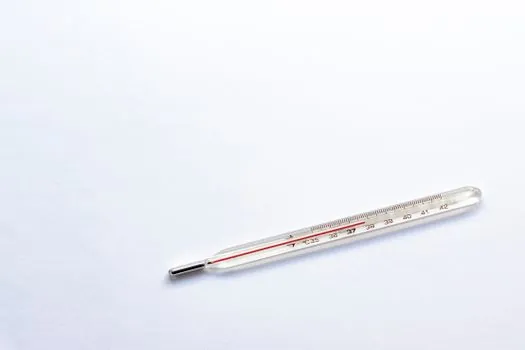
Use a bimetal thermometer when the user needs a local dial readout, when the point is not wired into the control system, when a sight-glass-style verification is required by the operator round, and when ambient vibration or limited panel space rules out a glass-stem liquid-in-glass thermometer. The mechanical dial survives loss of loop power and survives in radio-frequency-interference environments where a transmitter output would be noisy [S1].
Do not use a bimetal dial for any closed-loop PID control, any safety instrumented function, any batch or recipe endpoint (where a tight tolerance is required), or any fast ramp where the process moves more than a few °C per second, because the moving-coil mechanism simply cannot track the temperature change faster than its thermal mass allows, and any attempt to use it as a control input will produce severe lag and oscillation in the loop.
Comparison: Bimetal Dial vs Transmitter Plus RTD/TC
On response time, the bimetal dial is 5-20x slower (15-90 s typical) than an RTD/TC transmitter in a properly thermowelled installation (1.5-15 s in liquid/air). On accuracy, the bimetal at class 1.0-2.5 loses to an IEC 60751 Class A RTD by roughly a factor of 10 at a 400 °C span. On integration, a bimetal needs only a thermowell and a mechanical mount, while a transmitter needs a thermowell, an RTD/TC, a head, a cable run to the marshalling cabinet, I/O card allocation, and DCS configuration. The decision is therefore not "which is better" but "which axis is binding": if the binding axis is response or accuracy, choose the transmitter; if the binding axis is cost, local readability, and zero electronics, choose the bimetal dial. [S2]
Failure Modes and Constraints That Drive the Choice

The bimetal dial is mechanically robust, but the bonded strip loses calibration permanently if it is heated above its upper limit (typically +500 to +600 °C for standard grades), and the dial window will leak in steam or wash-down service unless specified IP66 or higher; the moving mass also makes it unsuitable for installation on a vibrating line without a remote capillary or vibration isolator [S1].
A transmitter is constrained by loop integrity (open loop, shorted cable, or failed power supply all produce a fixed 4 mA or 20 mA output by design, which the DCS must detect as a fault), by thermowell wake-frequency calculation per ASME PTC 19.3 TW (a too-long or too-thin thermowell in high-velocity flow is a fatigue failure waiting to happen), and by the inherent drift of the electronics (typically 0.1-0.5 °C per year depending on ambient). The transmitter is the right answer when any of these failure modes can be managed by the control system; the bimetal is the right answer when the failure mode of "no readout at all" is acceptable.
Verbatim Standard Reference and Practical Spec
IEC 60751 specifies Class A and Class B tolerance bands for Pt100 industrial RTDs (±(0.15 + 0.002|t|) °C for Class A, ±(0.30 + 0.005|t|) °C for Class B) and is the only widely cited industrial-grade accuracy spec on the sensor side of the transmitter chain [S1].
For a remote bearing-housing bearing-temperature spot read by a roving operator, the practical spec is: bimetal dial 100 mm stem, 6 mm OD, IP66 housing, range 0-200 °C, class 1.0, dial diameter 100 mm. Two completely different instruments, both correct, and the only reason to mix them would be if the same point needed both a fast control input and a local confirmation dial, in which case specify both and use the dial for the operator, the transmitter for the DCS.
For the cost-driver breakdown of the probe side of a transmitter chain, the thermocouple probe pricing 2026 guide maps out how sensor choice shifts total cost of ownership across a 5-10 year window. Where a fast non-contact spot check is needed (rotating shafts, electrical cabinets, furnace tubeskins), an infrared thermometer supplements rather than replaces the bimetal/transmitter split, and it should be selected by emissivity range, distance-to-spot ratio, and response in the 0.1-1 s band rather than by resolution claims.