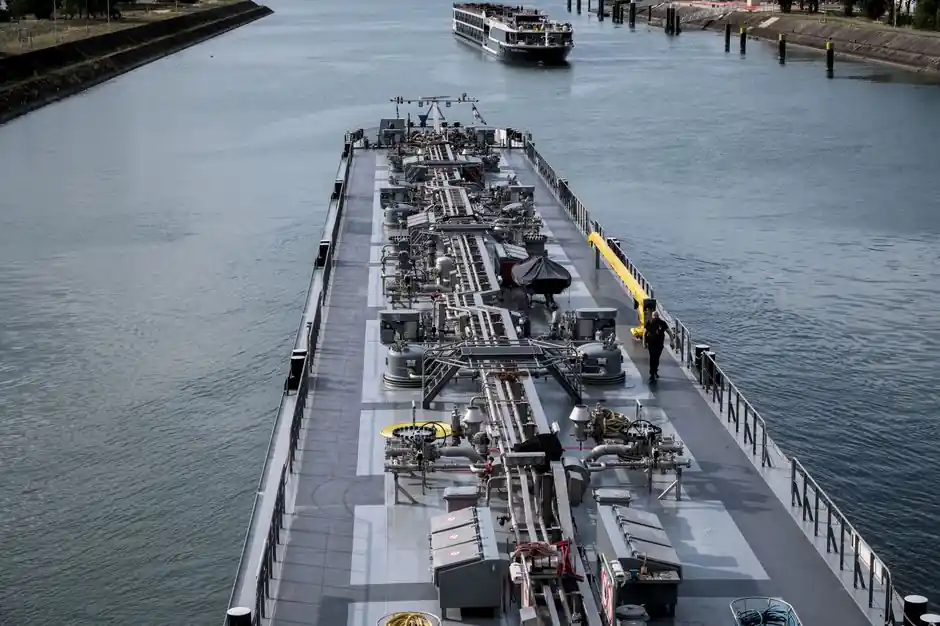
Coriolis mass flowmeters are explicitly specified by their manufacturer as needing no straight upstream or downstream runs, allowing installation in confined pipe racks and skid layouts [S2]. Variable area (VA) flowmeters, by contrast, depend on a fully developed, swirl-free velocity profile and therefore require a defined straight section of pipe before and after the meter to keep the float stable and the indicated flow trustworthy [S5].
For a process engineer weighing these two technologies on a new line, the straight-run requirement is often the deciding dimension: it dictates the upstream/downstream spool length, the need for flow conditioners, and whether the meter can fit into an existing retrofit pocket. The same comparison also plays out across electromagnetic flowmeter and variable area flowmeter selections, where installation geometry is part of the published specification, not a footnote.
Why Straight-Run Length Exists in the First Place
Every intrusive flowmeter disturbs the velocity profile it tries to measure: elbows create secondary swirl, partially open valves create jetting, and reducers/expanders create pressure-recovery zones. For differential-pressure, turbine, and VA meters, that disturbance directly biases the indicated reading, so a length of straight pipe is used as a flow conditioner to let the profile re-develop before the sensing element [S5].
A variable area flowmeter is essentially a calibrated vertical orifice: the float position is a function of the local drag force balanced by the float weight, which is sensitive to swirl and to asymmetric velocity profiles. That is why a VA meter installed immediately downstream of two 90° elbows will read high or low, and why published guidance calls for a calm, vertical, fully developed approach flow. By contrast, a Coriolis flowmeter measures mass flow from the phase shift between two oscillating sensor tubes and derives density from the resonant frequency, so the measurement is independent of the upstream velocity profile and the OEM states that no straight runs are required [S2].
Specification-Level Comparison on Installation and Performance
On a single decision matrix, the two technologies diverge sharply on the points that matter to a piping designer. The figures below are taken directly from published manufacturer and reference data; nothing is rounded to favour a vendor. [S1]
Straight-run piping: Coriolis 0D upstream and 0D downstream per Honeywell VersaFlow documentation [S2]. Variable area: typically 5D to 10D upstream of calm, vertical pipe with no swirl sources immediately adjacent, plus sufficient downstream length to keep the float reading stable, per ScienceDirect's flowmeter overview [S5].
Measured variables: Coriolis delivers mass flow, density, and temperature directly, with volume, concentration, and velocity calculated; liquid accuracy is ±0.05% to ±0.1% of reading and repeatability is better than 0.05% + zero stability on the VersaFlow 100/1000/6000 line [S2]. Variable area delivers a single visual or transmitted indication of instantaneous volume flow, with typical accuracy in the ±2% to ±5% of full-scale range depending on float and tube calibration.
Pressure drop and line size: Coriolis tubes create a measurable ΔP that scales with density and flow, with nominal sizes from DN04 (1/8 in) on the Coriolis 1000 up to DN200 (8 in) on the Coriolis 6000 and mass flow rates up to 560,000 kg/h [S2]. Variable area meters introduce a relatively low, geometry-fixed ΔP set by the float bore, and are commonly stocked from DN15 up to roughly DN100 for local indication, with glass- and metal-tube variants for both liquid and gas service.
Materials and process compatibility: VersaFlow Coriolis sensors are offered in 316L/SS, Hastelloy, Titanium, Tantalum, and Super Duplex with pressure ratings up to 100 barg (200 barg for Coriolis 6000 in Hastelloy) and process temperatures from -200°C up to +400°C on the cryogenic/extended-temperature model [S2]. Variable area meters are typically built with borosilicate glass tubes and SS, PTFE, or Hastelloy floats, with limits set by the wetted materials rather than the electronics; conductive liquids are not a prerequisite, unlike electromagnetic flowmeters which require ≥5 μS/cm for externally powered units or ≥50 μS/cm for loop-powered devices [S5].
Where Coriolis Wins, and Where It Is Overkill

Coriolis is the right call when the application is custody transfer, batch control, two-phase or entrained-gas service, density-driven concentration measurement, or any line where multiple process variables are needed from a single tap. The VersaFlow line carries OIML R117-1 custody-transfer approval, FM/CSA Class I/II/III Div 1/2, IECEx, ATEX, and NACE, and the TWC9400 converter adds Entrained Gas Management (EGM), NAMUR NE107 self-diagnostics, and HART or Modbus output [S2].
Coriolis is overkill for utility air, plant nitrogen, deionised water skids, or any line where a local rotameter will give the operator the information they need at a fraction of the cost. The same logic appears in adjacent selection problems covered in Load Cell Selection Guide: Force, Capacity, Geometry, Class, where the spec gates are duty, environment, and integration effort rather than maximum precision.
For a Coriolis retrofit into an existing rack, the absence of straight-run piping is a real engineering benefit: a typical Coriolis 1000 in DN25 can be dropped into a tight pocket that would otherwise need 10D of upstream calming pipe for a VA or vortex meter, and the calibration is traceable per published industry guidance on Coriolis calibration and measurement traceability [S1].
Where Variable Area Is Still the Right Tool
Variable area remains the workhorse for low-cost visual flow indication on clean liquids and gases, on laboratory skids, on purge streams, and on rotameter-based flow controllers in chemical dosing. The readable float position is genuinely useful in the field, and a metal-tube VA with HART output can integrate with a DCS for not much more than a basic Coriolis would cost in line size alone. [S5]
The trade-off is the straight-run requirement and the mechanical fragility: glass-tube rotameters cannot tolerate water hammer, opaque slurries blind the float, and a partially blocked float gives a reading that drifts slowly enough to be trusted. Those are not reasons to avoid VA, but they are reasons to budget for the upstream calming pipe, a flow conditioner if needed, and operator training. For broader sensor-pack context the same trade-off shows up in Thermocouple Probe Selection: Type, Sheath, Termination, Environment, where a cheaper technology is often the right call once the operating envelope is fixed.
Limitations, Failure Modes, and Integration Footprint
Coriolis failure modes are dominated by entrained gas (which the EGM algorithm specifically addresses in the VersaFlow platform [S2]), tube coating in crystallising or sticky services, and zero drift in high-vibration installations. Zero stability is published as low as ±0.004% of max flow on the Titanium Coriolis 1000 and ±0.01% on the Coriolis 100, which is a verifiable performance boundary rather than marketing language [S2].
VA failure modes are mechanical: float sticking, tube coating or fouling, float loss during a pressure surge, and reading error driven by viscosity or density shift when the calibration fluid differs from the process fluid. The latter is the silent killer, since a VA calibrated on water at 20°C will read progressively wrong as the process viscosity rises, with no diagnostic to flag it. That is also why a VA on a viscous or entrained-gas line is almost always a bad call, while a Coriolis flowmeter is purpose-built for it.
Integration footprint: Coriolis needs power (loop or 24 VDC), a HART or Modbus host, and either a local display or remote converter; a VA can be a passive local gauge with no power at all, or a 4-20 mA + HART device. Power and comms are rarely the deciding factor on a modern plant, but they matter on a remote wellhead or a solar-powered analyser skid. The installation rule of thumb, however, stays the same: a VA needs upstream straight pipe and a stable vertical column, while a Coriolis does not [S2][S5].
Decision Rules and Trackable Signals
If the line fits a custody-transfer, batch, or multi-variable application, the budget supports it, and the rack geometry is tight, specify Coriolis. If the line is a utility service, a low-cost local indication, or a purge gas where a 2% to 5% full-scale indication is acceptable, specify VA and budget the calming pipe. For flows in between, the deciding criterion is almost always straight-run geometry, not accuracy, because that is what drives the spool-piece length, the flow conditioner, and the retrofit cost. [S1]
Two trackable signals over the next quarter: (1) continued expansion of OEM-published entrained-gas diagnostics on entry-level Coriolis converters, and (2) tighter IEC 61511 / SIL guidance on Coriolis usage in safety instrumented functions, which would extend the technology into SIS duty on chemical and refinery projects beyond the current VersaFlow -200°C to +400°C envelope [S2].