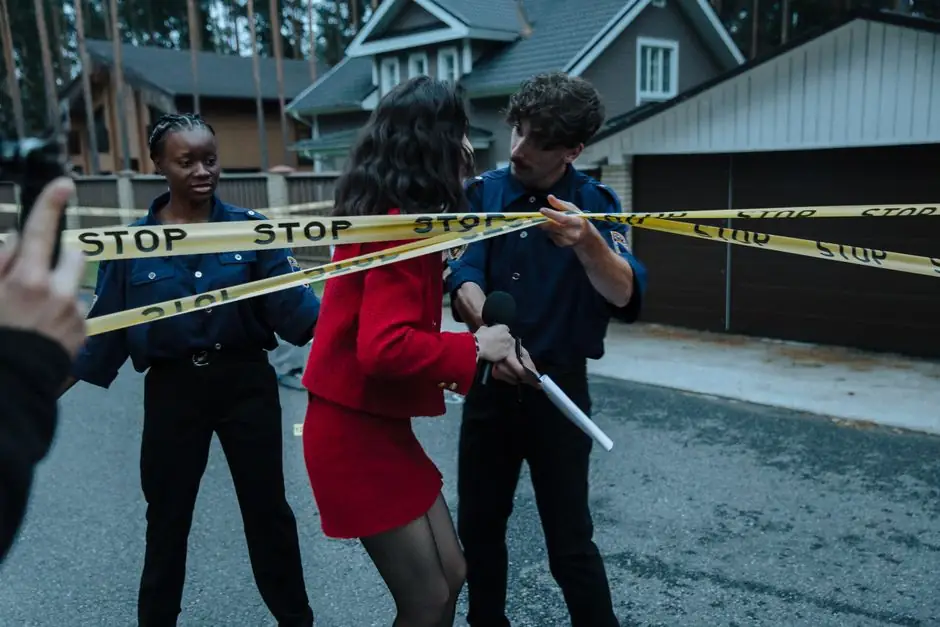
Under OSHA 29 CFR 1910.144, yellow is the only federally mandated color for marking physical hazards such as striking, stumbling, tripping, and falling, while red is the mandatory color for fire protection equipment and danger zones; black-and-yellow striping and red-and-white striping are the two hazard patterns built on top of that two-color base [S4][S1].
The practical rule: yellow/black stripe = caution/physical hazard (trip points, low clearances, pit edges, forklift swing radius); red/white stripe = danger/fire-equipment exclusion or emergency barricade (fire extinguisher floor area, sprinkler shut-off access, hot work permit zone). Mixing the two in the wrong application is a common audit finding, because 1910.144 only fixes red and yellow; the stripe patterns are industry convention layered on those two base colors [S4][S3].
What the OSHA two-color rule actually defines
OSHA 29 CFR 1910.144 ("Safety color code for marking physical hazards") explicitly names only two colors with binding force. Red is the basic color for fire protection equipment and apparatus, and for marking danger; example uses in the rule itself include fire extinguishers, fire alarm boxes, and sprinkler piping [S4]. Yellow is the basic color for designating caution and for marking physical hazards, including striking against, stumbling, falling, and tripping hazards [S4][S1]. Every other floor-marking color (green for first aid, white for equipment, blue for raw materials/WIP) is ANSI or industry convention, not federal law [S4].
That means a safety plan that claims "OSHA-required green or blue floor lines" is making a misstatement, and the auditor can call it. The legally defensible floor-marking tape color code is two-tier: red and yellow for the things 1910.144 names, and a wider convention (green, white, blue, plus the two stripe patterns) layered on top [S4]. For a working overview of the underlying caution-stripe category, see the warning tape reference page.
Decision matrix: black/yellow vs red/white stripe
For any given marking decision, run these four criteria in order. The stripe that wins on the most criteria is the correct one to lay down. The four criteria are: hazard severity (caution vs danger), message type (physical-hazard vs fire/danger), permanence (permanent floor marking vs temporary barricade), and regulatory anchor (OSHA 1910.144 yellow base vs OSHA 1910.144 red base). [S4]
Black-and-yellow striped hazard tape scores: caution severity, physical-hazard message, permanent floor-marking suitability, and a yellow base anchored in 1910.144 [S1][S3][S4]. Red-and-white striped barricade tape scores: danger severity, fire/danger message, temporary barricade suitability, and a red base anchored in 1910.144 for fire protection and danger [S2][S5][S6]. There is no OSHA provision that swaps one stripe for the other: a fire extinguisher 36-inch floor clearance zone is red/white, not yellow/black, because 1910.144 binds red to fire equipment [S4][S3]. A 4-inch step-down in a pedestrian aisle is yellow/black, not red/white, because 1910.144 binds yellow to striking/tripping hazards [S1][S4].
The comparison reduces to a single line: if the underlying hazard is physical (trip, strike, fall, pit edge, low clearance), the base color is yellow, and the stripe pattern is yellow/black; if the underlying hazard is fire, emergency stop, or active danger, the base color is red, and the stripe pattern is red/white [S2][S4][S5]. A useful adjacent reference for placement and code reality is the detectable vs barricade warning tape breakdown, which lines up the spec and code layer for non-stripe barricade products.
Where each stripe pattern actually goes on a floor or wall
Yellow-and-black hazard striping is the workhorse for permanent physical-hazard marking: edges of loading dock pits, low-hanging pipe and sprinkler-head clearance zones, swing radius of overhead cranes (where 1910.261 also mandates yellow paint on crane booms in pulp and paper mills), step-downs greater than 4 inches, and the perimeter of any no-go zone that does not involve fire equipment [S1][S3][S4]. Typical product is a 2-inch-wide vinyl or PE tape with rubber adhesive, sold in roll or case quantities [S5].
Red-and-white striping has two distinct uses that get conflated. First, permanent floor marking around fire protection equipment: 36-inch clearance floor stripes around fire extinguishers, hatched floor zones marking sprinkler shut-off valves, and red/white outlines around fire alarm pull stations [S3][S4]. Second, temporary barricade tape strung on stakes or around a hot work permit area, a confined space entry, or an active spill; this is the non-adhesive polyethylene roll printed "DANGER" or "CAUTION" in 2-inch or 3-inch width [S2][S5]. The red/white permanent and red/white temporary share a color code but differ in product format: 1910.144 covers the color choice, while ANSI Z535.1 covers the sign legend, and product selection between adhesive floor tape and non-adhesive barricade roll is a function of installation method, not color [S4].
Common misuse patterns that fail an audit
Four misuses show up repeatedly in facility walk-throughs. Using red/white stripe to mark a trip hazard: wrong, because red is reserved for fire/danger and yellow is the legally correct caution base, so a tripping hazard laid out in red/white undermines the 1910.144 red/fire link [S4]. Using yellow/black stripe to mark fire extinguisher clearance: wrong, same logic in reverse. Using yellow/black for a temporary spill barricade that needs to read as "DANGER, do not enter": the color is right for caution but the message urgency is wrong, so a non-adhesive red/white or red barricade roll with "DANGER" legend is the correct pick [S2][S5].
Using black-and-white striping where yellow/black was specified: black-and-white exists in some product catalogs (Tape Jungle lists it among striped warning tape options) but it does not carry the 1910.144 yellow caution anchor, so it reads as "traffic / housekeeping" rather than "physical hazard" [S5][S6]. Mixing green-and-white or red-and-yellow striped patterns into the hazard-striping set also breaks the convention: green/white is informational or first-aid in some facilities, red/yellow reads as warning or radioactive-context, and both deviate from the two-pattern hazard code of yellow/black and red/white [S5][S4].
Sourcing and standards backbone

Primary regulatory anchor: OSHA 29 CFR 1910.144 ("Safety color code for marking physical hazards") names red and yellow only, and the rule's example list fixes red to fire equipment, danger, and emergency stop, and yellow to caution and physical hazards including striking, stumbling, falling, and tripping [S3][S4]. Supporting consensus standard: ANSI Z535.1 governs safety sign color and shape; ANSI Z535.6 governs product safety information in product manuals; both sit alongside 1910.144 and are commonly cited in floor-marking plans even though they are not federally binding the way 1910.144 is [S4].
Specialty standard overlays: in pulp and paper mills, OSHA 1910.261 mandates yellow paint on crane booms for visibility, which is why yellow/black floor striping of the crane swing radius is reinforced rather than replaced [S3]. Outside OSHA jurisdiction, the same color logic shows up in construction and machinery contexts (see the construction machinery and equipment page for adjacent marking conventions on mobile plant). In public-safety contexts, yellow often marks a general police perimeter while red marks a higher-risk inner zone, which is the same caution-versus-danger split applied to a different control regime [S7][S6]. Product families to spec against: 2-inch yellow/black vinyl floor tape with rubber adhesive for permanent hazard striping, 3-inch red/white polyethylene barricade roll with DANGER/CAUTION legend for temporary work zones, and detectable warning tape variants where a metal detectable layer is required by food or pharma spec [S5][S2]. For a second cross-check on the detectable layer option, the detectable vs barricade piece cited earlier is the cleanest spec-level comparison currently in the catalog.
The underlying component specifications are covered under lamps and light fittings.