
Blue metal-detectable plasters are adhesive bandages dyed bright blue and built around a metal strip or foil layer, sized in 1"x3" (25x72 mm) fabric strips plus knuckle, fingertip, finger-wrap and butterfly variants, with case counts ranging from a 25-count refill box to a 1,500-count bulk carton [S2][S3][S5].
The product class targets HACCP-driven food and pharmaceutical sites, where a lost dressing has to be caught by the in-line metal detector and recognised by a colour-sorting camera before it ships out, so the "blue" is not cosmetic but a specification line item on the kit's bill of materials [S4][S7][S9].
Two-layer detectability: metal strip plus X-ray contrast
Dual-detect construction, pairing a metal-detection strip with an X-ray-dense component, is the engineering baseline sold under the Detectamet range so that a dropped plaster is rejected on either inspection technology common in food plants [S9]. First Aid Only's 1"x3" fabric variant is also marketed as a "food grade metal strip for metal detection" in the 100/box plastic bandage SKU, with the blue dye itself carrying the visual-spill signal for camera sorters [S7][S8]. On a typical line running ferrous and non-ferrous metal detectors calibrated around 1.5–3.0 mm Fe and 2.0–3.5 mm SUS 304 spherical equivalencies, an aluminium or stainless strip laminated between the absorbent pad and the PE backing is the simplest way to hit those thresholds without forcing the adhesive mass to change.
For a sense of scale, the Detectaplast Universal Waterproof 100-strip pack ships in mixed shapes (19x72 strip, 25x72 strip, butterfly, knuckle) and lists explicit food-handling and kitchen-aid use cases, putting the metal-detectable claim on the front of pack rather than buried in the datasheet [S1]. Procurement can read detectability off the box label, which is what QA auditors want during a BRCGS or SQF audit walk-through.
Pack configurations, sizes, and what the part numbers tell you
Standard food-service refill packaging breaks down into four common counts: 25/box (Lowes), 100/box (e-firstaidsupplies plastic and First Aid Only fabric), 500/box bulk (Dukal strip, knuckle, fingertip, finger-wrap), and 1,500/box (First Aid Only fabric) [S2][S3][S5][S8]. The 41-bag assorted refill used by First Aid Supplies Online (SKU 99 G0600) is a useful reference: 21x 1"x3" strip, 10x knuckle, 10x regular fingertip, individually wrapped and latex-free, in a 4x6x1 in zip-top bag weighing 2 oz [S3]. That split mirrors how a food plant burns through strips versus shaped dressings during a shift, with the strip taking the majority of incidents.
Width and length of strips stay close to the 1"x3" (25x72 mm) envelope, which is the ANSI/ISEA Z308.1 minimum dressing size for Class A kits, so a metal-detectable SKU can drop into a standard refill slot without reorganising the cabinet. The Detectaplast waterproof range extends the catalogue into 19x72 mm junior strips and butterfly closures for fingertip avulsions, which are common when a worker catches a hand on a conveyor seal strip [S1]. For routine cut and abrasion coverage the 1"x3" form is the workhorse; shaped dressings are stocked as 10–20% of the case count, not 50%.
Compliance anchor: HACCP, BRCGS, and visual contamination rules
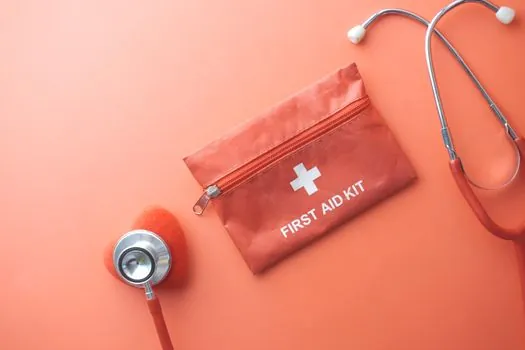
High-visibility blue and metal detectability together support HACCP programmes, with Mfasco's detectable-bandage category explicitly positioning the colour and metal content as tools to reduce product safety risk in food handling [S4]. First Aid Only states the blue colour "aids in the identification of visual contamination" on its plastic bandage SKU, framing colour as a detection channel independent of the embedded metal strip [S7]. The 3-shelf food services station from NorMed packages blue bandages and blue finger cots together in a 13.5"x16"x5.5" metal cabinet with door pouch, which is a typical mounting footprint for a wall station near a packaging line [S6].
For sites that need a forensic-grade chain of custody, the Detectamet dual-detect claim is the strongest documented option in this category, because the X-ray contrast layer survives when the metal detector is calibrated tightly enough to miss thin aluminium foil (a real failure mode in plants running high-frequency 100–300 kHz heads tuned for ferrous tramp metal only) [S9]. Specifiers writing a kit specification should require both properties on the datasheet rather than asking for "blue detectable" as a single attribute; vendors that only address colour or only address metal content are common, and the audit finding reads the same either way.
Selection criteria: who this product is for, and who it is not for
Blue metal-detectable plasters are specified for food and beverage processors, pharmaceutical and nutraceutical manufacturers, pet food plants, and any operation running in-line metal detection or optical sorting on a finished product stream [S1][S4][S7]. They are not the right pick for a general office ANSI Z308.1 Class A or B kit where there is no contamination risk to a sold product, because the 2–4x cost premium over a beige strip has no payback outside a food or pharma line. Blue dye also clashes with clinical colour-coding (blue is often reserved for "non-sterile" or "training only" in some hospital systems), so a healthcare-only facility should default to a skin-tone fabric strip instead.
Inside a food plant, the product class is also not a substitute for engineered machine guarding, sharp-edge replacement, or cut-resistant gloves; the plaster is the last line of defence after a wound has happened, not a prevention control. Treat it as a HACCP prerequisite programme (PRP) supporting element, and your auditor will accept it on that basis. For full HACCP context and the broader first aid kit requirement set, the first aid kit encyclopedia entry lays out how the detectable dressing slots into a complete kit specification.
Failure modes and operational limits
The first failure mode is calibration drift on the metal detector: a strip with a thin aluminium layer can be set to pass if the detector's sensitivity is dialled back to ignore "known good" product effect, and the dressing then ships in the bag. Counter-measure is to validate the detector with a test piece containing the actual bandage, not just a 2.0 mm Fe sphere from the standard test kit. The second failure mode is dye leaching: low-quality blue pigment can bleed onto the wound bed under heavy perspiration, which creates a staining complaint and a near-miss report. The Detectaplast waterproof range and the First Aid Only fabric SKU both position themselves against this with coated backing layers, but a small wear trial is still worthwhile before committing to a 1,500-count case [S1][S2].
A third limit is shelf life and adhesive tack under cold-room conditions; standard acrylic adhesive softens below about 5°C, so chill-room or frozen-food workers may see the strip lift within an hour, in which case a waterproof PE-backed SKU (Detectaplast, Detectamet) outperforms a basic fabric strip [S1][S9]. The Detectamet range is also the one to compare against when writing a detectability spec, because their dual-detect claim covers X-ray contrast that the metal-only SKUs do not address [S9].
Cross-reference: how this connects to broader industrial consumable specs
Blue metal-detectable plasters sit at the same engineering intersection as detectable warning tapes and detectable cable ties: a coloured visual signal layered on a metal or X-ray-dense substrate so a lost piece fails multiple inspection channels. For tape and barricade products, the comparable specification logic is laid out in Detectable vs Barricade Warning Tape: Spec, Placement, and Code Reality, and the same "colour + metal content" decision rule applies. A first aid kit for a food line is, in spec terms, a small-format detectable-consumable station, and the way an auditor reads the kit is identical to the way they read a detectable tape roll: prove detectability, prove colour contrast, prove traceability of the lot number on the case. [S4]
Track the next product change by watching the Detectamet catalogue refresh (their dual-detect X-ray-plus-metal construction is the most aggressive spec on the public market [S9]) and by watching whether ANSI/ISEA Z308.1 (the US first aid kit standard referenced by First Aid Only's site navigation) absorbs a food-service annex in a future revision. The 1,500/box case count and the 25/box retail refill are the two SKUs most likely to be re-priced if a food-safety rule change lands.
Component reference pages worth checking: metal material, and metal powder.
