Bucket elevator selection is driven by three engineering gates — material bulk density, lift height, and explosion-risk classification — and the four main structural variants (belt, chain, link-chain, continuous bucket) each occupy a defined operating envelope [S4][S1].
Selection mistakes most often trace back to one of three root causes: misjudging material form, ignoring bulk density above 1.6 t/m³, or omitting ignition-source monitoring on dust-handling units [S4][S3].
Defining the Unit: Belt, Chain, Link-Chain, Continuous
Bucket elevator is a vertical bulk-material conveyor whose buckets are fixed to a belt, chain, or link-belt and scoop product at the boot, discharging at the head [S1]. Four trade-named variants dominate procurement: belt bucket elevator, chain bucket elevator, link-chain bucket elevator, and continuous bucket elevator (also called multi-bucket / chain-bucket) [S1][S6].
Selection differs by lifting medium: belt units typically run lower speeds and suit non-abrasive granules up to medium capacity; chain and link-chain units accept higher tensile load and tolerate higher-temperature, abrasive, or denser material; continuous-bucket designs use closely spaced buckets on a single chain for high-capacity, gentle handling of free-flowing product [S1][S4].
Material Gate: Form, Density, Moisture, Abrasiveness
Selection starts with the material envelope: powder, granule, or small block, then its physical properties — adhesion, viscosity, moisture content — and finally its bulk density, with 1.6 t/m³ acting as the standard cut-off above which traction, transmission, and chain-tensile calculations must be re-derived from first principles [S4].
For high-density, high-abrasive ores, plate-chain bucket elevators using alloy-steel chain with controlled heat-treatment hardness remain the default specification [S5]. A dedicated bucket elevator reference consolidates these material-gate thresholds in one page.
Capacity, Lift Height and Speed Envelope
Capacity is set by bucket volume, buckets-per-metre, and belt/chain speed; lift height is bounded by the tensile rating of the lifting medium — belt elevators typically cap at shorter lifts, chain and link-chain units extend to tall cement, fertilizer, and grain terminals, and continuous-bucket units maximise throughput at the cost of head-room [S1][S4].
Head-pulley or head-sprocket diameter, boot design, and take-up type must all be re-checked whenever the calculated traction load rises by more than 20–25% above the catalogue baseline, otherwise belt slip or chain stretch becomes the dominant failure mode [S4].
ATEX, Explosion Monitoring and Safety Stack
Bucket elevators handling combustible dust — grain, flour, wood, plastic pellet, aluminium, sugar — sit inside ATEX category 1/2/3 zones depending on dust-cloud frequency, and ignition-source monitoring is treated as a primary safeguard, not an option [S3].
The Adix Spyline system, for example, continuously monitors belt turn, belt displacement, bearing temperature, jam, and power draw on each elevator leg to detect pre-ignition conditions before a dust explosion can propagate [S3]. Sizing a bucket elevator for a pressure transmitter / bearing-temperature loop is the easiest way to integrate this monitoring into a wider plant SCADA.
Selection Criteria — Side-by-Side
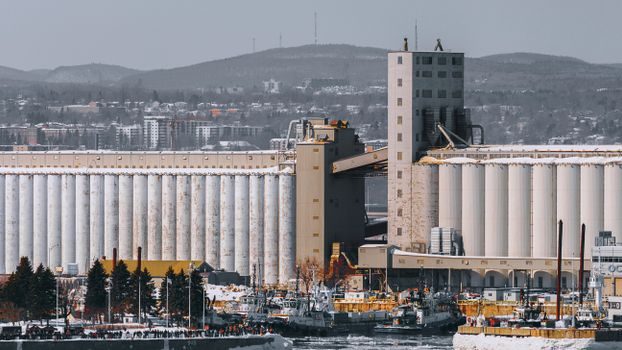
The four structural variants line up against decision criteria as follows. Belt bucket elevator: low–medium capacity, low noise, gentle on granules, limited lift height, simplest ATEX compliance. Chain bucket elevator: medium–high capacity, higher tensile rating, tolerates abrasive and hotter material, suited to cement and ore [S1][S5]. Link-chain bucket elevator: highest tensile rating, suited to very dense or lumpy material, heaviest maintenance. Continuous bucket elevator: highest throughput per footprint, gentle discharge, premium cost, complex head layout [S1][S6].
Cross-reference rules of thumb: stay with belt below 1.6 t/m³ and short lift; step to chain or link-chain when bulk density exceeds 1.6 t/m³, temperature exceeds the belt rating, or the duty cycle pushes past one shift; specify continuous bucket only when free-flowing product and a confined envelope justify the premium [S4].
Who Bucket Elevators Are For — and Who They Are Not For
Bucket elevators suit plants needing continuous vertical lift of dry bulk — grain terminals, cement mills, fertilizer plants, feed mills, plastic-pellet lines, foundries, and mineral-ore concentrators [S1][S2][S2]. They are a poor fit for wet, sticky, or stringy material that bridges inside the boot, for very low-throughput transfer points where a small industrial valve or airlock suffices, and for sanitary washdown duties where a linear guide-mounted pneumatic conveyor is the cleaner choice.
Foundry bucket elevators, for example, lift sand and prepared moulding mix on a separate duty cycle from the casting line, and suppliers in this segment quote MOQ of 1 piece against negotiable pricing on cast-steel heads and abrasion-resistant boots [S2].
Failure Modes, Maintenance and Sourcing Notes
The dominant failure modes are belt slip or chain stretch from under-rated traction, bucket deformation from impact loading, bearing failure from poor alignment, and — on dust-handling units — explosion propagation originating at a hot bearing or tramp-metal spark [S3][S4].
On link-chain bucket elevators, fatigue failure of the chain hook is documented as a recurring short-cycle failure mode driven by over-tension and undersized hook throat; failure analysis is the only reliable way to redrive the hook section [S6]. Routine vibration and bearing-temperature trending, integrated with the same SCADA that hosts a flow meter on the infeed, catches most of these in the wear-out phase.
For procurement, Chinese suppliers (Focus Machinery, foundry-machinery OEMs on Made-in-China, Okorder plate-chain vendors) typically quote CE-marked units, 1-piece MOQ on standard elevators, and 20 m / 9,999 m-per-month capacity on plate chain — useful as a capacity sanity-check when benchmarking delivery [S2][S5][S2]. The crossed-roller guide page covers the equivalent precision-actuator side of bucket-elevator boot alignment.
Track the next node by watching for: (a) updates to ATEX 2014/34/EU dust-handling guidance for bucket elevators in 2026, (b) any new OEM release of integrated belt-turn + bearing-temperature + power monitoring on a single controller, and (c) tightening of bulk-density cut-offs above the current 1.6 t/m³ benchmark in cement and ore duty [S3][S4].
For related coverage, see Cuplock Scaffolding Price & Cost Guide 2026: System, Top Cup and FOB Tier Map.