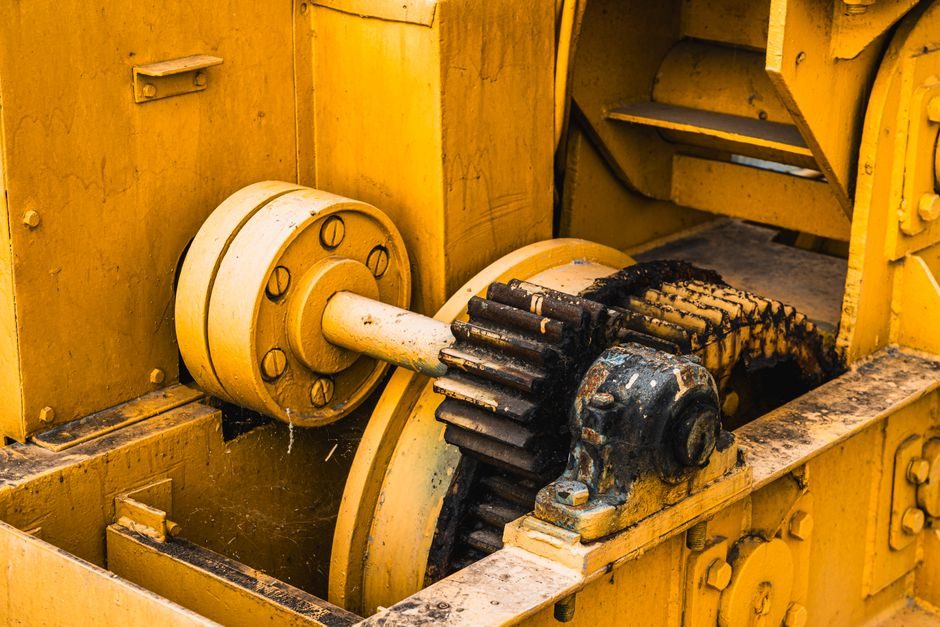
Harmonic drives use the elastic deformation of a thin-walled elliptical spline meshing against a circular ring gear with typically 2 teeth more, producing single-stage reduction ratios from 30:1 up to 320:1 in standard catalogue units [S2]. The strain wave generator rotates the elliptical spline, and because meshing occurs at both vertices of the ellipse, torque capacity roughly doubles versus a single-vertex concept of the same diameter [S2].
Standard harmonic reducer diameters span 8 mm to 350 mm with catalogue frame sizes in the 03/08/14/17/20/25/32/40/50/65 series; reductions are usually 30, 50, 80, 100, 120, 160, 200 or 320, and 100:1 is the most common catalogue ratio for industrial robot joints [S1][S5]. For comparison, the UHG100-2B from Harmonic Drive AG ships as a 100:1 unit in the 100 mm frame, with 100:1 listed on the used market at roughly USD 299 per unit [S5].
Three Internal Components and Why Ratio Gets That High
A harmonic reducer has three parts: a circular spline (ring gear) fixed to the housing, a flexspline (elliptical spline) that carries the output, and a wave generator with an elliptical cam and a thin bearing race that drives the flexspline [S2]. The flexspline has two fewer teeth than the circular spline, so each full rotation of the wave generator pushes the flexspline backward by exactly that tooth difference, which is why ratios of 50, 80, 100, 120 and 160 are achievable in a single stage with no multi-stage gear stack [S2].
The same three-port Simscape block (B = wave generator / base, F = flexspline / follower, C = circular spline) is also used in MATLAB/Simulink driveline models, with the same input/output labelling engineers use on real datasheets: input on the wave generator, output on the flexspline, fixed reaction on the circular spline [S2]. The block's default is non-rotating ring gear; selecting the ring-gear-rotation parameter enables a third port and switches the efficiency model from a Simple Gear to a Planetary Gear formulation, with thermal port option enabled by setting Friction model to Temperature-dependent efficiency [S2].
Selection Gates: Ratio, Torque, Speed, Backlash, Life
Selection should be data-driven, not catalogue-driven. Five gates filter a short list before price becomes a factor: (1) reduction ratio (must equal n_C / (n_C - n_E) given the tooth count difference, often 100:1, 120:1 or 160:1) [S2]; (2) peak and continuous torque at the output, in Nm, with a service factor of 1.0 to 1.5 depending on shock load; (3) input speed, with most catalogue units rated for 3000 to 5000 rpm continuous at the wave generator; (4) backlash class, commonly rated at less than 1 arc-minute (≤ 3 arc-min for economy, ≤ 0.5 arc-min for precision, zero-backlash as the design baseline) [S2]; (5) hysteresis and lost-motion, expressed in arc-min, which usually scales with size and ratio. Reading the harmonic reducer reference before shortlisting frame sizes prevents the common error of over-specifying ratio (320:1) when 80:1 or 100:1 is mechanically sufficient.
Layout is not a harmonic drive's strong suit: catalogues split into Coaxial (most common), Cycloidal (RV variant), Shunting and Expansion, and these describe the input/output shaft relationship rather than internal topology [S1]. Tooth-surface hardness is a different lever: hardened tooth surface is the default for industrial duty, soft tooth surface is reserved for low-duty or cost-driven assemblies [S1]. For higher-ratio needs beyond 320:1, two harmonics can be stacked, or the design can be paired with a planetary or servo drive stage to push ratios above 1000:1 with controlled inertia.
Comparison: Harmonic vs Cycloidal (RV) vs Planetary

Where the harmonic drive wins on zero backlash and compact form factor at ratios above 30:1, it loses on torsional stiffness and on continuous-torque density. A typical 25-frame harmonic at 100:1 delivers a few Nm continuous and a peak torque roughly 2 to 3 times that; a same-frame cycloidal (RV) reducer typically outputs 5 to 10 times the continuous torque at a higher stiffness, with backlash in the 1 to 3 arc-minute range and somewhat lower efficiency. Planetary reducers, including harmonic reducer alternatives such as strain-wave gearboxes, sit between these on ratio range and below them on backlash. [S1]
The pragmatic decision matrix for a precision joint or axis: pick harmonic when backlash is critical and ratio is above 50:1, when envelope is small, and when peak-to-continuous torque ratio is high; pick RV/cycloidal when continuous torque dominates, stiffness matters, and backlash under 1 arc-min is acceptable from a precision gear stage; pick planetary when ratio is below 30:1, cost per Nm is the main driver, and backlash tolerance is loose. The same rule of thumb generalises: harmonics are precision, RVs are power, planetaries are cost [S1][S2].
Materials, Lubrication and Failure Modes
The flexspline is a thin cup or hat-shaped spring steel, typically 300 series stainless or high-grade alloy spring steel, heat-treated to roughly 40-45 HRC, with a wall thickness scaled to frame size (about 0.2 to 0.5 mm on small 08-14 frames, 0.6 to 1.0 mm on 50-65 frames) [S2]. The wave generator's elliptical bearing is the wear-limited element: grease life at 3000 rpm continuous is usually 10,000 to 20,000 hours, with oil-bath or oil-mist pushing that to 30,000+ hours, which is why lubrication regime is a hard selection gate, not an accessory choice.
The dominant failure mode is fatigue cracking at the flexspline's major-axis crown, followed by wave-generator bearing brinelling and grease migration under elevated temperature. Operating temperature windows for the standard grease pack are roughly -10 °C to +80 °C; for low-temp or high-vacuum duty, a different grease (PFPE-based) is required. Misalignment at mounting is the leading cause of premature flexspline failure: the wave generator's elliptical cam has a typical deflection of 0.2 to 0.5 mm, and any runout or face-load beyond that accelerates tooth-flank wear dramatically. Where the application demands smooth linear motion downstream, the same caution applies to linear guide alignment, since harmonics in industrial robots almost always feed into a linear axis or a rotary joint coupled to a feedback stage.
Standards, Sourcing and Application Filters
Industrial sourcing for harmonic drives now clusters on two channels: a small number of high-precision Japanese and German first-tier brands (Harmonic Drive Systems / HDS, Harmonic Drive AG, Nidec / Shimpo) and a wider Chinese mid-tier supply base (Leaderdrive, Beijing Harmonic, etc.) with frame sizes 14 to 65 common and ratios 50, 80, 100 and 120 dominant on the Made-in-China product index [S1]. The same index lists R&D options of OEM, ODM, Own Brand and Others, plus business-type filters for Trading Company, Manufacturer/Factory and Group Corporation, with minimum order quantities and target prices quoted in USD/EUR/GBP/RMB/AUD/CHF/JPY/HKD/NZD/SGD/NTD at the inquiry stage [S1]. The Farnborough International Airshow 2026 (Hall 4, Stand 41141) is the next public airing of Harmonic Drive AG's precision gearbox line-up, and the company's German website carries matching CAD data and aerospace targeting language [S3].
Standardised duty ratings follow manufacturer conventions more than published ISO or IEC gearbox standards; the operative datasheet values are continuous torque, peak/emergency stop torque, rated input speed, no-load starting torque, hysteresis loss (arc-min), backlash (arc-min) and rated life (hours at rated load). For aerospace and medical applications, additional conformance to ISO 9001, AS9100 or similar is required, plus material traceability for the flexspline. Trade-in and used-market data points (e.g. UHG100-2B 100:1 at USD 299) sit well below new-unit pricing, but used units have no factory hysteresis or backlash certificate, so they are only acceptable for non-precision axes [S4][S5].
Selection sequencing that consistently ships: ratio first (decide 50/80/100/120/160/200/320 from kinematics), then continuous torque with a 1.25 service factor, then backlash class, then input speed and grease life, then frame size, then vendor. Application filters worth checking: industrial robot joints (high ratio, zero backlash, low duty cycle), semiconductor wafer handling (cleanroom grease, low particle emission), machine tool rotary axes (high stiffness, oil-mist lubrication), and aerospace actuator positioners (lightweight, CAD data, AS9100 traceability) [S3]. For projects where the harmonic is a downstream of a linear motion chain, the same spec discipline applies to crossed roller guide selection, where stiffness and flatness drive the next decision.
Linked Actuator and Coupling Context
When a harmonic reducer sits inside an electric linear actuator, the upstream selection of the drive, the load gate, the guidance path and the feedback device all change what the harmonic has to deliver. The companion guide on electric linear actuator selection: drive, load, guidance and feedback gates walks through that exact stack and is the most common place a harmonic stage shows up outside a robot joint. For the shaft coupling that bridges the harmonic output to a lead screw or pinion, the spec-driven map of seven core coupling families in shaft coupling selection: a spec-driven map of seven core families is the natural next read, because backlash, torsional stiffness and misalignment budget at that joint are set by the coupling, not by the reducer. [S2]
Trackable next signals: (1) the 2026 Farnborough International Airshow disclosure of Harmonic Drive AG's aerospace gearbox and CAD data set on Hall 4 / Stand 41141 [S3]; (2) the spread of Chinese mid-tier 100:1 units on Made-in-China with explicit OEM/ODM/Own-Brand R&D options, with quotes delivered inside 24 hours of an RFQ [S1].