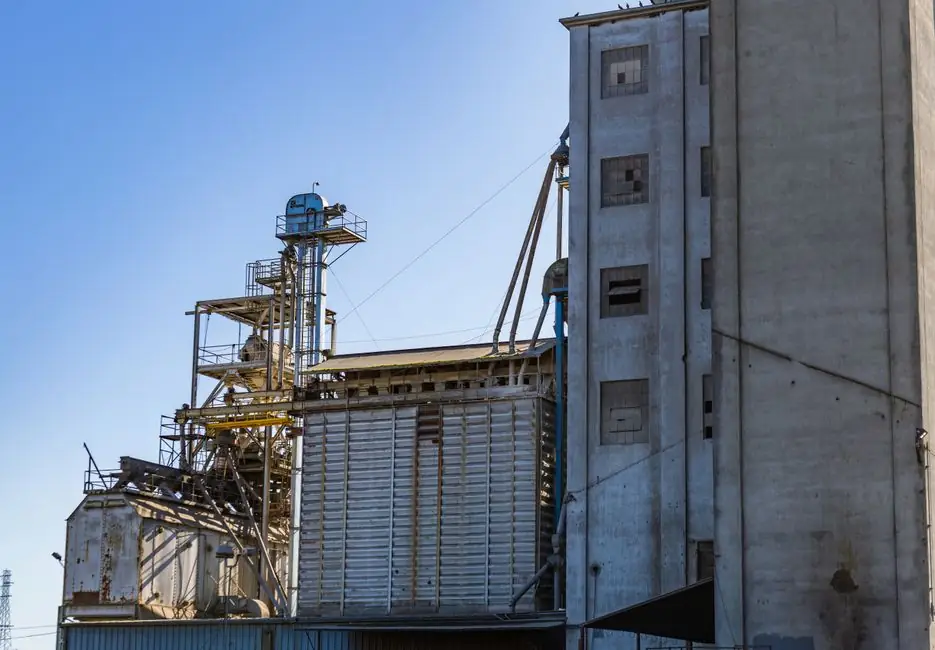
A bucket elevator moves bulk solids continuously on a belt or chain loop fitted with evenly spaced buckets, typically used for high-capacity, free-flowing materials such as grain, aggregate, and cement raw mix [S2][S8].
A skip hoist, by contrast, is an intermittent unit that lifts a single open-top bucket or skip car on twin cables, twin chain, or rope up a track or ramp, and is built for batch loading of mixers, furnaces, and weigh hoppers [S1][S3][S5].
Operating Principle and Material Flow
Bucket elevators are continuous conveyors: buckets are fixed to a belt or chain at a set spacing and pass through a boot (loading) section, a vertical casing (legs), and a head (discharge) section, with discharge typically driven by centrifugal force at speeds around 1.0-2.0 m/s or by gravity cascade at roughly 0.5-1.0 m/s [S2][S4].
Skip hoists work as reciprocating batch lifts: the bucket travels up the inclined or vertical track, tips automatically at the top, discharges, and returns for the next load, with a single load cycle typically in the 30-90 second range for mid-size industrial units [S3]. Direct-drive skip hoists eliminate overhead sheaves and use a frame-mounted drive plus twin hoisting cables on grooved drums, which the manufacturer cites as a way to extend cable life and reduce headroom [S3].
Capacity, Throughput, and Bucket Geometry
Bucket elevator throughput is a function of bucket volume, bucket spacing, and belt or chain speed, with the formula typically expressed in m^3/h at a fill factor of 0.75-0.85 for free-flowing materials [S2][S6]. Typical bucket volumes range from 0.5 L on small agricultural units to 50 L or more on heavy-duty industrial legs, and a single heavy-duty casing can reach several hundred t/h [S2][S8].
Skip hoists trade continuous throughput for a much larger single payload: skip bucket volumes of 0.3-5 m^3 are common, with cycle times that deliver roughly 20-200 t/h depending on bucket size, lift height, and hoist speed, well below a large continuous bucket elevator but high enough for batch-process duties [S1][S3]. For comparison, a bucket elevator running at 1.5 m/s with 10 L buckets at 250 mm spacing is the reference geometry most engineers start from [S2].
Construction Materials and Surface Treatment
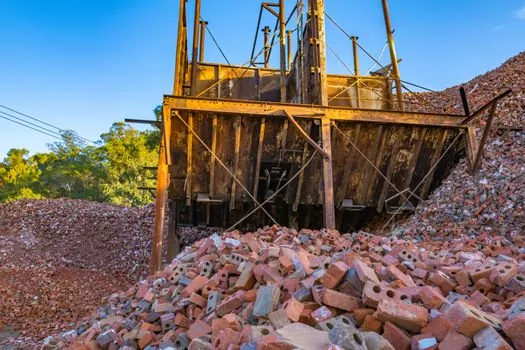
Standard bucket elevator construction is carbon steel with bolted buckets, and stainless steel (commonly 304 or 316) is selected for corrosive products, food-grade work, or aggressive chemicals; surface treatments for carbon steel include single-coat epoxy at 5-7 mil dry film thickness, with optional galvanizing, pickling, or passivation on stainless [S4].
Skip hoists from Gough Econ are built from mild steel or stainless steel, with steel-rope or twin-chain suspension selected by application, and the bucket is a discrete fabricated shell that can be lined, replaced, or reskinned independently of the hoist frame [S1]. The direct-drive design uses friction-free nylon roller bearings on a steel track to cut motor horsepower, with the manufacturer claiming a fraction of the power of competitive models at equal payload [S3].
Installation Footprint and Headroom
Bucket elevators need a full vertical casing with a boot pulley below ground or on a foundation and a head pulley at the discharge elevation, so headroom is set by the diameter of the head pulley plus discharge chute clearance; a tall, fully enclosed casing also means dust containment is integral to the equipment [S2][S4].
Skip hoists, especially direct-drive models, are framed structures sized only a few inches taller than the bucket in dump position, fitting into tight work areas and eliminating the deeper boot pit required by conventional designs, since the bucket tips back from the roller tracks in the loading position [S3]. This compact footprint is the reason skip hoists are common in retrofit plants, indoor mixer charging stations, and tight-headroom batch lines where a belt conveyor incline would be too long or a full bucket elevator would not fit.
Duty Cycle, Maintenance, and Safety
Bucket elevators run continuously, so wear items are belt splice, buckets, pulleys, bearings, and the take-up system, with zero-speed switches commonly fitted to the boot shaft to detect slippage or bucket jamming and to alarm before catastrophic damage [S4]. Backstop devices and belt alignment switches are typical on the head section to prevent reverse rotation on power loss.
Skip hoists run intermittently, so the dominant wear items are the hoisting cables or chain, the bucket rollers, and the track, with cable life extended by grooved drums that prevent cable climbing [S3]. A safety brake that holds the bucket in case of power failure is standard, and integrated track pins hold the bucket at a service height so rollers can be greased without lowering the load onto personnel [S3].
Selection Criteria: Which Equipment Fits the Job
Specify a bucket elevator when the duty is continuous, the material is free-flowing or gently degradable, capacities are tens to hundreds of t/h, and a tall enclosed casing is acceptable; centrifugal discharge suits free-flowing fines, while continuous discharge suits friable, aerated, or lumpy material [S2][S4].
Specify a skip hoist when the duty is batch, the load must be lifted into a single point such as a mixer inlet, blast-furnace charging ramp, or weigh hopper, headroom is constrained, and an inclined or vertical track is preferable to a fully enclosed leg [S1][S3][S5]. Skip hoists are also the cleaner answer for large, irregular lumps or for containerized charges, where a continuous belt of small buckets would be wasteful or impractical [S1].
For process lines that already use a chain conveyor or mesh-belt conveyor for horizontal transfer, a bucket elevator is the more natural match for the vertical leg, while a skip hoist is the more natural match for batch pre-weigh or pre-mix charging.
Limitations and Common Failure Modes

Bucket elevator limits are well known: the belt is the weakest link and a single splice failure can drop the entire leg, drum lag on the boot pulley can cause slippage, and backflow at the boot floods the casing; for very abrasive materials, bucket lip wear dictates the maintenance interval, not the belt [S2][S4].
Skip hoist limits are mechanical and structural: cable stretch, chain elongation, roller bearing wear, and track alignment drift; overloading the skip bucket is a common user error because the bucket volume looks large, and the hoist motor and brake are sized for a rated payload, not for a heaped load [S1][S3]. The direct-drive design partially mitigates this by mounting the drive inside the frame and lowering the center of gravity, but the rated payload remains the binding constraint.
For an extended comparison of casing and boot design choices that affect these failure modes, see Bucket Elevator Boot Section: Function, Failure Modes, and Specification.
Standards, Sourcing, and Specification Checkpoints
Common industry checkpoints for vertical conveying equipment include CEMA (Conveyor Equipment Manufacturers Association) for bucket elevator dimensions and capacities, FEM (Fédération Européenne de la Manutention) for hoist duty classification, and ISO 5048 for continuous mechanical handling equipment, with project-specific add-ons such as ATEX 2014/34/EU for dust-explosion zones, food-grade 3-A or EHEDG for sanitary lines, and NACE MR0175 for sour-service applications when applicable. [S4]
For a skip hoist, check the rated payload in kg, the lift height in m, the bucket volume in L or m^3, the hoist speed in m/s, motor kW, duty cycle class (FEM 1Bm, 2m, 3m, etc.), and the brake rating; for a bucket elevator, check the leg cross-section, belt or chain pull, pulley diameters, bucket spacing, take-up travel, and the zero-speed and alignment switches [S1][S3][S4]. Material of construction (mild steel, 304 SS, 316 SS), surface treatment (5-7 mil epoxy DFT, galvanizing, passivation), and any dust-explosion rating are the three specification items most often left out of inquiry RFQs and most often caught at the factory acceptance test.
Trackable signals to watch: OEM datasheets confirming twin-chain skip hoists above 5 t payload remain a standard offering through 2026, and centrifugal-discharge bucket elevator legs above 300 t/h continue to ship with 3-ply or steel-cord belts as the default carcass, per current manufacturer literature [S1][S3][S4].