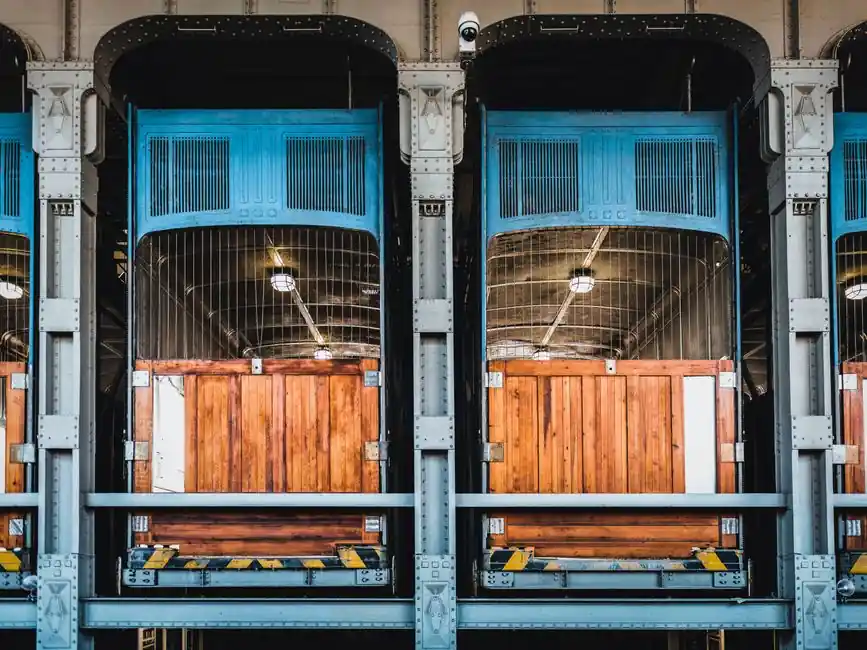
The boot section of a bucket elevator is the bottom enclosed casing that receives bulk material, houses the boot pulley or sprocket, and contains the take-up assembly used to set belt or chain tension [S2][S3].
Buckets physically push through a material pile inside the boot, which is why the boot is the primary wear zone and the most common source of unplanned downtime on a bucket elevator; a single broken bucket in the boot can cascade into spillage that overloads the take-up and stalls the drive [S3].
Anatomy of the Boot: What Is Inside the Lower Casing
The boot section integrates four functional elements in one welded or jig-welded housing: the receiving inlet, the boot pulley or sprocket shaft, the adjustable take-up screws or jacking mechanism, and clean-out doors for spillage and broken-bucket removal [S2][S4]. Manufacturers such as FEECO describe the boot as a horizontally and vertically heavy-reinforced, jig-welded section built to withstand both impact loading and the constant abrasion of buckets digging through the material pile [S2].
Material enters from a dump pit, drag conveyor, or auger inlet and forms a boot pool that buckets scoop from; the deeper that pool grows, the more aggressively the buckets "dig," and the faster boot liners and bucket lips wear [S3][S5]. On Martin catalog elevators the boot is offered with either a boot take-up (take-up at the bottom) or a head take-up (take-up at the top), and the choice changes how the boot is machined and accessed during commissioning [S5].
Why the Boot Drives Most Bucket-Elevator Downtime
A flooded boot, where feed rate exceeds the bucket carrying capacity, is singled out as one of the most common causes of mechanical failure in grain legs and industrial legs alike [S3]. Excess material in the boot rides back up on the return run, fouls the take-up, increases belt stretch, and forces the drive to pull a heavier load than it was sized for [S1][S3].
Wear in the boot is not gradual; because each bucket pushes through the material pile rather than scooping from a static surface, lip deformation, bolt-hole elongation, and casing liner erosion accelerate non-linearly with throughput [S1]. Belt and chain stretch is normal, and the take-up is the only field-adjustable component that restores proper tracking, which is why Schlagel's installation manual requires the boot to be "fastened securely on a suitable foundation and shimmed to level in all directions" before take-up travel is even measured [S4].
Boot vs Head: How the Two Sections Split the Work
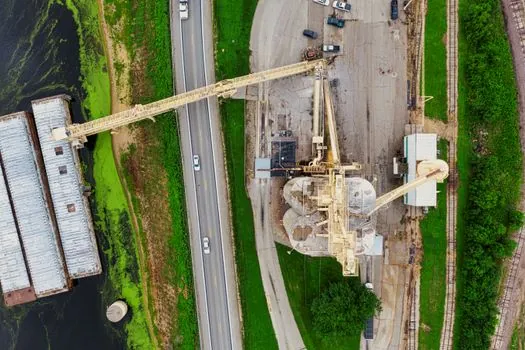
The boot is the loading and tensioning station; the head section at the top is the drive and discharge station, and the two are engineered as a matched pair rather than independent components [S2][S3]. On a centrifugal elevator running 225 to 300 ft/min with capacities up to 5,000 ft³/h (around 150 tons/h), the head pulley flings material out centrifugally while the boot must deliver a clean, consistent scoop on every pass [S1].
On continuous-discharge elevators, which run at roughly half the belt speed of centrifugal units, the boot feed geometry becomes even more critical: closely spaced buckets and gentler fill mean the boot pool height and inlet velocity must be tuned to the slower scoop rate or the elevator will underfill [S2]. This is also why boot take-ups are common on continuous and super-capacity elevators, where chain stretch over long shaft centers must be taken up from below to preserve bucket-to-casing clearances [S5].
Boot Selection Criteria: Capacity, Material, and Maintenance Access
Three specifications dominate boot selection on a new build. First, throughput class: standard, high-speed grain, super capacity, or mill duty, each of which Schlagel rates up to 60,000 BPH (bushels per hour) for the largest legs and which Martin segregates into distinct catalog series with different boot reinforcements [S4][S5]. Second, abrasion regime: mill-duty boots for cement, rock, fertilizer, lime, gypsum, coal, and fine ore service use heavier liners and AC-style buckets that resist the impact of dense, sharp material digging in the boot [S5].
Third, take-up style and access: a boot take-up gives more total tension travel for chain-driven legs but requires side-access clearance for the adjusting screws, while a head take-up keeps the boot geometry simpler at the cost of longer tension reaction paths [S5]. FEECO adds removable access doors on the boot specifically so operators can clear a plugged inlet or extract a broken bucket without cutting the casing open [S2].
Common Boot Failures and the Field Signals That Precede Them
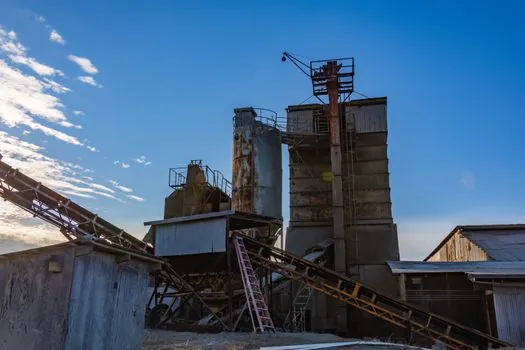
The boot is where the first symptoms of an unhealthy elevator show up. Uneven take-up screw travel on one side indicates the boot is racking out of level, usually because the foundation shims have settled since installation [S4]. A persistent spillage trail under the boot casing means the inlet is overfeeding or the casing seal between the inlet spout and the boot face has worn, both of which load the return run with carryback [S3].
On chain-driven super-capacity legs, audible slap on the up-run, coupled with the take-up running out of travel, is a textbook sign of chain pitch elongation starting in the boot where the chain first engages the loaded buckets [S5]. Monitoring belt alignment, speed, bearing temperature, and material plugging in the boot with standard instrumentation is a cost-effective way to catch these conditions before they cascade into head-section damage [S1].
Sourcing, Standards, and Installation Discipline
No single ISO or ASME standard governs the boot section as a discrete assembly; instead, manufacturers publish installation and operation manuals that lock down the boot as part of a "standard leg installation" alongside foundation, splicing, and safety-device requirements [S4]. Schlagel explicitly states the bucket elevator is a self-supporting design and is not intended to carry any additional equipment hung from the boot or head, a rule that frequently gets violated on retrofit projects [S4].
For grain service, the boot is typically sized to the same BPH rating as the rest of the leg (commonly up to 60,000 BPH on industrial units), and Martin recommends a backstop on every bucket elevator regardless of which section carries the take-up [S4][S5]. The closest related engineering reference for a buyer is the belt conveyor take-up literature, since the boot take-up functions on the same gravity-and-screw principle even though the loading is vertical rather than horizontal.
For buyers comparing elevator classes, the practical next step is to request the OEM's boot take-up travel number (in inches) and the boot inlet spout dimensions with the inquiry, because these two figures constrain both the allowable feed-rate envelope and the foundation footprint; both are listed in the Schlagel IOM and the Martin catalog sections covering elevator dimensions [S4][S5]. A useful cross-reference for the chain-driven super-capacity case is the round link vs bush vs plate chain bucket elevators: selection reference guide, which maps chain pitch elongation behavior directly to boot take-up duty.