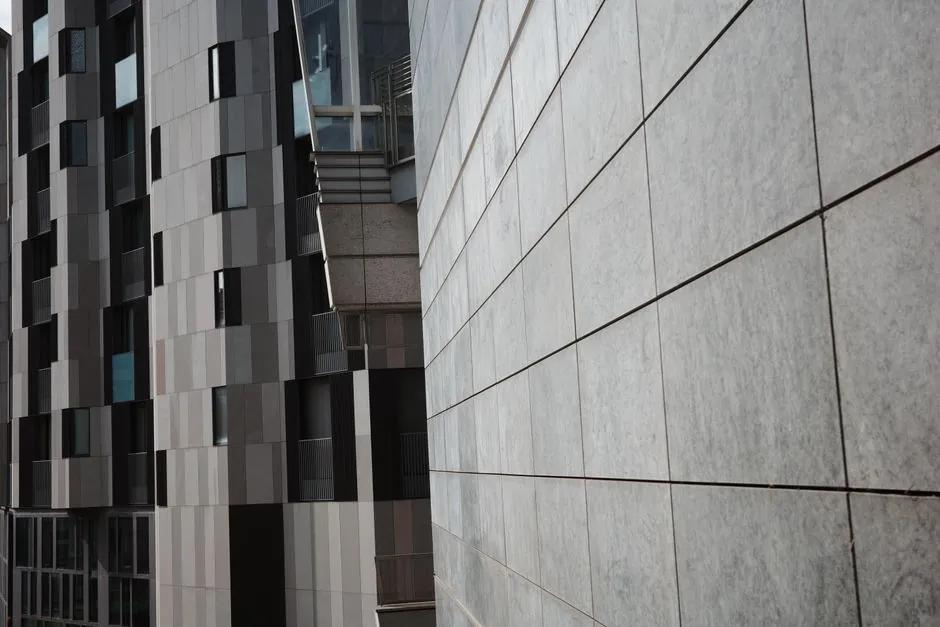
Porcelain slabs and panels are available in large formats that reduce the need for joints and create a sleek, seamless finish.
Natural stone can remain in service for a lifetime when protected and maintained, whereas porcelain removes routine sealing requirements and offers consistent appearance across multiple surfaces [S1][S4].
Lifespan depends on material, detailing, and exposure
Natural stone includes marble, granite, travertine, and limestone, and each has different porosity, hardness, and staining behavior [S1]. Natural stone is quarried from the earth, and each piece is unique in pattern and tone, with that natural variation contributing to its appeal.
Porcelain is a manufactured, non-porous product made from refined clay, sand, and minerals fired at high temperatures [S1][S4]. The service-life figure is a product claim rather than a universal guarantee.
The practical lifespan is not a fixed number attached to one material. It is the result of substrate movement, fixing design, edge protection, water management, freeze-thaw exposure, impact damage, cleaning chemistry, and the quality of installation. A correctly installed detail can protect either material from avoidable early failure.
Porcelain cladding outperforms stone in routine exposure
Porcelain’s non-porous body resists water and stains and does not require sealing. Natural stone is generally more porous and may need sealing to limit moisture penetration and staining [S1][S4].
Large-format porcelain can be used for wall cladding, shower walls, feature walls, floors, countertops, splashbacks, and furniture surfaces [S2][S4][S5]. The reduced number of joints changes both aesthetics and maintenance, because fewer grout lines mean fewer joints to clean and fewer interfaces where appearance can differ [S2][S5].
For the broader technical properties of the base material, the ceramic tile reference covers the product family, while the industrial flooring reference provides a different performance and installation framework for high-wear floor zones.
Natural stone delivers longevity with material-specific care

Natural stone is quarried material, so every piece differs in pattern and tone, and matching replacement pieces across a large elevation may be difficult [S1].
Porcelain slabs are engineered from refined clay, sand, and minerals and fired at high temperatures to create a dense, durable material. Thin porcelain panels, however, remain dependent on correct substrate flatness, adhesive selection, handling discipline, and perimeter detailing. A 6 mm slab is not equivalent to a 20 mm countertop product merely because both are porcelain [S3][S2].
Natural stone remains appropriate where the project values geological variation, repairable mineral surfaces, or an established architectural identity. The trade is maintenance: sealing, stain response, and the possibility of etching or scratching with softer stone [S1][S2].
Large formats change joints, logistics, and waste
Porcelain slabs support design intentions involving thin profiles, consistency, and continuity across countertops, backsplashes, walls, and outdoor kitchens. The available thickness range across porcelain slabs and panels extends from 3 mm to 20 mm [S3].
ANSI defines a gauged porcelain tile panel or slab as ceramic tile at least 1 square meter in area; products below 1 square meter are classified simply as tile [S3]. This distinction matters because fixing strategy, handling, edge protection, and fabrication requirements depend on both size and thickness.
Cladding selection by application and site exposure

For external cladding, porcelain offers low absorption, stain resistance, and large-format applications.
Natural stone provides a quarried origin and natural variation in pattern and tone. Porcelain provides consistent color and pattern, lower routine maintenance, and continuity across floors, walls, and counters.
For rainscreen and anchorage decisions, Set Stone Rainscreen Anchor Spacing by Loads provides a separate load-based framework for natural-stone rainscreen work.
Porcelain versus natural stone: decision comparison
Porcelain provides the stronger option for low absorption, no routine sealing, controlled appearance, and large-format continuity, while natural stone provides the stronger option for geological variation, established quarry supply, and potentially centuries-long service in well-maintained details [S1][S3][S4].
Environmental impact does not follow the service-life claim alone

Natural stone has a lower manufacturing environmental footprint than porcelain in the comparison published by the Natural Stone Institute [S6]. Porcelain can still reduce lifecycle impact through long service, low maintenance, and less replacement activity, but embodied manufacturing impacts must be evaluated separately from installed longevity [S2][S6][S7].
Large formats also reduce joints and can lower modular installation waste by up to 15 percent [S2]. That figure concerns layout efficiency, not a guaranteed project saving, because cuts, damage, fabrication tolerances, and site logistics still determine the final waste rate.
For an environmental review, record the selected tile or slab thickness, expected replacement interval, adhesive and mortar quantities, reinforcement requirements, water-management design, and end-of-life pathway. A claimed 75-year porcelain lifespan [S3] should not be converted into a universal carbon saving without an equivalent assessment of the natural-stone alternative.
Specification checks before ordering cladding
Specify the exact product, thickness, finish, exposed edge treatment, substrate, fixing or adhesive system, joint treatment, and wet or exterior detailing rather than approving a generic porcelain slab or stone designation. Confirm whether the project requires stone, porcelain, or a hybrid system and obtain samples from the production lot used for fabrication [S1][S3].
For porcelain, verify manufacturer installation data for the selected thickness, supported edge conditions, substrate tolerance, adhesive coverage, and handling requirements. For natural stone, record the stone type, porosity, sealer system, edge detailing, anchorage, and replacement availability. The building stone reference is useful for separating stone type and performance questions from the engineered porcelain specification.
The next trackable decision point is the mock-up and installation method statement: accept the material only after the panel size, joint pattern, edge build-up, substrate preparation, and exposure conditions have been demonstrated together. That check is more reliable than selecting a service-life number before the wall assembly is defined.