
Interior stone or faux-stone cladding should be specified by its documented reaction-to-fire class, with ASTM E84 Class A covering a flame-spread index of 0–25 and European classifications adding smoke and droplet suffixes [S2][S4].
The classification applies to the interior wall finish, while walls near a property line may require a separate one-hour fire-resistance construction [S1].
Separate surface burning from fire resistance
ASTM E84, commonly known as the tunnel test, measures how far and how fast flames spread across the surface of a test sample. Its reference scale runs from 0 for inorganic reinforced cement board to 100 for red oak, with Class A at 0–25, Class B at 26–75, and Class C at 76–200 [S4].
The commonly used ASTM E84 flame-spread classifications are Class I or A with a 0–25 FSR, Class II or B with a 26–75 FSR, and Class III or C with a 76–200 FSR [S4].
These values describe surface burning of the tested finish, not resistance to a fully developed fire. A one-hour wall classification is an assembly performance obtained under a separate fire test, so a Class A finish cannot be treated as proof of a one-hour wall [S1][S4].
Match the classification to the cladding type
Natural stone, concrete, and metal typically fall into European Class A1 because they are treated as non-combustible, while treated composites require evidence for their own class [S5].
Flexible stone panels can differ by formulation. Most faux-stone panels use polyurethane, which is combustible unless a specific tested version is ordered, and a decorative panel should never be described as fireproof merely because it resembles stone [S2][S3].
For comparison, Class A has a flame-spread index of 0–25, Class B covers 26–75, and Class C covers 76–200 [S4]. Stone, concrete, and metal are normally A1 under EN 13501-1, treated composites may reach A2 or B, and untreated wood is commonly Class D or E before treatment [S5].
For projects outside the United States, an aluminum veneer panel or stone-faced system must be checked against EN 13501-1. The classification must cover the exact product construction, substrate, and surface treatment rather than a generic stone category [S5].
Use the suffix to compare European ratings
EN 13501-1 adds smoke-production classes s1, s2, and s3, plus flaming-droplet classes d0, d1, and d2 to the principal reaction-to-fire class [S5].
The suffix s1 denotes low smoke production, which is critical in hotels, hospitals, schools, and transport hubs [S7].
Natural stone may qualify as A1 without a separate s1,d0 suffix because A1 is the highest non-combustible class. A treated composite or faux-stone panel with a B or A2 main class should be evaluated on its complete designation, including the suffix and test report [S5].
Verify the exact tested product
For an ASTM E84 classification, request the complete test report for the exact panel being supplied and verify the tested construction and its achieved flame-spread results; an installation address or the words fire-rated must not replace documentary evidence [S2][S3].
For EN 13501-1, the document should identify the product name, exact construction tested, substrate, achieved class, and test date. A certificate for a similar panel or related product range is not evidence for the specified item [S5].
Stone veneer can also carry an ICC-ES listing identifying a particular fire-rated version and its permitted application. One listed interior-use Class B product carries ESL-1247, so the listing should be checked for both classification and use restriction rather than copied into a general specification [S1].
Check installation limits and assembly design
Fire rating and exterior weather resistance are separate acceptance checks. A panel may carry Class A performance while lacking UV stability for outdoor exposure, and many interior-only fire-rated versions are not approved for exterior use [S2].
For building stone veneer, confirm the tested substrate, adhesive or mechanical support, joint treatment, backing, and wall assembly. The finish classification does not establish the complete wall's fire resistance, and walls close to a property line may require a one-hour rated construction [S1].
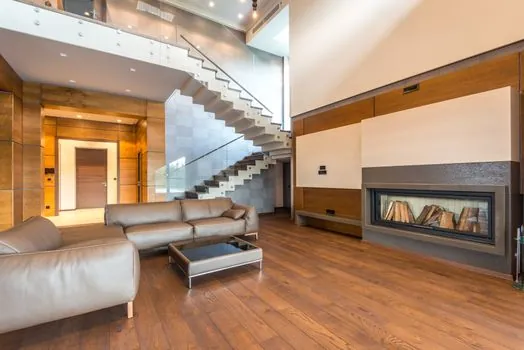
No stone or faux-stone finish should contact an open flame, embers, or a direct heat source. Maintain the fireplace or stove manufacturer's required clearances and apply the local code requirements for combustible materials [S2].
Make the specification auditable
A compliant submittal should state the cladding product, substrate, ASTM E84 or EN 13501-1 classification, complete index or suffix data, report identifier, and permitted indoor or outdoor use. It should also identify any required one-hour wall assembly separately [S1][S2][S5].
For material selection, brick or tile are generally Class I materials, while the fire performance of natural stone is not specified; faux stone panels may be combustible unless independently tested to a Class A rating under ASTM E84. The decisive distinction is between tested surface performance and tested wall construction, not between “stone” and “faux stone” labels [S3][S5].
The next procurement check is the supplier document package: confirm the exact product, test standard, classification, smoke and droplet suffix where applicable, installation restriction, and assembly evidence before releasing the cladding specification.