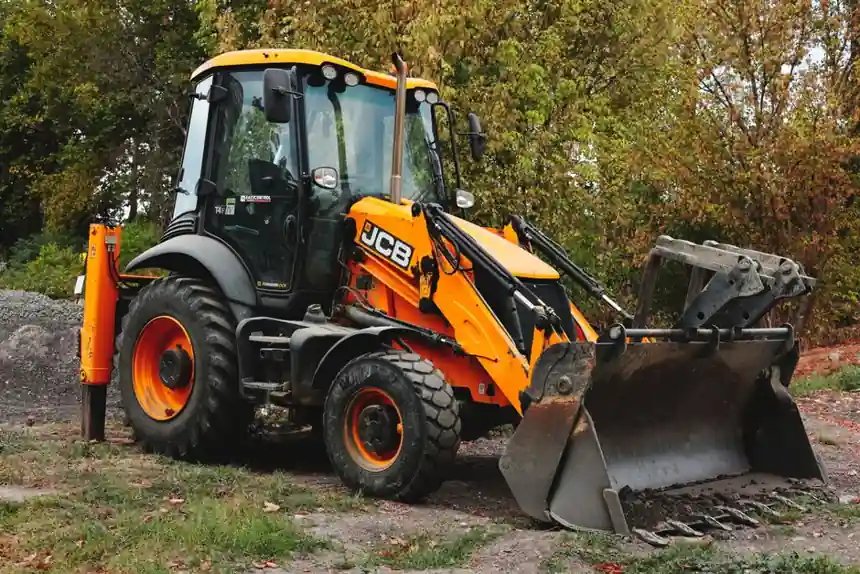
Wheel loader bucket capacity should be calculated from the target payload, loose material density, expected fill factor, bucket weight, and rated load, not from a volume label alone.
A 3.0 m³ bucket illustrates the risk: the same volume weighs about 4.26 tonnes in dry loose sand and 5.52 tonnes in wet sand at a 100% fill factor [S3].
Separate Volume, Payload, and Rated Load
Bucket capacity is volume, usually stated in cubic metres or cubic yards, while payload is mass. One cubic metre equals approximately 1.308 cubic yards [S3]. Rated bucket capacity establishes volume under a specified rating method, but it does not state how much mass the loader may safely carry.
Four variables must remain separate: bucket volume, actual fill factor, loose material density, and the loader's rated operating load. Bucket weight and the full-turn tipping-load limit also constrain the allowable configuration [S3]. A bucket can therefore be physically large enough to hold the required material yet unsuitable for the machine's load rating.
For the machine families covered in the wheel loader category, a 5,000 kg loader is offered with buckets from 2.7 to 4.0 m³, while comparable 5,000 kg machines also appear with 3.0 m³ buckets [S3]. This range shows why class name or rated payload alone cannot determine bucket size.
Calculate the Required Bucket Volume
Use this calculation for the required theoretical capacity: [S1]
<strong>Required bucket volume (m³) = target payload (t) ÷ [loose material density (t/m³) × expected fill factor]</strong> [S3].
For a target payload of 20 t in material with a loose density of 1.50 t/m³ and an 85% fill factor, the required capacity is 20 ÷ (1.50 × 0.85) = 15.69 m³. The calculation estimates volume, so bucket weight, loader operating weight, and tipping stability must still be checked against the selected configuration.
Cat's productivity method reaches the same result through a different sequence: divide the loose cubic metres required per cycle by the bucket fill factor to determine the bucket size needed [S5]. For estimating the mass carried, the alternative expression is:
<strong>Estimated bucket load (t) = bucket capacity (m³) × loose material density (t/m³) × fill factor</strong> [S3].
Choose a Fill Factor That Matches the Material
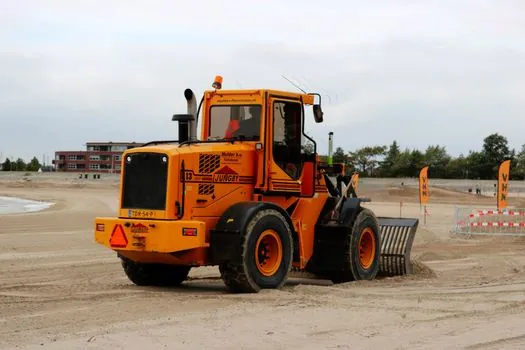
Fill factor corrects nominal volume for material shape, packing, spillage, and the practical ability to fill the bucket. Published excavator guidance gives 100–110% for loose soil, 90–100% for clay, and 80–95% for rock [S2]. These are planning factors, not guarantees of the material actually retained in every pass.
A nominal 3.0 m³ bucket filled at 90% contains 2.70 m³ before accounting for spillage, while a 2.7 m³ bucket filled at 100% contains 2.70 m³ under the simplified method.
The comparison should be made on delivered volume and payload rather than on the largest advertised bucket. For example, at the same density and fill factor, a 3.0 m³ bucket carries 11.1% more nominal volume than a 2.7 m³ bucket. Whether that advantage is usable depends on whether the added mass remains within the loader's rated load and tipping-load envelope.
Check the Configuration Before Ordering
A safe bucket selection requires more than matching a target volume to a loader model. The check must include rated operating load, bucket mass, operating weight, full-turn tipping load, tire and counterweight configuration, linkage, and the exact attachment arrangement. Published comparison data show a SANY SYL956H5 rated at 5,000 kg with 2.7–4.0 m³ buckets and a 10,700 kg full-turn tipping-load figure, while a LiuGong 855H rated at 5,000 kg is listed with a 3.0 m³ bucket and an 11,100 kg tipping load [S3].
Those figures are model-level references, not automatic approvals for every production variant. Bucket type, tires, linkage, counterweight, coupler, and emissions package can change the operating configuration [S3]. The supplier's exact configuration data and the machine's data plate should therefore govern the final selection.
For a replacement or used bucket, the fitting dimensions also need to be recorded: lower/outside pin-hole diameter, upper/center pin-hole diameter, the center-to-center spacing between them, inside bucket height, depth, and width [S4]. A matching volume does not compensate for incompatible pins, linkage geometry, or an unsuitable adapter arrangement.
Verify Physical Capacity When Dimensions Are Known
A wheel loader bucket is not a rectangular box. Its volume can be estimated by dividing the interior profile into sections, calculating the area of each section, adding those areas, and multiplying the resulting cross-sectional area by the bucket length [S1].
The heaped portion depends on the material's angle of repose. SAE terminology cited for wheel loader buckets uses a general 2:1 heap ratio, compared with a typical 1:1 slope for a hydraulic excavator bucket [S1]. The procedure draws the interior outline, establishes a baseline from the spillboard to the cutting edge, adds the heap triangles, and then calculates the cross-section [S1].
This geometric estimate is suitable for checking a bucket whose shape must be approximated. Where an OEM capacity rating exists, use the rated figure for fleet comparison and the geometric calculation as a cross-check, because the measurement convention, included heap, and bucket geometry can otherwise differ.
Match the Bucket to the Loading Cycle
Bucket selection is an operating decision, not only a payload calculation. If the loader feeds haul trucks, the target may be a required loose volume per cycle rather than a fixed tonnage. Cat defines the sizing step as dividing loose cubic metres per cycle by the bucket fill factor [S5]. The result must then be matched to the truck body, loading height, travel distance, and required number of passes.
A larger bucket is not automatically more productive. Added capacity can increase cycle time, reduce machine stability, increase tire loads, and exceed the allowable payload. Material density, operator technique, travel surface, stockpile shape, and the receiving vehicle all affect the number of effective passes.
For a mixed fleet, two buckets can be rational if one supports higher-volume production and another addresses a lighter-density or space-constrained operation. The articulated steering and wheel loader stability comparison covers another relevant variable because machine geometry changes how bucket mass and payload affect operating stability.
The defensible workflow is to calculate required volume from target tonnes, density, and fill factor; round up to a purchasable bucket size; subtract or otherwise account for bucket mass; and compare the resulting load with the exact loader rating and tipping data. Record the intended material and fill factor beside every capacity figure, because a bucket selected for 15.7 m³ of loose material may be unsuitable for the same machine when handling wet, dense, or cohesive material.