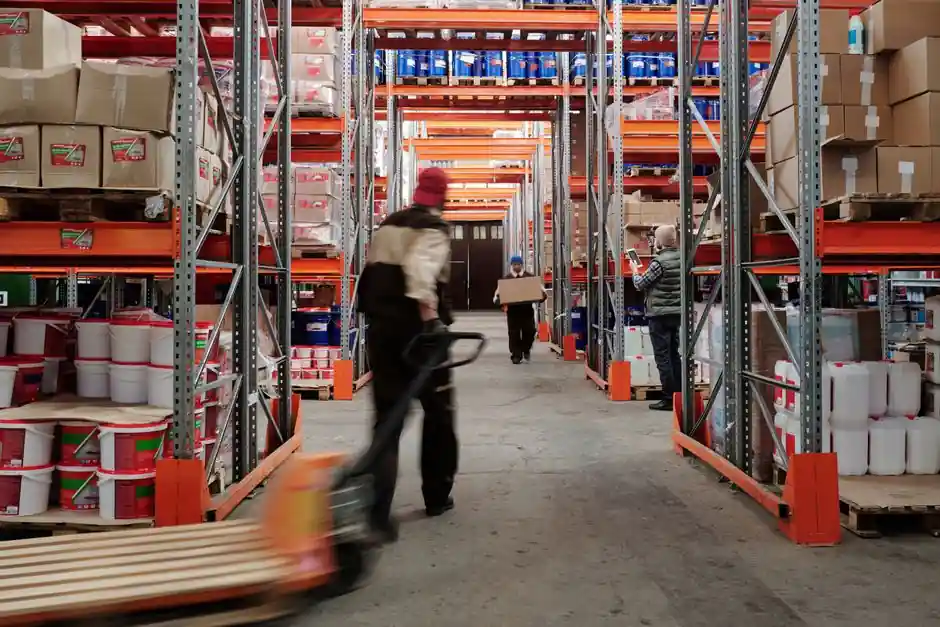
Cantilever rack stores 50 ft-plus bar stock with no front uprights, while selective pallet rack requires bars to be cut or bundled to a standard pallet footprint before they can be loaded, a constraint that drives most of the engineering difference between the two systems [S2].
For steel service centers, metal fab shops, and any operation holding 12 ft and longer round, square, or hex bar, the open-front arm design is the decisive spec; selective rack is restricted to short off-cuts bundled onto pallets or in pallet rack wire decks. Cantilever's structural and roll-formed variants cover light to heavy duty, with structural systems specified for tall, high-capacity applications above typical light-duty range [S2].
Load Geometry Is the First Spec Filter
Length, depth, weight per tier, and handling method must be locked down before arm length, upright height, or brace spacing are chosen, because cantilever ratings are published as a Uniformly Distributed Load (UDL) across all support arms on a level [S3]. The standard capacity check is straightforward: Total Weight per Level divided by Number of Arms equals Required Arm Capacity, so a 3,000 lb lumber bundle on three arms requires each arm rated for at least 1,000 lb UDL [S3]. The same UDL rule is what kills naive selective-rack retrofits: a pallet of 20 ft bars concentrates point load at the beam ends, far outside the UDL envelope a pallet rack beam is rated for.
Deflection is the second geometry test, and it is the one most often skipped. Place the longest bar or bundle over two supports, observe whether the material sags at mid-span, and if it does, add a third or fourth arm on that level to spread the UDL; ignoring deflection permanently warps the inventory and overstresses the outer arms [S3]. Cantilever is also the only rack type with effectively no upper length limit on a single load, with structural systems designed for 50 ft-plus load lengths where conventional lift trucks are still used [S2].
Arm Style and Pipe Stops for Round Bar
Straight arms with a slight upward pitch are the default for flat, stable loads such as plate, sheet, skids, and bundled rectangular bar, while inclined arms with an upward angle are the correct pick for cylindrical materials including round bar, tubing, pipe, and conduit, because the angle prevents roll-forward during loading and retrieval [S3]. Pipe stops, removable pins set at the outboard end of each arm, add a positive physical barrier and are the safety accessory most often specified when round bar shifts during forklift cycles [S3].
Selective pallet rack cannot replicate any of this. A standard pallet beam pair forces the load to fit a 42 in or 48 in deep pallet footprint, and the front upright frame blocks any product longer than the beam-to-beam span, which is why bar stock longer than about 8 ft on a standard beam is universally a deflection or protrusion problem, not a capacity problem. Where a small quantity of short bar off-cuts does need to ride a pallet, a plastic pallet with welded wire decking keeps the bundle from migrating, but that is a cut-length operation, not a long-bar storage operation.
Upright, Base, and Anchoring Rules
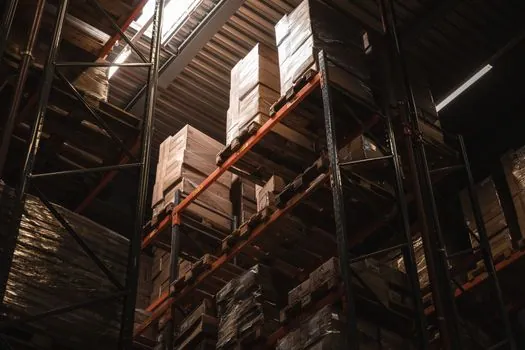
Heaviest loads belong on the base level to keep the center of gravity low, every cantilever rack must be bolted to a level concrete floor through the pre-drilled base plates, and the rack must remain free-standing; bolting a cantilever upright to a wall transfers lateral load into a non-engineered building element and damages both the rack and the structure [S3]. The components that differentiate a properly specified cantilever are the base (which anchors the system and counterbalances asymmetric long-load weight), the upright column (single- or double-sided, with a punched hole pattern for arm height adjustment), the arms themselves, horizontal and diagonal braces between uprights for lateral rigidity, and optional decking for short or flexible inventory [S2].
Selective rack has the same base-and-anchor logic, but the failure mode is different: an overloaded or poorly anchored selective beam pair is more likely to beam-disconnect under forklift impact than to overturn, which is why manufacturers publish separate beam-capacity, frame-capacity, and seismic-anchor tables. For mixed-load rooms that store both bundled bar on pallets and long bar on cantilever, the safer pattern is a dedicated cantilever bay with its own pallet rack aisle adjacent, not a hybrid where cantilever arms share uprights with a beam level.
Decision Matrix: Cantilever vs Selective for Bar Stock
The decisive criteria, drawn from the comparison work in the industry literature, line up as follows [S1][S4][S5]:
Best fit for product type: cantilever is rated "excellent" for steel, pipe, lumber, and long materials, while selective pallet rack is rated "excellent" for boxes and palletized loads, and "poor" for long products, lumber, pipe, and steel [S5]. Front access: cantilever is completely open, selective is limited by the front upright frame [S5]. Forklift access: both are rated excellent, but cantilever allows side-loading of long stock without beam interference [S5]. Capacity cost: cantilever is more expensive per linear foot than selective because the base, heavier upright, and arm material add cost versus a beam-and-frame selective cell, but the per-foot premium is offset by reduced product damage and faster retrieval of long stock [S1][S7]. Storage density: selective wins on a pure cubic-foot basis for uniform pallet loads, cantilever wins for long-load rows where selective cannot accept the product at all [S1][S2].
Use selective pallet rack when the bars are cut to length, bundled, and palletized, the SKU count is high with frequent rotation, and the forklift fleet is standard counterbalance or reach. Use cantilever when any bar exceeds about 8 ft, when the load is round or irregular, when retrieval speed on long stock matters, or when the yard stores pipe, tubing, structural steel, or lumber alongside bar [S3][S4][S5].
Handling, Safety, and Standards Anchors
Both rack types must be engineered to a recognized rack standard and installed to the manufacturer's anchor and bracing tables, with periodic inspections by a qualified person; the cantilever guide language above on heaviest-loads-at-bottom, UDL capacity, and floor anchoring is consistent with the published RMI / ANSI MH16.1 family of specifications for steel storage racks, which governs selective and cantilever systems alike. Cantilever-specific guidance calls out that the open-front design removes the protruding beams that selective operators frequently strike with forklifts, which is one reason cantilever installations are described as generally safer for long-load operations in industry comparisons [S10].
For operations running forklifts alongside cantilever, a pallet stacker or electric pallet truck can handle short, bundled bar on a cantilever base level, while a sit-down counterbalance forklift is the standard match for loading inclined-arm cantilever bays holding 20 ft and longer bar. The same fleet usually services the adjacent selective aisle, and the two systems are routinely co-specified in steel service centers and metal-fab warehouses, with cantilever for the bar and structural stock and selective for the boxed fittings, fasteners, and palletized consumables [S1][S5].
Cost, Lead Time, and Procurement Notes
Cantilever per-foot cost is higher than selective because of the heavier base plates, structural or roll-formed uprights, arm hardware, and the labor to install and anchor each arm location; selective is cheaper per bay for plain pallet positions [S1][S7]. The price gap narrows once the project values reduced product damage on long stock and faster crane-free retrieval, and it can flip when long-stock damage on selective is priced in [S7]. Procurement for cantilever should fix arm length, arm pitch, upright height, base plate dimensions, finish (painted or hot-dip galvanized for outdoor yards), and the UDL per arm, with the deflection test called out as a hold point in the PO [S3].
Watch for two telltale signs that a supplier is selling a selective rack into a long-bar application: 12 ft or longer product sitting on a beam with no center support, and a cantilever quote that omits UDL arm capacity and brace spacing on the submittal drawing.
Trackable next signals: a structural-cantilever quote with hot-dip galvanized base plates and drilled concrete anchors specified, and a deflection test pass on the longest bar SKU before sign-off.
This topic is covered further in Extending or Rerouting an Existing Overhead Conveyor Loop.