An existing overhead conveyor loop can be extended, reconfigured, or rerouted on site because the underlying chain families (X-348, X-458, X-678 rivetless, plus enclosed-track and I-beam components) are built as a modular bolt-together system rather than welded assemblies [S6].
Modular overhead systems already cover roughly 6,480 ft of installed loop in single distribution-center projects, so an additional 10-30% capacity expansion is a routine change order rather than a rebuild [S2].
Why Overhead Conveyor Loops Are Designed to Be Modified
Forged rivetless chain with X-348 (T-shaped link), X-458 (straight link), and X-678 (heavy straight link) connection geometry is the dominant standard for overhead conveyor construction, which is why a new straight, curve, or track drop-in section from any OEM in the family mates to an existing run without re-engineering [S6].
Modularity also extends to track profile: standard 3 in., 4 in., and 6 in. high-carbon I-beam monorail sections and Jervis Webb Unibilt enclosed track share the same installation orientation, hanger spacing, and drive interface, which is why additions and reroutes can be specified against an existing drawing set [S4].
Three Extension and Reroute Scenarios That Work in Practice
Scenario 1, simple loop extension: add a straight section plus a matching return curve at the loop end. Capacity gain is limited only by drive unit horsepower and chain tensile rating, not by track style, because all three chain families (X-348, X-458, X-678) share the same coupling logic [S6].
Scenario 2, branch re-routing: install a new curve section and a divert trolley, then tie the new branch back into the original loop via a power-and-free switch. This is the same approach used when installation crews needed to make quick on-site changes and re-routing of overhead conveyors at a 6,480 ft distribution-center build [S2].
Scenario 3, vertical lift addition: insert an elevator or spiral lift module to drop product to a second-level packing zone, with no need to break the existing loop seal. Spiral lifts can be added to an existing track because curve sections and elevator in-feeds share the same trolley wheel interface as horizontal runs [S3].
Who Can Extend a Loop vs Who Should Start Over
An existing loop is a good candidate for extension or reroute when the chain, trolleys, drive, and take-up have less than roughly 50% of their wear life consumed, and the structural supports (ceiling beams, mezzanine framing) have spare capacity for the additional dead and live load [S1].
Extension or reroute is the wrong call when the existing system runs hand-pushed chain (no onboard drive provision), when the original chain family cannot be cross-matched to a current supplier, or when the load per carrier exceeds 250 lb (115 kg) on Unibilt enclosed track, which is the published per-carrier ceiling for that family [S4].
Comparison of Common Overhead Conveyor Types for Modification Work
On modification suitability: enclosed track (Unibilt-style) is rated up to 250 lb per load, accepts shorter-radius curves (tighter floor print during a reroute), and is sealed against contamination, making it the easiest family to extend in a clean environment [S4]. I-beam monorail uses 3 in., 4 in., or 6 in. high-carbon I-beam, accepts heavier per-carrier loads, and is open to the atmosphere, so it handles corrosive dip-tank and paint-line reroutes but requires more frequent track inspection [S4]. Power-and-free (two-track) overhead conveyors are the only option that supports accumulation and zone-stop behavior during a partial shutdown, which matters if a reroute must be done on a live line [S3].
For a working reference of the underlying track and carrier system, the overhead conveyor encyclopedia entry covers the standard X-348, X-458, and X-678 chain family, I-beam profile options, and Unibilt enclosed track dimensions. Where the reroute crosses process baths, ovens, or robotic cells, the overhead bridge crane entry is a useful sanity check for structural-support assumptions that the new track will impose on the building.
Structural, Drive, and Control Constraints During a Reroute
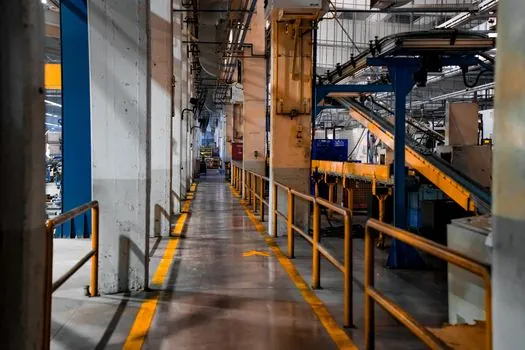
Every added foot of track adds dead load: an X-458 chain weighs roughly 3.0-3.5 lb/ft depending on pitch, so a 200 ft extension adds 600-700 lb of moving mass that the existing drive motor, gear reducer, and take-up must absorb [S6].
Control-side, adding a branch or re-routing requires new sensor stops, divert confirmation switches, and possibly an updated PLC program; the new I/O typically rides on a sensor extended I/O block or a remote rack on the existing fieldbus, which keeps the wiring change scoped to the new section [S3].
For predictive life on the modified line, modern systems layer vibration and load monitoring on the drive and take-up shafts to flag chain stretch, trolley bearing wear, and uneven load distribution before a failure occurs, which is especially useful after a structural change [S7].
Standards, Safety, and Common Pitfalls
Conveyor modifications are typically governed by the same OSHA 1910.219 mechanical-power-transmission rules and ANSI/CEMA B20.1 safety standard that applied to the original install, with any new guarding, e-stop, and lockout-tagout provisions extended to the added sections at the same level as the existing line [S1].
The most common pitfall in an extension is mis-matched chain pitch: a new X-348 section cannot be coupled into an existing X-458 loop, even though both look similar, because the link geometry and pin diameter differ. The second most common pitfall is hanger spacing: original supports were laid out for the original loading, and longer spans will sag under a heavier or more frequent carrier pattern [S6].
For background on the engineered chain and trolley standard that ties the whole question together, see the overhead conveyor reference page; for the structural framing implications of adding new hangers and curves, the overhead bridge crane entry covers support-beam and runway sizing in more detail.
Trackable signals to watch over the next reporting cycle: a clear uptick in distribution-center re-routing projects, more standardized predictive-maintenance retrofits on existing X-348 / X-458 / X-678 lines, and a measurable share of conveyor extension quotes that are won by integrators offering modular add-on sections over full system replacement.
Component reference pages worth checking: sensor extended.
Related analysis: Stainless Steel Procurement Pulse: BHEL SS Wire Award, Consumer Price Floors, and India....