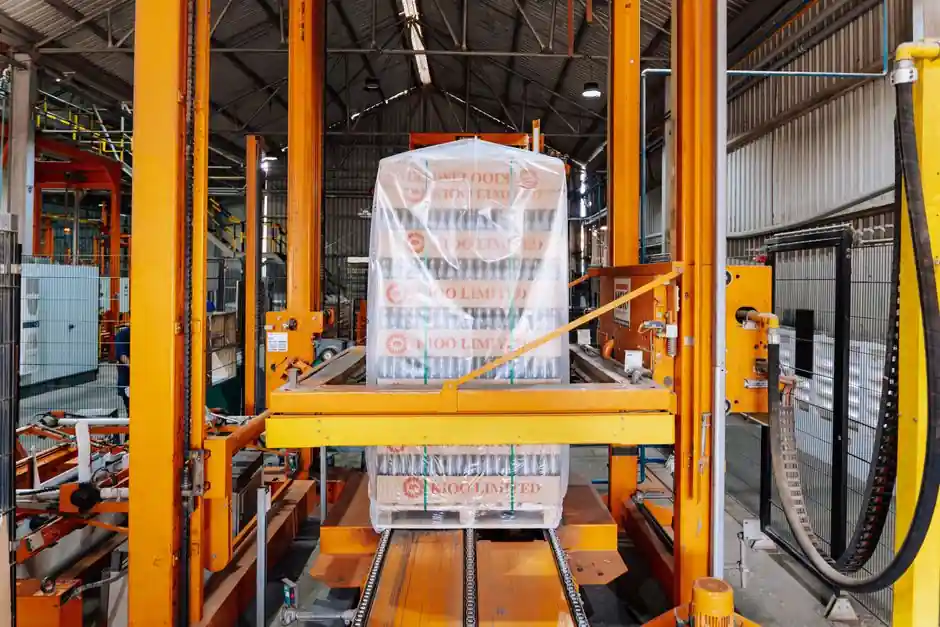
Minimum case size must be checked against case style, product orientation, pack count, gripper or drop geometry, conveyor clearance, and sealing requirements, with machine speeds ranging from under 10 to over 75 cases per minute across side-load systems [S2].
Minimum case size is a machine-specific envelope
These dimensions are not a market-wide limit for every case packing machine.
A smaller case may fit through a conveyor or form an acceptable RSC, yet still fail because the product layer, guide rails, case flaps, gripper travel, or discharge geometry cannot accept it. Buyers should therefore separate the minimum shipping case from the minimum case the complete machine can erect, load, and seal [S8].
The comparison is straightforward: a wrap-around design needs sufficient panel-forming and closure geometry, a side-load design needs a workable product-entry plane, and a top-load design needs sufficient vertical movement and gripper clearance. The architecture changes the limiting dimension, so a single L × W × D threshold cannot be transferred between machine types without an OEM drawing [S4][S8].
Dimension definitions must be fixed before testing limits
Case length is the dimension in the direction of travel through the machine, width is perpendicular to travel, and height is the vertical dimension; these definitions prevent an L × W × D quotation from becoming ambiguous [S3]. For primary packages, specify carton length, width, and depth in the same orientation used at infeed [S3].
A 24-count 3 × 4 × 2 example means 3 packages along length, 4 along width, and 2 layers in the height direction, giving the pack pattern a direct dimensional consequence for the minimum case [S3]. Round containers require diameter and height instead, while label direction and the desired view when the case is opened can constrain orientation [S3].
The minimum case should also be tested against product presentation, not measured in isolation. A small case may be physically capable of receiving one product while remaining unsuitable for the requested pack count, layer orientation, flap closure, or downstream handling [S4][S8].
Compare case packers by the limit that governs them

Side-load systems slide or push horizontally oriented products into an erected case, making infeed width, case depth, product length, and pack-layer geometry more important than the same limits would be for top loading [S4]. Brenton offers top-load, side-load, and robotic automatic case packers, as well as automatic case-packer add-ons [S2].
Top-load systems place product from above through pick-and-place, drop, or gravity-assisted methods, making vertical clearance and gripper travel central to small-case feasibility [S4]. Hamrick’s drop packers load rigid glass, metal, and plastic containers and operate at 15 to more than 60 cases per minute [S7].
Small cases suit rigid products, but not every product mix
A compact case is a suitable target when it contains regular rigid containers, has a repeatable pack pattern, and remains easy to grasp, close, and discharge. The drop-packer format specifically addresses rigid glass, metal, and plastic containers, and its published operating band is 15 to more than 60 cases per minute [S7].
The same architecture is a poor fit for fragile, irregular, wet, sticky, slippery, hot, cold, frozen, liquid, or wobbly products unless the machine has suitable handling and settling controls [S3]. Product weight also matters: buyers must define whether goods are heavy or light, whether the pack is stable or soft, and whether ambient temperature and humidity create handling changes [S3].
Small cases create additional downstream risk because every case repeats the same dimensional weakness. A narrow case can restrict labeling, inspection, palletizing, storage, and later case opening, even if the carton erecting machine handles the blank without damage. The minimum case should therefore be evaluated as a complete handling system, not a packaging-machine accessory.
Throughput and minimum size must be tested together
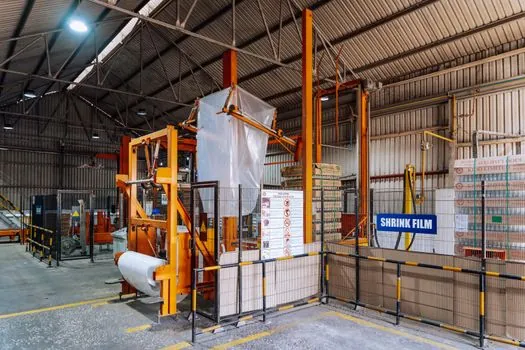
Hamrick’s drop packers load rigid containers and operate at 15 to more than 60 cases per minute [S7].
The required capacity should be stated in packages per minute, including whether upstream product arrives as a steady stream or in surges and gaps and whether more than 1 upstream machine will feed the packer [S3]. Pack count per case also affects effective rate, so 24 units per case and 2 units per case create different case-per-minute requirements at the same product rate.
Changeover can become the practical minimum-size constraint. SKU number, pack pattern, case dimensions, and format changes must be included in the acceptance test, because a machine can meet steady-state speed while losing production time during adjustment [S4]. For multiple SKU families, the case packer changeover cost and number of adjustable parts should be documented before purchase.
Sealing and product settlement affect small-case limits
The case must close after loading, so flap interference is a direct minimum-size risk. Brenton’s A7 settler and agitator uses controlled vibration to avoid over-packing so the top flaps can close without product interference, illustrating that successful closure depends on settling behavior as well as case dimensions [S2].
Small RSCs also create orientation risk because the manufacturer’s joint can contribute to product-loading jams; its position must be agreed with the OEM relative to the loading direction [S3]. Glue or tape sealing adds another acceptance condition, and the configuration must identify whether the case is wrap-around, horizontal, top-load, bottom-load, left-hand, right-hand, inline, perpendicular, or counterflow [S3].
For the smallest cases, sealing geometry should be tested with the actual blank or case, not inferred from product volume. The practical lower limit exists only when case formation, product loading, settling, closure, sealing, and discharge all work together at the required rate. Sealing can be integrated downstream through a dedicated capping sealing machine only where the mechanical interface and product-transfer sequence are defined.
Build the OEM test around the smallest real case

Request the proposed minimum and maximum case dimensions, units of measure, permitted product range, pack count, and arrangement from the supplier, then test the smallest production case rather than a nominal sample [S8]. The evaluation should include minimum and maximum case dimensions, the number of products per case, and the required arrangement [S8].
Five acceptance observations are practical: the smallest case forms correctly; all products enter the intended count and orientation; flaps close without interference; the case seals; and discharge remains stable at the specified rate [S4][S8]. If the minimum case also contains the lightest or least stable pack pattern, use that combination as the conservative test condition [S3].
Two public benchmarks provide useful reference points: 101.6 × 101.6 × 152.4 mm minimum case dimensions for the cited wrap-around machine and 15 to more than 60 cases per minute for rigid-container drop packers [S5][S7]. They are comparison data, not universal acceptance criteria, and any purchase should close with a signed dimensional and rate test using the actual SKU set.