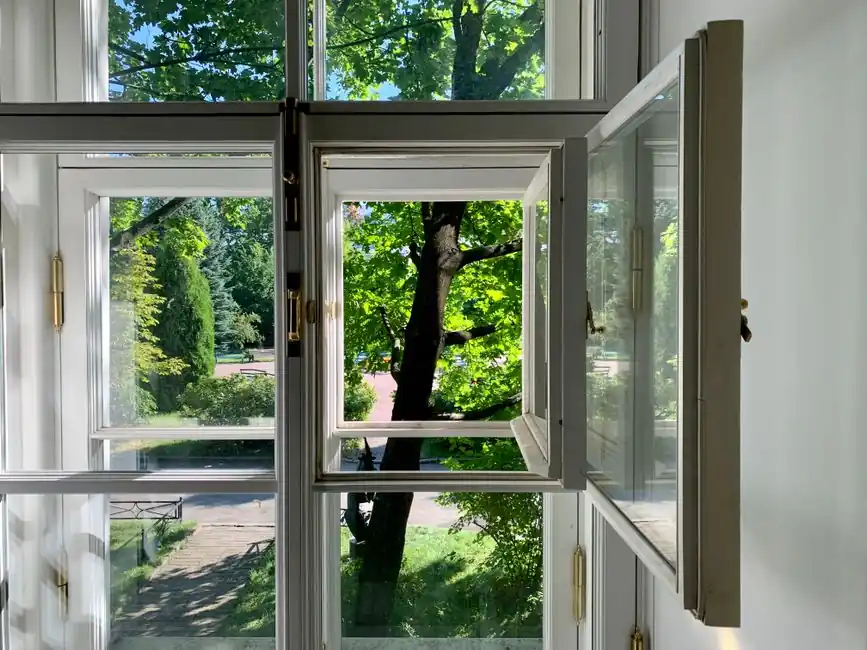
A tilt-and-turn window uses one handle to control two inward-opening modes, with the sash pivoting from the bottom to open inward at the top or swinging fully inward like a door, whereas a casement swings outward on side hinges using a crank mechanism [S1][S2][S5].
The decision affects ventilation, cleaning, locking, sash capacity, installation space, and hardware cost. Tilt-and-turn is stronger where controlled airflow, interior access, and coordinated perimeter locking matter; casement fits simpler outward-opening or space-constrained installations [S2][S5].
Compare the Two Hardware Actions
A tilt-and-turn sash has two mechanically linked movements controlled through a handle, gearbox, corner drives, hinges, and locking points. In tilt mode, the sash pivots from the bottom and opens inward at the top, while the turn mode swings the sash fully inward like a door [S1][S2].
A casement has one side-hinged movement. An outswing opens outward through a crank or push-out lever, while an inswing opens into the room. Its hardware can include hinges or friction stays, a handle, restrictor, and single-point or multi-point locking [S2].
The linked action of a tilt-and-turn package makes the complete hardware set part of the window design, not a collection of interchangeable handles. Sash dimensions, glass weight, profile, and local safety requirements must all match the selected configuration [S2].
Ventilation and Cleaning Drive the Choice
A tilt-and-turn window provides two useful ventilation states rather than one. Tilt mode provides limited ventilation while the sash remains connected, and the separate turn mode allows the sash to swing fully inward [S2][S4].
An outswing casement can provide greater immediate airflow because the full sash is available to the wind. That benefit does not make the partially open position equivalent to a tilt-and-turn tilt: in tilt mode, the sash remains locked at the sill, whereas a partially released casement depends on a stay or friction mechanism and loses perimeter compression [S4].
For apartments, hotels, schools, and upper-floor rooms, the tilt mode supports controlled ventilation without a fully released sash. The turn mode is valuable where both glass faces must be cleaned from inside, particularly above ground level where ladders create avoidable risk [S1][S2].
Locking, Weather Performance, and Security
A tilt-and-turn window can use coordinated multi-point locking around the sash, with one published example locking at 4–8 points [S2][S5]. This pulls the sash against a continuous compression gasket and supports more uniform closure than a basic single-latch casement.
Casement security is not automatically weak. The relevant specification is the locking hardware and complete tested window, not the product category.
These figures describe specific glazing and frame combinations, not a universal performance level.
For any project, compare the exact sash under the project’s wind, water, air, and security conditions. Hardware changes can alter compression and force paths, so a product category alone cannot establish performance [S2].
Sash Size, Glass Weight, and Clearances
Hardware capacity must be checked before the opening style is selected. The cited Reynaers MasterLine 8 tilt-and-turn configuration supports a maximum sash of 9 ft 2 in and 441 lb, while the cited European casement range is 110–397 lb [S5]. A larger opening position does not compensate for an undersized hinge, gearbox, or operator.
Tilt-and-turn turn mode requires clear space inside the room for the sash to swing toward the occupant. Casement outswing avoids that internal obstruction, although exterior space, screen placement, and safe service access must be considered. A casement with the insect screen inside can conflict with the outward-opening sash, while an outswing may require exterior screen placement [S5].
For large glass, specify the hinges, stay or operator, locking points, reinforcement locations, and maximum dimensions as one assembly. Do not scale a residential hardware schedule into a heavy commercial sash without checking the manufacturer’s size and weight limits [S2][S5].
Installation, Maintenance, and Total Cost

A tilt-and-turn system coordinates two opening movements from one handle, whereas a casement system can use a simpler hardware arrangement [S1][S2].
Published market pricing places tilt-and-turn windows at $400–$1,300 each and casement windows at $300–$1,000 each [S1]. These are broad retail ranges, not engineering estimates. A project comparison should separate sash and frame cost, hardware set, operator, screen, installation labor, internal clearance, and any structural reinforcement.
For example, a same-size comparison on one aluminum system found an outswing casement and a tilt-and-turn unit at equal cost up to 36 in wide, but that is a specific estimator observation rather than a universal rule [S5].
Specify by Use Case, Not by Window Name
Choose tilt-and-turn hardware when the project requires controlled background ventilation, indoor access to both glass faces, or coordinated multi-point locking. Specify it for upper floors, apartments, hotels, schools, and rooms where occupants need two opening modes and security during partial ventilation [S1][S2][S4].
Choose casement hardware when outward airflow is the priority, interior swing clearance is unavailable, or a familiar crank-operated action is required. It is also the practical choice where exterior maintenance access is acceptable and the project favors a simpler hardware arrangement [S2][S5].
Do not use casement hardware for tilt-and-turn operation, or specify a tilt-and-turn package by appearance alone. Request the manufacturer’s hardware schedule, allowable sash dimensions and weight, operating sequence, locking-point layout, and test evidence for the complete window. The selection should close with an approved sample or mock-up proving the handle movement, sash clearance, locking engagement, and service procedure.