Industry cold-storage flooring guidance explicitly flags tile as unsuitable for freezer floors, with cold rooms typically operating at -20°F or lower, a regime in which "standard flooring materials, such as untreated concrete or tile, crack and degrade" [S1].
For a building spec, that means the question is not "which tile for the floor" but "which floor system replaces tile," and, separately, how to store ceramic tile inventory correctly inside or adjacent to the cold envelope. The two questions share the same ceramic-tile product line but live on opposite sides of a spec: one rejects the material, the other depends on it.
Why Standard Ceramic Tile Fails as a Cold-Storage Floor
Standard flooring materials such as tile crack and degrade under cold-storage conditions, and flooring that lacks thermal shock resistance is prone to uneven expansion and contraction during defrost cycles or when cleaned with hot water or steam, leading to cracks and delamination [S1]. Tile's low tensile strength across grout lines also makes it vulnerable to the point loads from pallet jacks, pallet riders, and ASRS shuttles that move through a typical freezer [S3]. The reference floor detail in cold-storage construction is a polyurethane-insulation slab sandwiched between a top concrete wear layer and a lower concrete subfloor, typically over a one-foot gravel bed, with PVC underfloor heating lines to keep the subgrade from freezing [S4].
Replacement Floor Systems: PU Concrete vs. Epoxy, vs. Tile
Polyurethane (PU) concrete is the most-cited replacement for tile in cold rooms: "PU is the most common type of flooring used in cold storage facilities because it is seamless, extremely hard-wearing, and temperature/thermal shock resistant" [S2]. PU concrete expands and contracts at a rate similar to the concrete substrate, which is the property tile-and-grout cannot match [S1]. Epoxy is a cheaper, easier-to-install alternative for areas with stable temperature and no routine thermal-shock wash-down, but it is described as "not as thermally resistant as PU concrete, so it's best suited for cold storage areas with stable temperatures" [S1][S2]. A third option, urethane concrete, is recommended by Duraamen specifically for the "sudden temperature" swings in freezers [S7].
Comparison across the three options on the criteria that govern cold-room service:
Thermal-shock resistance: PU concrete and urethane concrete are rated for it; standard epoxy is rated for stable-temperature zones only; ceramic tile with cementitious grout is not rated for it [S1][S2][S7]. Load and forklift traffic: all four systems can accept heavy traffic, but only PU/urethane concrete and reinforced epoxy survive the dynamic point loads of pallet riders without joint failure [S1][S3]. Hygiene and cleanability: PU, urethane concrete, and seamless epoxy are non-porous and bacteria-resistant; ceramic tile's grout joints are porous and a documented hygiene weak point in food/pharma cold rooms [S1][S2]. Installed cost and downtime: epoxy is generally "more affordable and easier to install than PU concrete, though it may require more maintenance" [S1].
Cold-Storage Floor Design Drivers Beyond the Surface
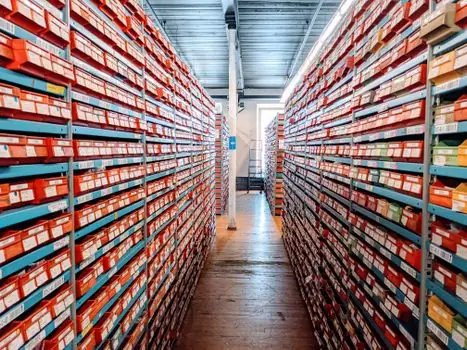
The floor system is part of an envelope, not a finish, so the spec is set by upstream variables: subfloor heating, vapor barrier, insulation thickness, and rack/equipment loading. A treated wooden thermal break lines the slab perimeter to block cold-air transfer through the slab edge, and a plastic visqueen vapor barrier sits between the insulation and the subfloor to stop moisture migration into the insulation [S4]. Underfloor defrost heat is typically piped as PVC loops carrying warm ambient air, with electric and glycol-pump variants also in service [S4]. For racked facilities, the concrete floor has to be engineered for the constant point loads of upright pallet racks, which "provide constant pressure on the floor," distinct from the dynamic loads of forklifts and ASRS equipment [S3]. The more automated and the heavier the racking, the more the floor's joint count, joint detailing, and slab thickness dominate the spec conversation [S3].
When Ceramic Tile Is the Product, Not the Floor
Ceramic tile, as a stored product, has its own spec requirements that overlap with cold-chain warehousing. Cubework's tile-storage guidance calls for dry, well-ventilated space, no direct sunlight, a consistent concrete floor surface, and storage on 48"x40" pallets stacked no more than four high [S5]. Adjustable shelving is recommended at a minimum 4-foot shelf height, with tiles ideally stored on their edges to "reduce direct pressure and potential cracking" [S5]. For sites that already handle temperature-sensitive cargo, the cold-chain strapping selection guide is a useful reference because PP, PET, and composite strap choice on a tile pallet is governed by the same cold-chain considerations as food and pharma loads. Where ceramic tile is warehoused in a building that also stores dry goods, an access-control spec map helps define the clean/dirty and cold/dry zoning that keeps a tile-storage area segregated from a freezer envelope.
Storage Conditions vs. Floor Conditions: Two Different Specs
Storing finished ceramic tile in an unheated garage that drops below freezing is a separate question from using tile as a freezer floor, and forum guidance indicates tiles stored at below-freezing temperatures are at risk if the packaging is not dry and the thermal cycle is uncontrolled [S6]. A dry-storage room kept above freezing with a consistent concrete floor, edge-stacked pallets, and shrink-wrapped loads is a stable environment for tile inventory and is the right read of the Cubework spec [S5]. A freezer room at -20°F or lower, with periodic hot-water defrost, requires a PU or urethane concrete floor system, not tile [S1][S7]. Mixing the two by laying tile in a freezer for "easy cleaning" trades a known floor technology for a high-maintenance, hygiene-compromised assembly. The materials handling side of a cold warehouse is covered in the storage rack and rack-loading guidance, and the substrate design side is covered in the insulated slab and cold-room construction reference.
Ceramic tile inventory that is currently stored in a cold-storage warehouse should be moved to a dry, above-freezing zone with rack-based pallet storage on 48"x40" pallets, while freezer floors in the same facility should be specified as PU or urethane concrete over an insulated slab with underfloor heating and a visqueen vapor barrier. Two trackable signals: (1) any retrofit that quotes tile over an existing freezer slab should be rejected at design review, and (2) tile-storage areas adjacent to freezers should be humidity-monitored, because subfreezing excursions combined with packaging moisture are the documented failure mode for stored tile [S1][S5][S6].
For component-level specifications, see ceramic tile.