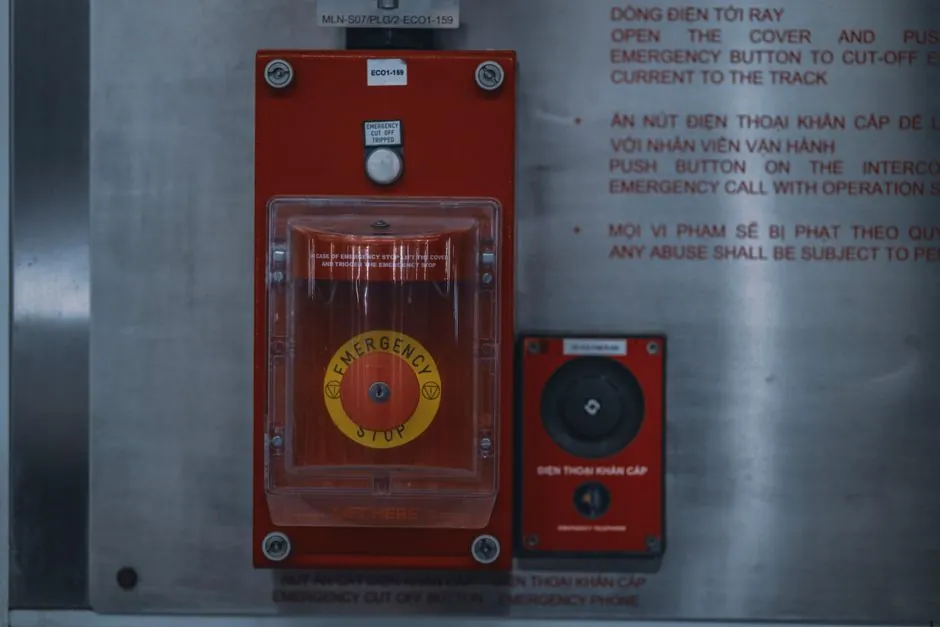
Selecting a warehouse access control system in 2026 starts from three hard constraints: dozens of entry points (dock doors, personnel gates, restricted cages), zone-based role permissions, and audit-grade logging that survives an insurer or fire-marshal review [S4][S3].
Modern deployments combine electronic credentials (cards, fobs, mobile, PIN, biometrics), OSDP-compatible readers, and cloud or on-prem controllers that integrate with the WMS so every door event ties back to a shipment or shift record [S2][S4].
Core Components: Readers, Controllers, Locks, and Credentials
Every warehouse access stack is built from four physical blocks: credentials (card, fob, PIN, mobile, fingerprint, face), readers mounted at doors, dock gates, and restricted cages; a controller that validates the credential against an approved profile; and the electronic lock or magnetic lock that physically secures the leaf [S4]. For high-security cages and chemical stores, fingerprint or facial readers are common, while cards and PIN pads cover general warehouse doors and dock entries [S3][S4].
ProdataKey's PDK Red Pedestal and Rugged Readers are sold as outdoor, weatherproof, vandal-resistant reader/controller combos with OSDP support, intended for gate entrances and harsh dock environments [S2]. Wireless backhaul (PDK WiMAC) and Power over Ethernet reduce the need to run home runs to every door, which is a real cost driver in buildings that stretch across hundreds of thousands of square feet [S2][S4].
For the locking side, magnetic door locks combined with push bars and push-to-exit buttons are the standard pattern for loading bays, where life-safety egress must remain code-compliant even when the door is electrically secured [S5].
Credential Strategy: Cards, Mobile, PIN, and Biometrics by Zone
Zone-based credentialing is the most consequential design choice, because a single warehouse typically mixes low-sensitivity bulk storage, medium-sensitivity dock doors, and high-sensitivity chemical or high-value cages [S4]. A reasonable 2026 spec calls for 13.56 MHz contactless cards or mobile credentials at personnel entries, keypads with PIN at dock doors for driver verification, and biometric readers at controlled-substance or high-value cages [S3][S4].
Credentials should be programmable per employee by clearance level and time window, so an operator cannot enter a chemical store without the relevant training record on file, and so a contractor's badge can be auto-revoked at end-of-shift [S3][S7]. Mobile credentials, supported by vendors like Avigilon Alta and PDK, are increasingly specified for new builds because they remove the cost of re-issuing physical cards and let managers revoke a phone-based credential in real time [S1][S2].
Biometrics should not be deployed everywhere. They earn their budget at choke points like cage access control and hazmat rooms, where shared or stolen cards would create a real loss exposure, and they are most defensible when paired with a secondary PIN for two-factor verification [S4].
Selection Criteria and a Side-by-Side Comparison

Use the four criteria below to compare the main option families before committing to a vendor. Each row maps a system type to a typical warehouse use case, the credential it pairs with, its integration depth, and the deployment cost band that matches its capability [S1][S2][S4][S5].
Standalone keypad/PIN systems suit small single-tenant warehouses with one or two doors; they are low cost but produce no per-user audit trail, which is a real weakness during an inventory-loss investigation [S3][S5]. Card-and-reader systems (RFID, 13.56 MHz, OSDP) are the workhorse for most 2026 builds, support role-based permissions, and export the access logs a WMS or ERP needs to reconcile against shipments [S4].
Cloud-managed multi-site platforms (Avigilon Alta, PDK.io) are the right pick for logistics operators with more than one distribution center, because they consolidate credential management, remote unlock, and emergency lock-down from a single browser or mobile session [S1][S2]. Biometric + card dual-auth systems are the correct fit for chemical, pharmaceutical, or high-value cage zones, but they require a privacy review and should be specified alongside a documented retention policy for biometric templates [S4].
Integration, Software, and Audit-Grade Reporting
An access system that does not export its event log into the warehouse management system, video management system, or ERP is functionally half-built, because the access event cannot be reconciled to a shipment, a shift, or a camera frame [S4]. ProdataKey documents an open API and out-of-the-box integrations with Microsoft Entra, VIVOTEK VORTEX, and Turing, plus a Zapier connector to over 8,000 software tools, which is enough breadth to cover most mid-market IT stacks [S2].
Avigilon positions its warehouse stack around a unified video management software that ties Alta cameras and access events into the same timeline, so an investigator can pull a door-forced alarm at 02:14 and immediately see the camera frames from the corresponding dock-door and aisle cameras [S1]. Both approaches, and a useful parallel is the welding-cell access control spec-first selection pattern for hot-work zones, share the same underlying logic: credential plus zone plus audit trail, validated against a hazard class.
For emergency planning, access logs should produce muster reports on demand so fire wardens know which employees and contractors are still inside the building, a function that regulators and corporate safety teams increasingly require [S4].
Implementation Constraints and Failure Modes

Access control on a working warehouse cannot be allowed to slow the line. The most common failure mode is a credential that takes more than a second to validate at a high-traffic dock door, which leads operators to prop the door open and silently defeats the entire system [S3][S4]. Specifying OSDP readers with encrypted channel, rather than the older Wiegand wiring, is the practical fix, and it also lets the same reader carry firmware updates and tamper alerts back to the controller [S2].
Environmental constraints are real. Outdoor gate entrances, cold-storage roll-up doors, and dusty loading bays will kill an indoor-grade reader in months, which is why vendors like ProdataKey sell stainless-steel, weatherproof, vandal-proof readers explicitly for these locations [S2]. Power and network reach is the other constraint: the same article on linear module selection for material handling notes how drive and cabling decisions cascade into commissioning delays, and access control runs into the same issue at any door more than 100 m from the server room, where PoE extenders or wireless modules are the practical workaround [S2][S5].
For a side spec conversation on enclosure and remote I/O hardware adjacent to doors, the control cabinet reference covers the protection ratings a door-side enclosure needs, while the control cable page covers the conductor and shielding choices for the runs between reader, controller, and lock.
Who This Is For, and Where It Falls Short
Cloud-managed, role-based, audit-logged access control is a clear fit for distribution centers, 3PL warehouses, and any operation holding high-value or regulated inventory, because the system pays back through theft reduction, faster incident investigation, and clean compliance evidence [S1][S2][S4]. It is also a sensible fit for multi-tenant industrial parks where the landlord has to manage dozens of tenant suites under a single badge system, a pattern covered in the lab access control selection write-up at the zone-and-audit level [S7].
It is the wrong tool for unmanned yards, where vehicle gates and ANPR/LPR are the actual choke point, and where the relevant physical asset is an haulage access vehicle rather than a person credential. It is also a poor primary control for an exterior access scaffold on a construction site, where lock-and-tag and a trained scaffold inspector are the governing method statements.
Finally, a layered approach with access control at the door plus CCTV and intrusion detection at the perimeter is the only configuration that gives a risk officer a defensible posture, because any single layer can be defeated by a tailgater, a lost card, or a camera outage [S1][S5].
Standards, Sourcing, and Trackable Signals
No single global standard governs warehouse access control, so specifiers should anchor the design to three reference points: OSDP for the reader-to-controller channel, PoE (IEEE 802.3at) for power budgeting at the door, and the local fire code (typically NFPA 101 in the US) for the fail-safe direction of magnetic locks on egress doors [S2][S5]. For high-value or chemical zones, the access policy itself should be cross-referenced with the site's OSHA hazard-communication plan and any industry-specific regulation (C-TPAT, AEO, or 21 CFR Part 11 for pharma), so the audit trail produced by the access system is admissible in the relevant compliance review [S3][S4].
Trackable signals to watch over the next two quarters: vendor moves around mobile credential interoperability (pass keys and wallet-based IDs converging on a common standard), OSDP Secure Channel adoption replacing legacy Wiegand in retrofit projects, and tighter integration between access event logs and WMS shipment receipts so dock-door events reconcile to the bill of lading within seconds rather than overnight [S1][S2][S4].