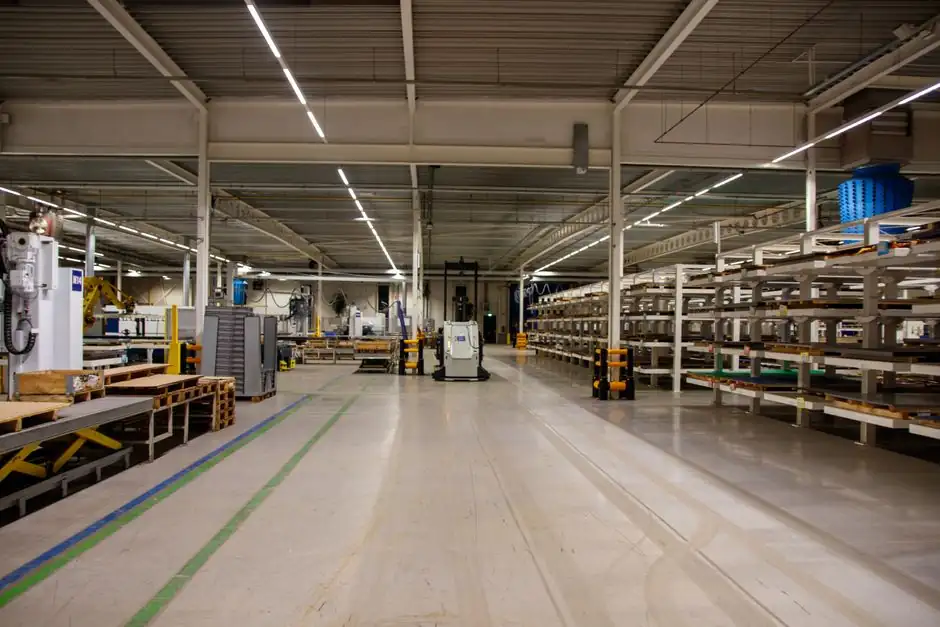
Chain conveyor pitch must be selected against the maximum loaded pallet weight and the pallet’s bottom-runner arrangement, because structural capacity alone does not prevent pallet impact, vibration, or unstable transfer.
The relevant scope is a powered, pallet-handling chain conveyor, not a vertical carrier conveyor or a general bulk-material drag chain. Specify the pitch, strand arrangement, drive power, load rating, and pallet support condition as one system.
Define the chain conveyor pitch and the governing load
Conveyor chain pitch is the distance between adjacent link centers, measured from roller-pin center to roller-pin center. In a pallet conveyor, the adjacent conveying element or roller center spacing is also commonly called roller pitch, and it must not be confused with the chain’s own link pitch [S8].
The governing load is the maximum mass of the pallet plus its contents, including any overhang, accumulated product, and handling shock. For a vertical chain conveyor, the combined moving load includes the product and carrier, but for a horizontal pallet conveyor, the critical checks are loaded pallet mass, pallet geometry, support arrangement, drive pull, and chain strength [S4].
The P3 Series selection guide identifies the P301A as a double-row center-drive chain conveyor [S3]. These values describe one design envelope, not a universal rating for every pitch.
Select pitch from pallet geometry before load capacity
Pallet bottom construction determines whether a chain conveyor is appropriate and how closely the supporting elements must be spaced. Pallets with parallel runners can bump and vibrate when supported by widely separated rollers, while runners perpendicular to the conveying elements provide a cleaner support line [S5].
A practical roller-pitch comparison is available for common pallet families. EUR pallets measuring 31 1/2 by 47 1/4 in, 39 3/8 by 47 1/4 in, or 47 1/4 by 47 1/4 in can travel with the narrower side leading on a 7 in roller-pitch conveyor. Moving them with the 47 1/4 in side leading normally requires a narrower 3 1/2 in roller pitch [S2].
GMA pallets measuring 48 by 42 in or 48 by 48 in can generally move with the 48 in side leading at 7 in roller pitch, or with either side leading at 3 1/2 in pitch. Full-base pallets with bottom boards in all four directions can move in either direction at 7 in pitch [S2].
The 7 in pitch is generally more economical than the 3 1/2 in pitch, but the 7 in arrangement may require guarding for personnel safety and security. The 3 1/2 in arrangement supports more pallet configurations and generally allows two rollers beneath a runner at the same time, which reduces impact and vibration [S2][S5].
Compare roller pitch, close roller pitch, and chain conveyor options

Compare the main conveyor choices against pallet support, directional flexibility, load capacity, and installed cost. The numerical pitch values apply to the cited roller-conveyor configurations, while the decision principle remains valid for chain-supported pallet systems. [S2]
For chain conveyors specifically, the chain system must be selected as a complete load path. SMB International offers two- and three-strand pallet chain systems driven by motors from 0.37 to 1.5 kW, with the arrangement matched to loaded pallet weight and size [S6].
Do not use one pitch for every loaded pallet
Do not select 3 1/2 in pitch solely because the pallet is heavy. Weight establishes the required structural, chain, shaft, bearing, and drive capacity, while pallet construction establishes support quality and transition performance [S5]. A heavy pallet with parallel runners can still produce a poor ride if the support spacing is too wide.
Conversely, do not select 7 in pitch solely because it is economical. That choice can be unsuitable when the pallet must lead with a different side, when its runners are parallel to the conveying elements, or when the product is sensitive to impact and vibration. The 7 in option is generally the economical choice for compatible pallet geometry, whereas 3 1/2 in is the more tolerant choice for mixed orientations [S2].
For quarter pallets measuring 15 3/4 by 23 5/8 in and half pallets measuring 23 5/8 by 31 1/2 in, a 3 1/2 in roller pitch can usually accommodate the load, although some bottom configurations require special verification. Chain conveyors are often more suitable for quarter pallets when their bottom configuration does not perform well on rollers [S2].
Check the chain rating and drive duty after pitch selection

The conveyor pitch establishes the support geometry, but the selected chain must still meet the loaded pallet duty. Renold’s designer guide identifies inner plates pressed onto bushes, free-fitting rollers around the bushes, and outer plates with bearing pins whose ends are riveted over the plates. Pin and bush diameters, plate-hole accuracy, and pitch accuracy all influence articulation and wear life [S1].
Normal maximum chain pitch can be increased by adding strengthening bushes between link plates, with suitable sprocket-tooth gaps to clear them [S1]. That modification is not a substitute for a load rating: bush reinforcement, plate strength, roller capacity, sprocket engagement, fatigue performance, and lubrication must be evaluated for the actual chain model and duty.
SKF’s conveyor-chain catalogue includes standard and alternative chains with pitches beginning at 12.7 mm [S7]. Chain pitch is therefore a model-specific dimension, and a nominal pitch stated in millimetres should not be substituted for the pallet conveyor’s roller or supporting-element spacing without checking the drawing and chain designation.
Drive sizing should follow the selected conveyor configuration, speed, friction, and load rather than a motor-power rule based on one pallet. The cited pallet-conveyor data spans 12–20 m/min and 0.37–1.5 kW across the listed configurations, while the vertical-chain comparison uses carrier count, carrier spacing, travel speed, and transfer cycle as throughput inputs [S3][S4].
Use a repeatable procurement and test sequence
Specify at least six concrete items on the conveyor data sheet: maximum loaded pallet mass, pallet dimensions, bottom-runner direction, required travel orientations, chain pitch or supporting-element pitch, and conveying speed. Include chain model, strand count, drive power, support spacing, and guards where applicable [S2][S5][S6].
Test representative pallets rather than relying on nominal dimensions alone. Confirm that each pallet seats without impact, travels without roller or chain obstruction, maintains product stability, and transfers cleanly at the infeed and discharge. Pallets with runners in both directions can support bidirectional use, while parallel-runner pallets require close support or a chain arrangement selected for that geometry [S5].
Record the final operating envelope: loaded mass, speed, drive rating, ambient conditions, tensioning provision, and guarding arrangement. For the cited P301A design, the reference envelope is 1,500 kg/m, 12–20 m/min, -5 to +45 °C, and 30–70% RH without condensation; deviations require engineering review rather than extrapolation [S3].