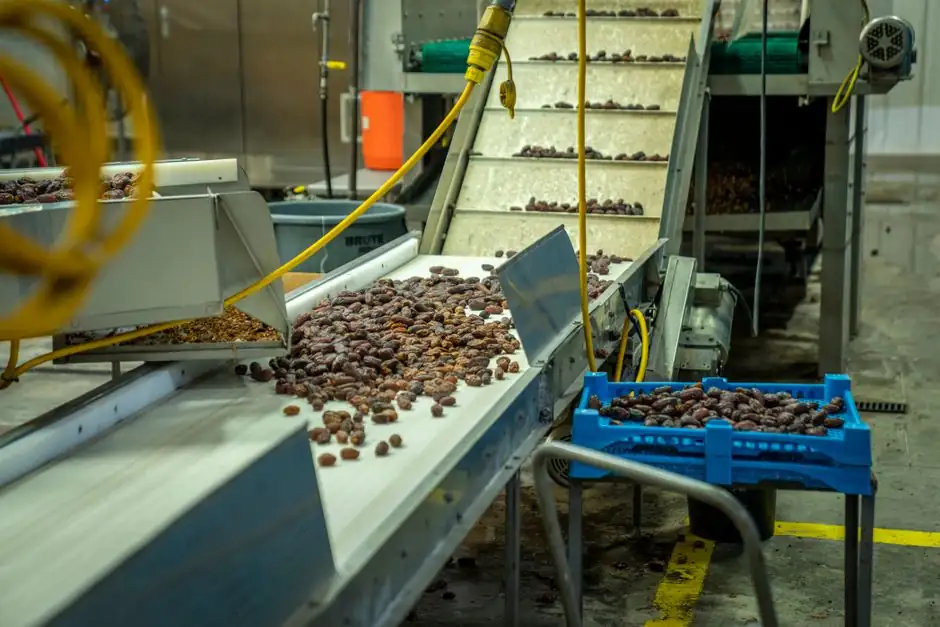
Published conveyor data includes speed selections from 30 to 90 ft/min [S6][S8].
What speed limit actually means
The documented multi-strand chain conveyor is rated for 3,000 lb per unit load [S1].
The distinction matters because speed, load capacity, drive power, and pallet support are separate design constraints. A published drag-chain model operates at a constant 30 ft/min, carries a 10,000 lb maximum distributed live load at that speed, uses a maximum 3 HP motor, and offers 12 in elevation [S8].
Throughput is a separate metric. Conveyor velocity sets the pace; accumulation, spacing, transfers, and downstream equipment determine system throughput [S5].
Pallet stability starts with support geometry
Pallet deck orientation has a direct effect on stability because parallel runners can cause the pallet to bump and vibrate during travel [S3]. Pallet runners perpendicular to the conveyor rollers are always the best option [S3].
A drag-chain conveyor carries the load directly on strands of chain, whereas a CDLR conveyor moves the load across driven rollers [S4].
Chain strand spacing must match the pallet size, weight, and load distribution.
Compare support systems before raising speed
Chain-driven live roller conveyors move pallets by surface contact across driven rollers, while drag-chain conveyors support the load directly on chain strands [S4]. CDLR conveyors move pallets across driven rollers, while drag-chain conveyors carry the load directly on strands of chain [S4].
The comparison rules out a universal 30 or 60 ft/min rule. A damaged pallet may justify direct-support drag chain, while a stable, flat pallet can use CDLR accumulation controls. Published pallet conveyor systems reach speeds of up to 80 ft/min for one configuration and 90 fpm for two others, but those figures describe equipment capability rather than a blanket pallet-stability limit [S6].
Match speed to load composition
For unstable or mixed loads, floor-based wrapping is a valid alternative to conveyor transport. A wrapper can wrap a stationary load on the floor with the film carriage rotating around it, eliminating the conveyor from the process [S2].
Use 30 ft/min as a verification baseline
Three acceptance tests should follow: verify that pallet runners engage the intended supports, inspect for bump, vibration, rocking, or slip at 30 ft/min, and then step the controlled speed through an approved commissioning sequence only after the downstream process can accept the added rate [S3][S5].
Adjustable-speed capability is valuable where product mix or throughput changes. Conveyor speed should be matched to throughput goals, product characteristics, equipment limitations, and the way materials move through the facility [S5]. A conveyor that runs too slowly can cause backups and leave workers idle, while one that runs too fast can create bottlenecks farther down the line [S5].
Specify the operating envelope
A procurement specification should state more than “maximum speed.” It should identify the approved velocity, minimum and maximum operating range, unit-load mass, distributed-load rating, pallet orientation, permitted pallet condition, accumulation behavior, incline, drive rating, and transfer locations [S1][S4][S8].
The documented construction options include carbon steel, galvanized steel, and stainless steel, while the cited chain conveyor uses structural-channel or formed-steel-plate frames [S1]. For food or corrosive environments, material selection and cleaning access must be resolved before a speed is accepted; speed alone cannot correct contamination retention, corrosion, or damaged chain engagement.
Safety documentation also requires careful review before release. The cited multi-strand design incorporates OSHA-approved diamond-tread walk plates for operator crossover, 4 in adjustable-height structural-channel floor supports, and slave-driven transfer loops at conveyor ends [S1]. These provisions are separate from the pallet-stability decision and should not be copied into another design without project-specific verification.
Traceable sign-off criteria

The next engineering step is to release a speed trial only after the pallet population is characterized by deck condition, runner orientation, total mass, load distribution, and center-of-gravity position. Keep the initial 30 ft/min baseline, record vibration and alignment at transfers, and document the downstream rate before approving any increase [S1][S3][S8].
Two signals should drive further review: any pallet rocking, bumping, or loss of traction at 30 ft/min, and a downstream requirement exceeding the conveyor’s stable transfer rate. Both point to a support or system-balance problem, not permission to raise speed [S4][S5].