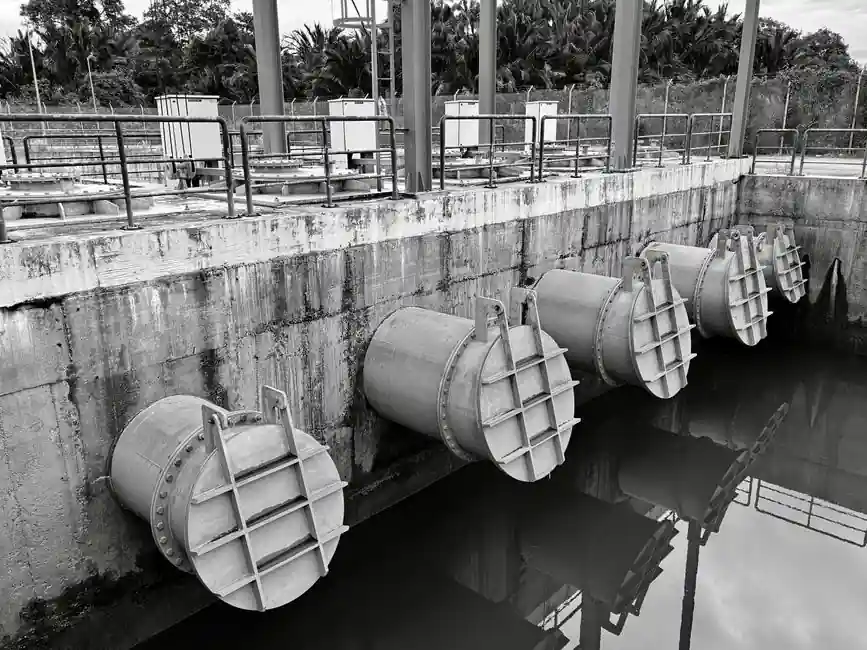
A characterized disc butterfly valve is a quarter-turn rotary control valve whose disc and seat geometry are deliberately shaped (concave, contoured, or segmented) to convert the valve's native S-shaped gain curve into a usable linear or equal-percentage installed characteristic [S3][S4].
The defining feature is a characterized disc profile: a high-performance double-offset or triple-offset body, with the disc edge or seat contoured so that flow rate tracks controller output across a useful portion of the 0-90° travel, rather than the steep low-gain / high-gain transition a standard concentric disc produces [S3][S4].
Inherent vs Characterized Flow Curves
A standard concentric butterfly disc is not inherently linear: published field data shows its installed gain varies by a factor of roughly 15 from low to high travel, swinging from under 0.2 to nearly 3.0 as the controller output ramps across the stroke [S4]. That swing is the root cause of the oscillating level loops Optic Controls documented on a distillation column, where the same proportional gain that worked at high flow drove the loop unstable at normal flow [S4].
Characterizing the disc (or pairing the disc with a contoured seat) reshapes that curve toward one of three standard installed characteristics: linear, equal percentage, or quick opening, so the installed Cv versus travel approximates the curve the control loop was actually designed for [S2][S5]. GlobalSpec's selection guide defines the linear target explicitly: 50% disc travel should deliver 50% of maximum flow, and the same proportionality holds across the working range [S2].
Linear vs Equal Percentage vs Quick Opening
Linear: flow rate is directly proportional to disc travel. Best for loop spans where the process pressure drop is dominated by other equipment, so the valve sees a roughly constant ΔP across travel [S2].
Equal percentage: each equal increment of disc travel produces an equal percentage change in flow. Preferred when the loop has to control over a wide range and the valve is asked to operate near its seat at low flow [S3][S5].
Quick opening: most of the rated Cv is delivered in the first 20-30° of travel; used for on/off or soft-start isolation, not for modulating control [S3].
For most process control work, equal percentage is the safer default because it preserves controllability at low flow, while linear is the right pick when piping pressure drop is large and relatively constant relative to valve drop [S3][S5]. A characterized disc can be ordered in any of the three profiles, which is the practical value of the geometry: you specify the installed curve, not just the body.
Where a Characterized Butterfly Fits, and Where It Doesn't

Characterized disc butterfly valves are a good fit for large line sizes (commonly up to 72" in high-performance designs), low-to-medium pressure classes, clean liquids and gases, and tighting control where a globe or characterized ball valve would be too costly or too tall to install [S1][S3]. Per Control Engineering (2025-02), they are the least expensive rotary option in large sizes and may be the only available body style above a certain line diameter [S3].
They are not a good fit for: high pressure drop with flashing or cavitation risk (the disc's high recovery coefficient drives the vena contracta close to the disc, which damages the seat and the disc edge), slurries and fibrous fluids (the contoured seat edge catches debris), and tight shutoff at very low bubble-tight leakage classes, where a soft-seated characterized ball or a triple-offset metal-seated butterfly is a better answer [S3][S6]. Emerson's high-performance butterfly line is positioned for throttling control and positive isolation, not for choked-flow or flashing service [S1].
For a side-by-side view of how the characterized butterfly compares to other rotary options in low-ΔP installed service, the Butterfly Valve Installed Flow at Low Pressure-Drop Ratio reference walks through the same Cv-vs-travel comparison in a piping context.
Selection Criteria for the Characterized Disc
Five parameters drive a defensible spec: (1) required installed characteristic (linear, equal percentage, or quick opening), (2) Cv at rated travel and the resulting rangeability, typically well under 50:1 for a butterfly versus 100:1 or more for a characterized globe, (3) seat leakage class per API 598 or FCI 70-2, (4) pressure class and end connection (wafer, lug, double-flanged), and (5) disc and seat material pairing for the process fluid and temperature [S3][S5].
For torque and actuator sizing, the characterized disc profile shifts the breakaway torque vs. a standard concentric disc; pair the spec with a published torque curve at the design ΔP and use a linear actuator for linear-position feedback when the positioner only has rotary feedback available. For position feedback on quarter-turn shafts, a linear encoder referenced off a cam or a rotary encoder is the standard method; the actuator sizing itself is documented in the linear actuator reference.
Disc Profile Geometry and How It Linearizes Flow

The shape that produces a near-linear installed curve is a contoured disc edge (or a contoured seat lip) that throttles the effective flow area at a constant rate per degree of rotation, instead of the abrupt area change a flat disc delivers near 0° and 80° [S4][S5]. Concave profiles trend toward quick opening, convex profiles trend toward equal percentage, and a carefully tuned cam-like profile produces a near-straight Cv-vs-angle line across the useful travel band [S4].
Optic Controls' 2012 field data is the cleanest illustration: a characterizer block in the controller linearized the loop well enough to stop the oscillation, but the post-characterization residual was still worse than a true linear control valve would deliver, which is why the long-term fix was a characterized disc, not a software trick [S4]. The same logic is built into Belimo's characterized control valve family, where a characterized disc on a ball body is used to deliver a true equal percentage installed characteristic in a package that fits where a globe will not [S9].
Rangeability, Turndown, and Practical Limits
Butterflies, even characterized, are rangeability-limited compared to globes and characterized balls: Control Engineering (2025-02) states the rotary butterfly offers "very limited turndown and less control range than the other valve styles," which is why the characterized disc is normally specified between roughly 20% and 80% of rated travel, with the trim sized so the normal operating point sits mid-stroke [S3].
Below ~20% travel, even a characterized disc loses resolution and the seat edge chatter on metal seats; above ~80°, Cv flattens out and the disc approaches the full-bore flow area. Sizing for 60-70% of the calculated required Cv at the design point is a common rule of thumb for modulating service, leaving headroom for wear and future capacity creep [S5].
Spec Sheet, Sourcing, and Standards
For a documented spec, the specifier should pull: body and disc material (e.g. ASTM A216 WCB carbon steel body with 316 SS disc, or duplex for chloride service), seat material (PTFE, RPTFE, or metal-to-metal for high temperature), pressure class (ASME B16.34 / ASME B16.5 flange rating), fire-safe certification (API 607 or API 6FA where hydrocarbon service applies), leakage class (FCI 70-2 Class IV, V, or VI), and the documented installed characteristic curve (linear, equal percentage, or quick opening) at the named Cv [S1][S3][S6].
For documentation control, ask the vendor for the published installed characteristic curve at the actual Cv, not the generic curve, and confirm the curve was measured per ISA-75.02 or an equivalent control-valve testing standard. The same documentation discipline is used for characterized ball valves, which is why Belimo publishes a characterized disc curve alongside the ball body Cv [S9]. For body geometry context, the butterfly valve reference covers the family-level differences between concentric, double-offset, and triple-offset designs that the characterized disc is typically built on.
Trackable signals over the next quarter: (1) at least one major actuator or positioner vendor publishing an updated characterized-disc torque and Cv dataset for sizes above 24", and (2) a new ISA-75.02 or FCI 70-2 revision commentary on installed characteristic verification for rotary control valves, which is the standard that gates whether a shipped disc actually delivers the labeled linear or equal-percentage curve.