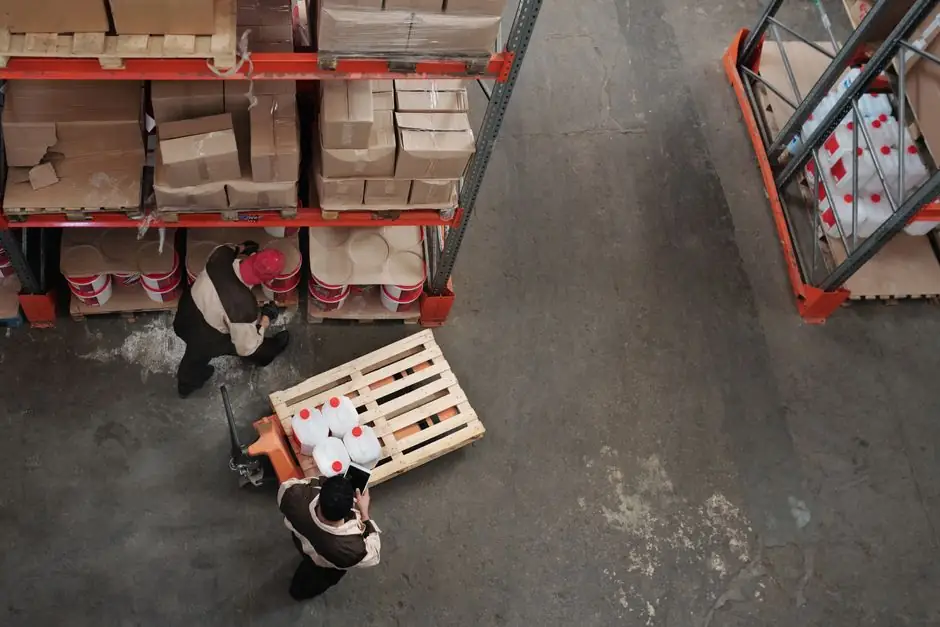
Warehouse pallet racks transfer their full operating load to the slab through base-plate anchors, so the anchor specification is a structural decision, not a finishing detail, and selection should sit inside the rack engineer's design package rather than be left to the installer [S1].
For pallet racking in the 2026 specification environment, the practical rule is to default to chemical (resin-bonded) anchors where the slab is cracked, near a free edge, subject to forklift-induced vibration, or carrying tall selective racks above roughly 6 m, and to reserve mechanical expansion anchors for low-rise, static-duty, removable fitments [S1][S2].
Why chemical anchors dominate modern rack base-plate design
Resin-bonded anchors transfer tension and shear into the concrete along the full embedded length, which lets engineers tune capacity by changing embedment depth rather than chasing a heavier mechanical anchor [S1]. Approved cracked-concrete systems are available across the major European approvals frameworks, and bonded systems also reduce the expansion stress that can split weak concrete near edges or rebar [S1][S2]. That combination, depth-tunable capacity plus edge tolerance, is the main reason specifiers in seismic and high-bay racking projects have moved toward chemical anchor systems over the past decade.
Commercial sites, including offices, warehouses, and retail spaces, rely on chemical anchors to safely connect heavy machinery, signage, and shelving units, and the warehouse racking sub-segment is one of the named demand drivers in current market reporting [S4]. In a typical selective rack with a 12 t bay load, four M12 chemical anchors at 120 mm embedment in C25/30 concrete will usually out-carry four M12 mechanical wedge anchors at the same embedment, and they will do it without the wedge's expansion footprint.
Resin chemistry: polyester, vinylester, hybrid, epoxy
Chemical anchor resin comes in five common formulation families, polyesters, vinylesters, epoxy acrylates, hybrids, and epoxies, each with a different balance of cure speed, chemical resistance, and ultimate bond strength [S2]. The choice is governed by substrate, load, and environment rather than by price alone [S3][S5].
Epoxy resins give the highest bond strength and the best resistance to chemicals, moisture, and elevated temperature, but their slow cure means the rack cannot be loaded for hours, which is a real cost on a live warehouse floor [S5]. Vinylester resins cure faster while still tolerating wet holes and mildly aggressive atmospheres, which is why they are the workhorse for industrial plants and coastal warehouses [S2][S5]. Polyester is the cheapest and fastest-curing option, but it is generally limited to non-structural or lighter-duty work on hollow masonry rather than structural slab anchoring [S5]. Hybrid systems sit between vinylester and epoxy, trading a little ultimate strength for faster turnaround and more forgiving substrate behaviour, and they are increasingly the default where the slab condition is mixed or unknown [S5].
Substrate and slab condition as the first filter
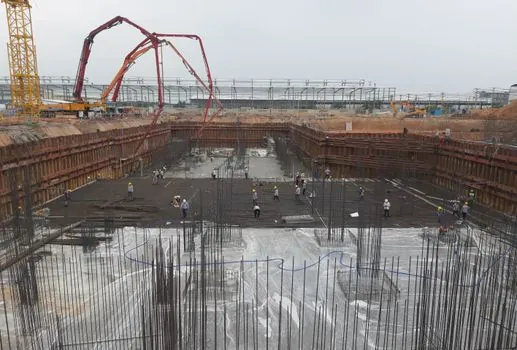
The first selection filter is always the substrate: solid concrete, hollow masonry, or perforated brick each rule out different anchor families before load is even considered [S3]. Cracked versus uncracked concrete is the second filter, because only anchors with a cracked-concrete approval may be used where the slab is known or expected to crack in service [S1][S2].
On warehouse slabs, three substrate conditions drive the decision. New, uncracked C25/30 to C40/50 concrete accepts any approved system. Existing slabs with hairline cracking need a cracked-concrete-approved resin, typically a vinylester or epoxy with an ETA Option 1 or equivalent assessment. Hollow deck slabs, common in older mezzanines, must use a resin with a sieve sleeve or a hybrid system designed for voids, because the resin would otherwise drain into the hollow [S3][S5]. Hole preparation is non-negotiable: dust left in the bore destroys bond area, and the standard practice is to blow, brush, and blow again with the manufacturer's specified tool before injection [S1][S2].
Load class, seismic, and vibration: matching anchor to duty
Load type is the second hard filter: static pallet loads behave very differently from the cyclic, shock-loaded environment a forklift impact creates, and the anchor must be rated for the actual service condition, not the static label on the box [S2]. Engineers should classify duty as static, dynamic, or seismic, and then verify that the design actions E_d do not exceed the design resistance R_d at the chosen embedment and edge distance [S2].
The practical mapping for warehouses looks like this. Low-rise static shelving on sound slab, M8 to M10 mechanical wedge or sleeve anchors are usually adequate and give immediate loadability. Selective pallet racking 4-6 m high with M12 to M16 base plates, vinylester or hybrid chemical anchors at 100-160 mm embedment are the mainstream choice, sized so E_d stays below roughly 0.7 of R_d to leave margin for cyclic loads. High-bay or seismic-rated racking, drive-in racks, or rack near slab joints, epoxy or high-grade vinylester with cracked-concrete approval, edge distance verified, and typically a 1.0-1.5 safety factor on top of the design resistance. Mechanical anchors in this last band are a code-compliance risk on most European and UAE frameworks because their expansion mechanism can slip under sustained cyclic tension [S1][S2].
Comparison: chemical vs mechanical anchors on five warehouse criteria
On the five criteria that drive warehouse anchor selection, chemical and mechanical anchors line up as follows. Installation speed: mechanical wins because there is no cure time and no hole-cleaning ritual, so a mechanical base plate can be loaded within minutes [S1]. Load capacity at equal embedment: chemical wins, often by a factor of 1.5-2 in tension on cracked concrete, because the bond area is the full embedded surface, not a single expansion ring [S1][S2]. Edge and spacing tolerance: chemical wins, because bonded systems generate far lower expansion stress and tolerate reduced edge distances that would split a wedge anchor [S1][S2]. Vibration and seismic performance: chemical wins, since bonded anchors do not rely on a friction grip that can loosen under cyclic loading [S2]. Removability and re-use: mechanical wins, because a sleeve or wedge can be backed out if the rack layout changes, while a resin anchor has to be cut off or drilled out [S1].
The trade-off in plain numbers: vinylester chemical anchors typically cost 2-4 times the material of an equivalent mechanical wedge, but on a high-bay rack the engineering savings on slab thickness, edge distance, and rebar avoidance usually offset that premium within the same project [S4][S6]. On a 2 m static shelving run, the same premium never pays back, which is why a blanket "always specify chemical" rule is wrong for warehouses.
Environmental exposure and corrosion: matching anchor material to the building
Atmospheric conditions fix the anchor material, not just the resin type: a chemical anchor in a coastal warehouse, a cold-store, or a chemical-compounding bay can fail by rod corrosion long before the resin degrades, and the specification has to treat the steel and the resin as a system [S2]. Stainless steel A4 / 316 rods are the default for external or humid interior zones, and hot-dip galvanized rods are acceptable for dry interior warehouses where some surface oxidation is tolerable [S2][S5].
Resin choice follows the same logic. Epoxy tolerates the widest chemical and temperature envelope, including chemical-plant atmospheres and temperatures up to roughly 80-120 °C sustained, depending on grade [S2][S5]. Vinylester is the mainstream choice for general warehouses, including cold stores down to roughly -20 °C with the correct winter-grade formulation, and it tolerates wet holes during installation. Polyester is acceptable only for dry, interior, non-aggressive atmospheres on non-structural fixings [S5]. For the slab-to-base-plate interface in any racking, the resin and rod materials should appear together on the engineer's data sheet, and cold-store warehouses in particular should require a low-temperature cure-grade resin rather than a generic summer formulation.
Installation discipline: where most warehouse anchor failures actually start
Field data consistently points to installation, not anchor type, as the leading failure cause: hole cleaning skipped, torque not applied to spec, or resin loaded before full cure [S1][S2]. A chemical anchor in a poorly cleaned hole can lose 30-50 % of its bond capacity, which is enough to flip a passing design into a failing one without anyone noticing on site.
Five installation rules that should appear in the method statement for any warehouse racking job. First, drill to the manufacturer's specified diameter and depth with a hammer drill (rotary or diamond only where the approval allows), and clean the hole with blow-brush-blow using the branded tool, never a substitute [S1][S2]. Second, inject resin from the base of the hole upward with a mixing nozzle to avoid air pockets, and discard the first pump stroke that has not been properly mixed [S3]. Third, insert the rod with a slow twisting motion so the resin wets the steel, and do not load until the full cure time for the on-site temperature has elapsed, which on vinylester can stretch from a few minutes at 30 °C to over an hour near 5 °C [S1][S5]. Fourth, torque the nut only after cure, to the value on the data sheet, using a calibrated wrench [S1]. Fifth, on existing slabs with known services, scan with rebar and conduit locators before drilling, because hitting a post-tensioning tendon or an embedded electrical conduit is an order of magnitude worse than any anchor specification error [S2].
Standards, approvals, and what to demand on the data sheet
On a safety-critical warehouse, the data sheet, not the brochure, is the spec: it should name the approval body, the concrete class, the cracked or uncracked concrete category, the design resistance, and the temperature range, all together [S1][S2]. A specifier who accepts a generic "suitable for concrete" data sheet is buying a liability, not an anchor.
For European projects, look for an ETA or equivalent assessment that explicitly covers cracked concrete and the relevant seismic performance category, with a clear value for R_d at the intended embedment and edge distance. For UAE and Gulf projects, follow the same ETA plus local civil-defence or municipality approval route, and confirm that the chosen product has been used on a comparable project reference [S1]. For US projects, ICC-ES ESR reports with cracked-concrete and seismic categories are the equivalent benchmark, and ACI 318 Chapter 17 governs the design method. In all cases, the design method must check tension, shear, and combined loading separately, and must apply the correct reduction factors for edge distance, spacing, and concrete condition, with E_d <= R_d on every check [S2]. Two design follow-ups from the same anchor family: chemical anchors sized for pallet racking can be cross-referenced against the expansion anchor baseline when a project has both rack and mezzanine anchor duties, and a broader side-by-side of options for industrial facilities is covered in the expansion anchor selection for industrial facilities reference.
Trackable signals for the next spec cycle: whether major racking OEMs move their default high-bay detail from M16 mechanical wedge to M16 vinylester chemical on new builds, and whether cold-store and seismic-zone warehouses start to mandate low-temperature-cure vinylester grades rather than the generic summer formulation.
For the relevant spec sheets and selection criteria, see chemical material.