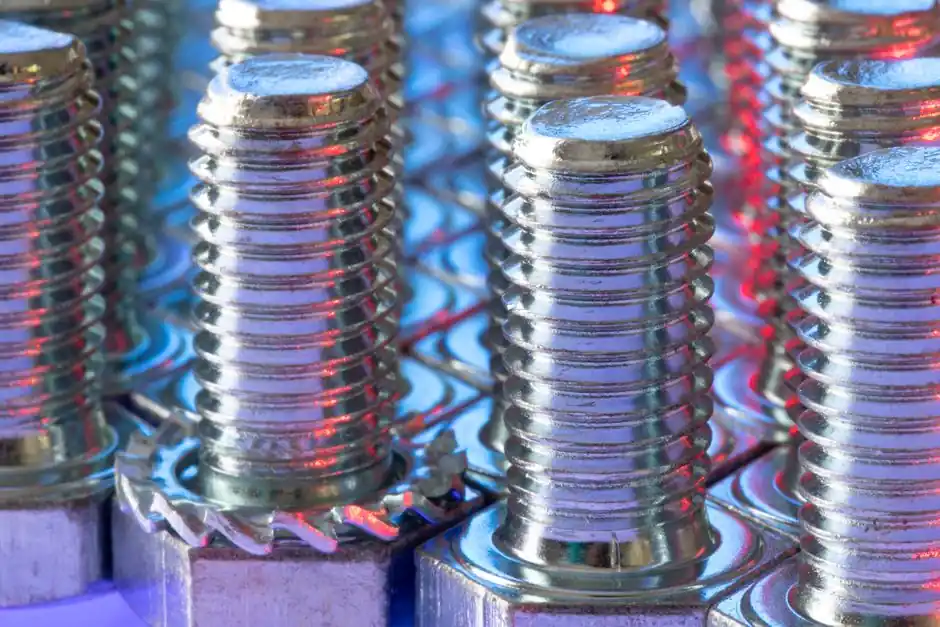
In ISO Class 5 to 8 cleanrooms, post-installed mechanical expansion anchors must combine corrosion resistance (304 or 316 stainless, or zinc-plated carbon steel) with low-particulate, flush-mounting hardware to avoid shedding, snag points, or crevices that trap viable particles [S2][S3].
The four anchor families that show up on cleanroom specs are wedge anchors for solid concrete, sleeve anchors for mixed masonry, drop-in internally threaded anchors for flush MEP hangers, and undercut or chemical anchors for safety-critical or vibration-loaded equipment bases [S1][S2][S4][S5].
Substrate Drives the Family, Not the Brand
Cleanroom slabs are typically 3000 to 5000 psi (20.7 to 34.5 MPa) normal-weight concrete, while upper-level cleanroom builds often rest on hollow-core plank or CMU block, so the anchor type has to follow the substrate, not the room classification [S3][S4]. Drop-in anchors from Simpson Strong-Tie such as the DIAB, DIA-SS, and HDIA are rated for both hollow base materials (CMU, hollow-core plank) and solid normal-weight or lightweight concrete, with the DIAB accepting 1/4 in. through 3/4 in. threaded inserts and the HDIA accepting 1/4 in. through 5/8 in. inserts [S3]. HDIA shells are die-cast Zamac 3 alloy (Zn with Al, Mg, Cu), which is fine for dry MEP hangers but is not the right pick for wet-process or wash-down cleanrooms where 316 stainless is required [S3].
For hollow block, aerated concrete, or low-strength masonry, a single-point expansion such as a wedge anchor will cause localised crushing, so specifiers should step up to a double expansion sleeve that expands both near the mouth and deeper in the hole to spread the bearing area [S2][S4]. For solid concrete, the wedge anchor remains the highest-capacity per-bolt option, with Trubolt-style designs using a stainless steel expansion clip, threaded stud body, nut, and washer in plated carbon steel, hot-dipped galvanized, or stainless variants [S1].
Material and Finish: Matching Room Class and Chemistry
For ISO Class 5 and better, the working envelope is A4/316 stainless steel (Type 316 for chloride exposure such as biotech or semiconductor wet benches), with 304 acceptable in dry rooms where deionized water is not present [S3]. Drop-in anchor bodies from Simpson are offered in zinc-plated carbon steel, Type 303/304 stainless, and Type 316 stainless, while threaded drop-in shells in HDIA are Zamac 3 alloy, which is a constraint the spec must surface [S3].
Wedge and sleeve anchor bodies in the Trubolt line are produced in plated carbon steel, hot-dipped galvanized carbon steel, and 304/316 stainless, with the stainless expansion clip separate from the body so the wetted surface is fully alloy [S1]. For ceiling MEP supports in pharma cleanrooms where peroxide or vaporous hydrogen peroxide (VHP) is used for bio-decontamination, 316 stainless is the conservative pick, while zinc-plated carbon steel is generally limited to non-wetted, non-process zones such as return-air plenum framing [S3]. Avoid uncoated carbon steel entirely inside the cleanroom envelope; it will rust from any condensation on the slab soffit and start shedding iron oxide particles onto the HEPA filter face.
Flush vs Protruding Heads: Why Drop-Ins Dominate Cleanroom Ceilings

Drop-in internally threaded anchors sit flush to the base material after setting, which is exactly the geometry cleanroom operators want: no bolt end protruding into the return-air plenum, no snag point for garment sleeves, and no place for a wipe-down to miss [S3]. They are displacement-controlled expansion anchors: a setting tool hammer-drives the internal expander plug downward, which forces the cylindrical anchor body outward against the hole wall over a defined engagement length [S3].
Common drop-in sizes in cleanroom MEP/FP (mechanical, electrical, plumbing, fire protection) support are 3/8 in. and 1/2 in. UNC internal thread, which accept standard threaded rod for duct supports, conduit trapeze, and small cable tray [S3]. Hollow drop-in variants (HDIA) have shorter thread lengths than the standard DIAB and rely on horizontal embossments on the Zamac shell to develop capacity in hollow base materials, which is why they are the right pick for hollow-core plank ceilings but not the right pick where a fully stainless load path is required [S3]. When the equipment base needs a through-bolt or a fixture that must be removed and re-set repeatedly, a flush drop-in also lets the bolt be backed out without spinning the anchor, which wedge and sleeve anchors will not do cleanly.
Load Path Comparison Across the Four Families
Wedge, sleeve, drop-in, and undercut anchors all transfer tension differently, and the spec has to match the load path to the equipment, not the other way around [S4][S5].
Undercut anchors develop the highest stiffness and the most ductile tension behaviour because the load is transferred by bearing at the end of the anchor rather than by friction along the sleeve, and they qualify for ductile seismic connections when the steel grade is selected for yielding along the rod length [S5]. That same ductility makes them the preferred pick for cleanroom equipment that sees cyclic loading, such as chiller skids on isolation mounts, but the spec has to call out the dedicated undercut drill bit and setting tool, not a standard hammer-drill bit, or the bearing surface will not form [S5].
Installation Discipline: Hole Cleaning and Embedment Depth
All four families require the same three-step discipline: drill with a carbide-tipped bit matched to the anchor diameter and embedment, clean the hole with a wire brush plus compressed air or a vacuum, then set the anchor with the manufacturer-supplied tool [S2]. Skipping the cleaning step is the single most common cause of expansion anchor underperformance in the field, because concrete dust left in the hole reduces sleeve-to-substrate contact and drops the effective expansion pressure [S2].
For wedge anchors in cleanroom slabs, follow the Trubolt-style installation data for the specified embedment depth (typically 1-1/2 in. to 12 in. depending on diameter) and torque the nut to the catalog value rather than to "feel", which is the usual cause of either sleeve spin or stud stretch [S1]. For drop-in anchors, set with the matching setting tool so the lipped top sits flush and the plug travel is correct, because over-driving or under-driving both reduce the developed bearing area against the hole wall [S3]. Sleeve anchor expansion is generated by torque on the hex nut, so the same torque-wrench discipline applies; sleeve anchors also tolerate slightly oversized or irregular holes better than wedge anchors, which is why they are the better pick on older concrete where drilling is not perfectly clean [S4].
Where Adhesive or Cast-in Beats Expansion in Cleanrooms
Adhesive (chemical) anchors and cast-in-place headed studs are sometimes the right answer even when the spec is centred on expansion anchors, and the trade-off has to be made explicitly [S2][S5]. Adhesive anchors reach higher tension capacity in cracked concrete and avoid the concrete breakout failure that limits wedge and sleeve anchors at shallow embedment, but they require a curing window that sleeve and wedge anchors do not, which is a problem on shutdown work where the room has to be returned to service fast [S2][S5].
Undercut anchors in their structural form develop load by bearing deep in the concrete, similar to a headed stud cast in place, which is why load-displacement data in the Structure Magazine comparison shows undercut anchors are the stiffest of the post-installed options and the only expansion-style anchor that matches adhesive anchors in stiffness while exceeding them in ductility [S5]. For new cleanroom builds where the slab is being poured anyway, cast-in-place J-bolts or L-bolts in the baseplate mounting are usually cheaper and more reliable than any post-installed system, and the question for the specifier is only whether the slab is already in place [S2]. When the slab is existing and a piece of equipment has to be re-anchored, post-installed mechanical expansion in the form of stainless wedge or sleeve anchors is the default, with drop-ins reserved for flush-mount MEP supports and undercut anchors held back for the most safety-critical or vibration-loaded connections [S1][S3][S4][S5].
What to Verify Before Issuing the Submittal
Three checks catch most cleanroom anchor submittal errors: confirm the substrate (solid slab versus hollow plank versus CMU) and reject any anchor type that is not rated for the actual base material, confirm the material certificate (Type 304 versus Type 316 versus zinc-plated carbon steel) matches the room's chemistry envelope including any VHP or isopropyl alcohol exposure, and confirm the embedment depth and torque values are pulled from the manufacturer's current catalog rather than from a generic chart [S1][S2][S3].
A reasonable selection rule for ISO Class 5 to 8 cleanrooms: 316 stainless wedge anchors for equipment base plates on solid concrete, 316 stainless sleeve anchors for pipe and conduit supports on mixed masonry, 316 stainless or zinc-plated drop-in anchors for flush ceiling MEP, and double-expansion sleeves only when the wall is genuinely hollow CMU and the load is light [S2][S3][S4]. For related specification context on industrial-grade expansion anchor families, the expansion anchor selection for industrial facilities writeup covers the same four families outside the cleanroom envelope. Mechanical expansion anchors are a subset of the broader expansion anchor category, and the drop-in family in particular is the most common sub-type on cleanroom MEP drawings. For a refresher on how the basic wedge anchor geometry transfers load, the encyclopedia page on expansion joints covers the same friction-versus-bearing logic in adjacent wording.
The underlying component specifications are covered under chemical anchor.