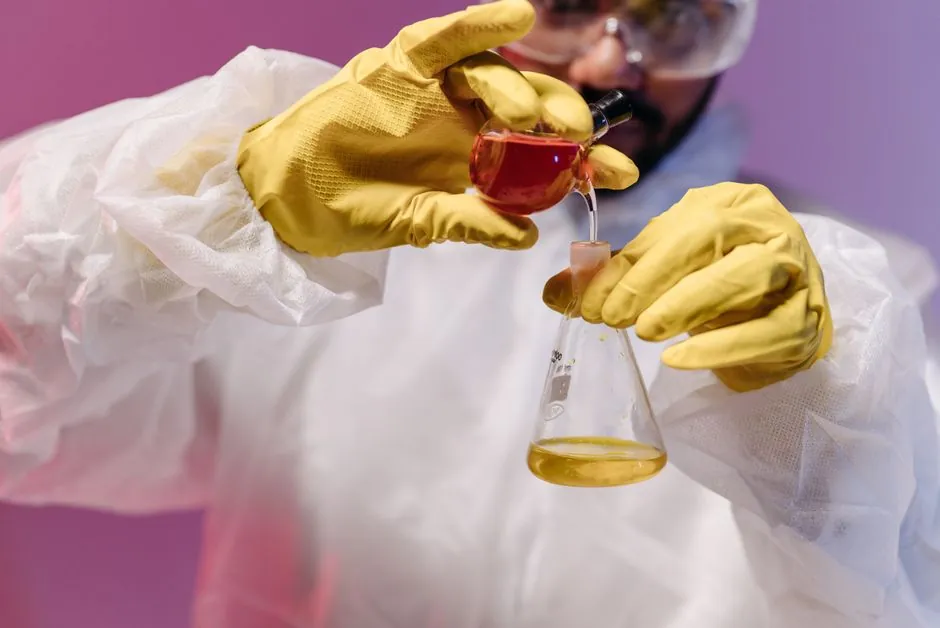
For chemical-plant glove specification in 2026, the working cut is polymer chemistry first, EN ISO 374-1 chemical letter codes second, and thickness third, with Nitrile, Neoprene, Latex, Butyl and Viton accounting for the bulk of industrial SKUs in major chemical-resistance catalogs [S2]. The category spans disposable 0.025 mm film to heavy 3 mm gauntlets, and a single plant typically stocks three or four constructions rather than a one-size glove [S2].
ASTM D6978-05 and ASTM F1671 chemotherapy-drug permeation testing shows up alongside the European EN 374-1 framework on premium SKUs, while OSHA PPE standards remain the compliance baseline for U.S. plant use [S2]. Buyers should treat glove selection as a per-chemical risk assessment, not a generic PPE purchase, because natural rubber tolerates dilute inorganic acids but fails rapidly against concentrated nitric and sulfuric acid [S4].
Polymer family vs. chemical class: the core decision matrix
Butyl (141 SKUs) and Viton (10 SKUs) dominate polar-solvent and ketone handling, while Nitrile (402 SKUs) remains the workhorse for fuels, oils, and many acids within its concentration window [S2]. Neoprene (161 SKUs) and Neoprene/Nitrile blends (e.g. MICROFLEX 93-260, 0.20 mm, EN ISO 374-1 Type A with letter codes JKLOPST) cover caustics, alcohols, and acids where Nitrile is marginal, and Latex (200 SKUs) handles dilute aqueous chemicals but degrades fast against hydrocarbons [S2]. For the highest permeation resistance to aromatics, chlorinated solvents, and esters, fluoroelastomer (Viton) and laminated-film (7 SKUs) are the default, with the trade-off being cost and reduced dexterity [S2].
Selection logic: if the chemical is a hydrocarbon, oil, or fuel, lead with Nitrile; if it is an acid, caustic, or alcohol, lead with Neoprene or Butyl; if it is a strong solvent (ketone, ester, chlorinated), specify Butyl, Viton, or a laminated film; and treat Latex as a dilute-aqueous / biological option only [S2][S4]. The thicker the glove the longer the breakthrough time, so heavy Butyl at 0.71 mm or 0.76 mm is the typical choice for sustained handling of concentrated acids, whereas 0.06 mm to 0.11 mm Nitrile is restricted to splash protection during sampling [S2].
EN ISO 374-1, EN 374-5 and EN 388: what the codes actually require
EN ISO 374-1 categorises chemical permeation as Type A (six tested chemicals, letter-coded), Type B (three), and Type C (one), with the letter code (e.g. J = n-Heptane, K = Sodium Hydroxide 40%, L = Sulphuric Acid 30%, O = Ammonium Hydroxide 25%, P = Hydrogen Peroxide 30%, S = Hydrofluoric Acid 40%) printed on the glove marking [S2]. A premium Type A neoprene-nitrile (e.g. MICROFLEX 93-260) ships with code JKLOPST and AQL 0.65, which is the typical acceptance quality limit for laboratory-grade disposable chemical gloves [S2].
EN ISO 374-5 covers microbial hazard: "Bacteria, Fungi WITH Virus Protection" is the highest tier and is mandatory for gloves used against biological contamination in plant labs, while plain "Bacteria, Fungi" is acceptable for general chemical handling [S2]. EN 388 (referenced via EN 388:2003 and EN 388:2016 on the same datasheet) covers mechanical resistance to abrasion, cut, tear, and puncture, which matters when the same glove is used for valve turning or drum handling as for chemistry protection [S2]. For radiation or microbial contamination zones, EN 421 (protection against ionising radiation and radioactive contamination) is added to the compliance line [S2].
Thickness, length, and fit: engineering the right physical barrier
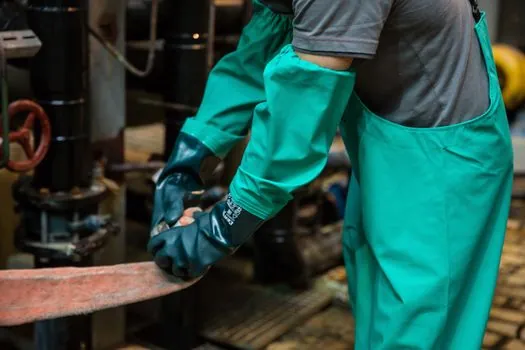
Catalog thickness spans 0.025 mm to 3 mm, with the dense 0.38 mm bin (80 SKUs) reflecting the most common mid-duty Nitrile/Neoprene industrial glove [S2]. The 0.45 mm to 0.55 mm range covers heavy butyl and neoprene gauntlets for bulk acid transfer, while 0.71 mm and 0.76 mm sit in the premium heavy-solvent tier with 19 and 25 SKUs respectively [S2]. Length is typically 30 cm (11.8 in) for wrist-cuff laboratory styles and 36 cm to 40 cm for elbow-length gauntlets used at bulk-transfer stations.
Size coverage in the 2026 catalog runs from size 6 (12 SKUs) through size 11 (72 SKUs) with size 9 (109 SKUs) and size 10 (127 SKUs) as the modal sizes, and ambidextrous construction is standard for disposable to mid-thickness gloves [S2]. For unlined Butyl, the trade-off is dexterity vs. permeation time, and many plants issue a thin Nitrile liner under a heavy Butyl gauntlet for prolonged ketone handling. Glove cuff style (beaded, straight, gauntlet) is the third decision after polymer and thickness, because beaded cuffs improve donning and reduce roll-down during wet work [S2].
Standards compliance, audit trail, and FDA-grade options
FDA 21 CFR 177.2600 (rubber articles intended for repeated food contact) appears on laboratory SKUs together with ISO 9001 QMS audit and ASTM D6978-05 chemotherapeutic permeation compliance, which is the closest U.S. analogue to EN 374-1 chemical permeation [S2]. For European plant issue, the compliance line typically reads Category III (PPE Regulation 2016/425, third-party-monitored for high-risk use), EN 420:2003 + A1:2009 (general glove requirements), and EN ISO 374-1 / EN 374-5 chemical/microbial codes [S2]. The EAC TP TC 019:2011 (Eurasian Customs Union) certification is also commonly stamped, so procurement in multi-jurisdiction plants should look for the full bundle rather than EN alone [S2].
Latex-free, powder-free, and unlined constructions are now default for most disposable chemical SKUs, with only 25 rubber-latex SKUs carrying the natural-rubber tag versus 402 Nitrile in the same catalog [S2]. The unlined MICROFLEX NeoTouch 25-201 (29 cm / 11.5 in, Neoprene, 0.16 mm) is a representative powder-free, partially-textured chemical-resistant SKU for cleanroom-adjacent lab work [S2]. For higher-tier hand protection in process areas, see safety glove selection for oil and gas facilities, which follows the same polymer/standards logic under NACE MR0175 and EN 374 gates.
Failure modes, mis-specification traps, and supply-chain notes
The most common mis-specification is issuing Nitrile where the contact chemical is a strong ketone (acetone, MEK) or chlorinated solvent (methylene chloride), where Nitrile permeates rapidly and Butyl or Viton is required [S2]. Conversely, defaulting to thick Butyl for routine acid sampling costs dexterity and leads workers to remove the glove for fine tasks, which is the underlying failure mode in most chemical-handling incidents [S4]. Natural rubber (Latex) is also frequently misapplied to hydrocarbon service, where it swells and loses barrier integrity within minutes [S4].
Another trap is treating the EN 374 letter code as a permanent property: permeation time is measured at a defined temperature and is degraded by temperature, mechanical flexing, and contamination of the inner surface, so a Type A glove on letter K (NaOH 40%) does not guarantee the same breakthrough time on a 50 degrees C line as on a 23 degrees C bench [S2]. Plan glove replacement against the EN 374-1 measured permeation time divided by an appropriate safety factor, and inspect before each donning. Chemical-safety glove manufacturing concentration in China is heavy (Hubei, Jiangsu, Guangdong clusters), and procurement teams should verify ISO 9001, EN 374 test reports, and ASTM D6978 where applicable rather than relying on catalogue claims [S3]. For a wider view on how elastomer hardness and certification gates work in process equipment, see industrial rubber selection for oil and gas.
Sourcing and supplementary PPE: tying gloves into a hand-protection program
Specifying a glove is the easy half; the harder engineering step is the chemical inventory cross-reference, where each SDS chemical is mapped to a polymer, a thickness, a length, and an EN 374-1 letter code [S2]. For benzene, toluene, xylene, and gasoline, the working answer is Nitrile 0.38 mm or heavier; for glacial acetic acid, Butyl 0.71 mm is the conservative call; for 40% hydrofluoric acid, the EN 374-1 letter code S is required on the marking, and only certain Butyl and Neoprene SKUs carry it [S2]. Plants operating mixed acid/alkali/solvent streams usually run a three-tier issuance: 0.20 mm Nitrile for light splash, 0.40 mm Neoprene for general acid/alkali, and 0.71 mm Butyl or Viton gauntlets for bulk solvent transfer.
Gloves never stand alone in chemical-plant PPE: eye, body, and respiratory protection must be specified on the same chemical-permeation logic, and the broader fire-safety and machine-safety context is covered under fire safety and machine safety in the technical reference set. A good next step for any chemical-plant PPE audit is to pull the current EN 374-1 / ASTM D6978-05 test certificate for each stocked glove, and confirm that the letter code printed on the cuff matches the chemicals actually on site, because a mismatch on even one high-hazard chemical invalidates the program for the whole line.
For component-level specifications, see safety gloves.