NIOSH 42 CFR Part 84 defines the three particulate filter classes (N, R, P) with efficiency bands of 95, 99, and 99.97%, and for structure fire overhaul and wildland post-fire cleanup a P100 filter is the standard minimum because the contaminant is typically oil-bearing and sub-micron [S2].
CE-side, EN 149:2001 + A1:2009 sets the FFP1/FFP2/FFP3 bands at 80/94/99% minimum filtration, with FFP3 the only class that approaches the P100 efficiency on solid and liquid aerosols; EN 143 covers the equivalent bayonet-cartridge P1/P2/P3 used with reusable half masks [S2].
Class Selection by Fire Phase and Contaminant
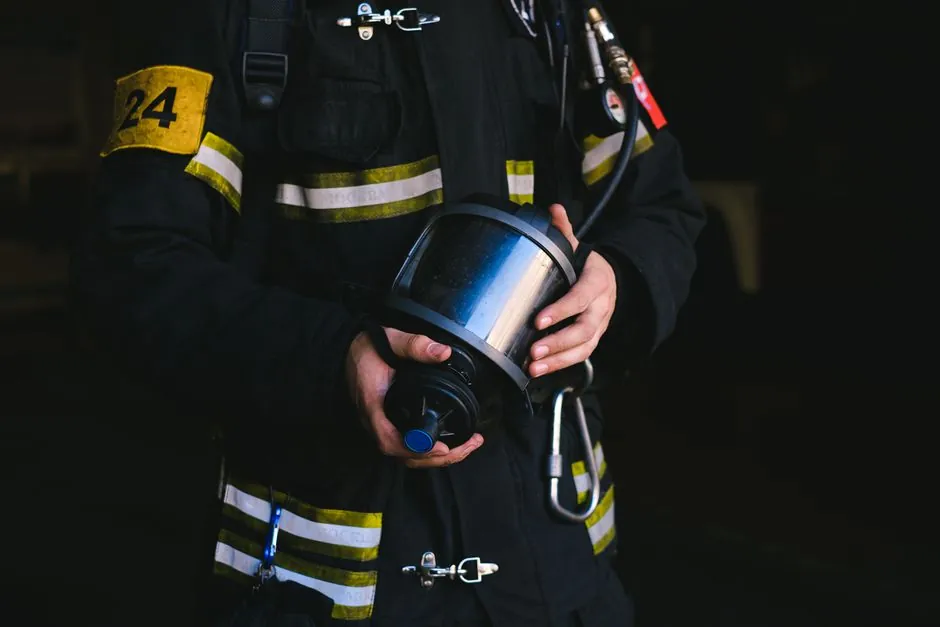
During active knockdown the respirator is the SCBA facepiece, not a dust mask, because the atmosphere is IDLH by definition and oxygen may be below 19.5% [S2].
During overhaul, when suppression is complete but char, asbestos in older structures, silica from concrete spall, and lead-bearing dusts remain, a half-face elastomeric with P100 cartridges is the common specification; the half-face must carry a fit factor of at least 100 to meet OSHA 29 CFR 1910.134 quantitative fit testing [S2].
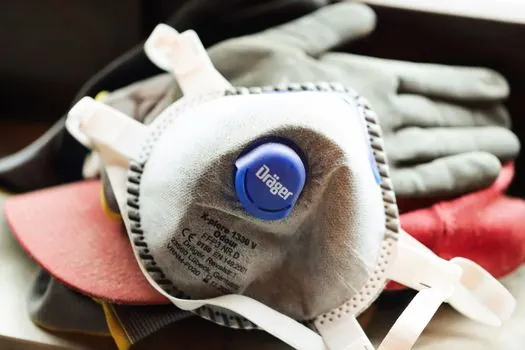
For wildland post-fire mop-up where particulates dominate and no gas/vapor hazard is present, a filtering half-face FFP3 with exhalation valve can be specified, provided the jurisdiction accepts non-sealed filtering facepiece respirators in smoky atmospheres; the trade-off is no eye protection and a fit factor near 10-20, which does not meet the Assigned Protection Factor 10 expected of a half-face elastomeric [S2].
Half-Face vs Full-Face vs Hooded Configurations
Half-face elastomeric respirators cover the chin, mouth, and nose only, weigh 100-200 g, and use bayonet P100 cartridges; they allow direct SCBA facepiece donning over the top if the mask is removed at the door, but cannot be worn simultaneously with the SCBA facepiece because the two elastomeric seals interfere [S2].
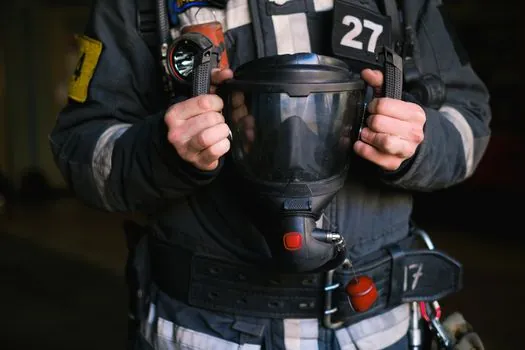
Full-face elastomeric respirators add a polycarbonate visor with ANSI Z87.1 impact rating, raise the APF to 50, and provide eye protection against UV, sparks, and irritant smoke; they are the correct choice for overhaul in smoldering structures where eye irritation is the dominant complaint [S2].
Powered air-purifying respirator (PAPR) hoods, such as those specified in EN 12941 / EN 12942 class TH3, deliver filtered air at 120-160 L/min to a loose-fitting hood, eliminate fit-testing, and are used by European fire brigades for prolonged overhaul; the head harness and chin strap must clear the SCBA facepiece mounting bracket when the wearer transitions to a fresh-air feed [S2].
Helmet, Mask, and SCBA Mechanical Coupling
The binding between a structural fire helmet (EN 443:2008 or NFPA 1971) and the respirator is a known interference point; the helmet's front brim can shear the top strap of a half-face elastomeric and break the seal during forward head tilt [S1].
Patented coupling designs integrate a blower unit between the helmet crown and the mask frame so the helmet suspension becomes the mask retention harness, removing the top strap and lifting the seal line above the brim line [S1].
When a SCBA facepiece must be donned later, the helmet-mask assembly is removed as a single unit to avoid re-donning a contaminated half-face inside the structure; departments specifying this coupling must include a doffing drill in the SOP because the integrated harness changes the removal sequence [S1].
Filter Service Life and Replacement Triggers
P100 cartridges for fire overhaul typically load with 1-2 g of particulate before the pressure drop across the filter rises above the OSHA breathing-resistance limit of 35 mm H2O for inhalation and 25 mm H2O for exhalation, and most brigades set a one-shift service life as a hard cap regardless of measured loading [S2].
Char and soot aerosols carry polyaromatic hydrocarbons that can off-gas from a loaded cartridge; a P100 with an integrated acid-gas layer (P100/AG) is specified for overhaul in structures where PVC, polyurethane foam, or electrical insulation has burned, because HCl and HCN are present at sub-IDLH but TLV-exceeding levels [S2].
FFP3 filtering facepieces are single-shift disposables; any mask that has been wetted by water spray, sweat, or fire-suppressant foam loses electrostatic filtration efficiency and must be bagged and replaced, not dried and reused [S2].
Selection Gates and Decision Matrix
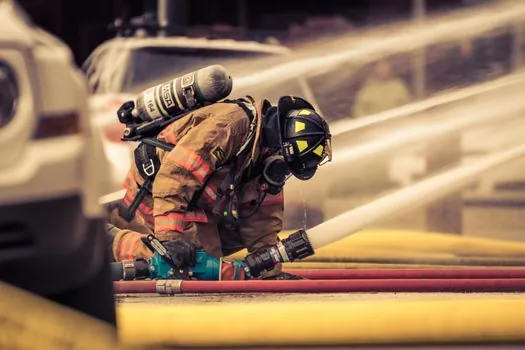
For structure fire overhaul inside a known IDLH atmosphere the minimum specification is a SCBA with NIOSH-certified facepiece, not a dust mask, per 29 CFR 1910.134(d)(2); using a half-face P100 in this phase is a respiratory protection program violation [S2].
For overhaul in a non-IDLH atmosphere, spec FFP3 (EN 149) or P100 elastomeric (42 CFR 84) with fit factor ≥100; full-face adds eye protection and APF 50 if the visor rating is Z87.1+ [S2].
For wildland post-fire mop-up with particulates only, FFP3 with valve is acceptable; for any acid-gas or VOC concern upgrade to half-face elastomeric with combined P100/AG cartridge and quantitative fit test [S2].
For confined-space post-fire entry, the configuration is identical to the Dust Mask Selection for Confined Space Entry: Spec Gates and Limits reference, with the addition that the SCBA facepiece replaces the dust mask the moment a continuous monitoring instrument reads below 19.5% O2, which is a common case in basement overhauls [S2].
Failure Modes and What Not to Specify
Valved FFP3 masks must not be used in surgical or sterile environments because the exhalation valve vents unfiltered breath, and this valve is the same valve that makes the mask comfortable in fire overhaul [S2].
Half-face elastomerics must not be specified for atmospheres above 10× the PEL when the contaminant is an unknown IDLH; in that case the choice is SCBA, not a higher-class cartridge, because cartridge sorbent capacity against unknown mixtures is not bounded [S2].
Beard growth between the face and the elastomeric seal breaks the fit factor regardless of filter class, and OSHA 29 CFR 1910.134(g)(1) forbids tight-fitting respirator use with facial hair that crosses the sealing surface; a PAPR hood with loose fit is the only alternative for a bearded firefighter on overhaul duty [S2].
Standards and Certification Anchors
NIOSH approval under 42 CFR Part 84 is the binding US certification for P100 and similar particulate filters, and the approval number is printed on every cartridge and on the mask body; an EN 149 FFP3 mask without NIOSH approval is not legal in US municipal fire service [S2].
EN 149:2001 + A1:2009 is the binding EU standard for FFP-class filtering half masks, EN 143 governs reusable P-class cartridges, and EN 14387 covers combined particulate + gas cartridges; CE marking under PPE Regulation (EU) 2016/425 is required for any dust mask placed on the EU market as fire PPE [S2].
Fit testing follows OSHA 29 CFR 1910.134 Appendix A (qualitative, QLFT) or Appendix B (quantitative, QNFT) on the US side, and EN 13949 on the EU side; the test must be repeated annually, after weight change of 10% or more, and after any dental work that alters the seal line [S2].
For a parallel look at the same class of mask used outside fire response, the Dust Mask Selection Gates for Warehouse Operations reference covers warehouse-specific load cases (silica, grain, fiberglass), where FFP2 is often the right economic pick and the FFP3 / P100 minimum from fire service is over-spec.
Track these two signals over the next quarter: any NIOSH publication updating the P100 loading guidance for char/soot aerosols above the 1-2 g heuristic, and any revision to EN 149 that adds a smoke-aerosol test class between FFP3 and TH3, both of which would shift the half-face vs PAPR-hood line for European fire brigades.
For the relevant spec sheets and selection criteria, see dust mask, dust detector, and dust particle meter.