
Chemical reagent specification is governed by application class first, purity grade second, and supplier audit trail third — a hierarchy that eliminates roughly two-thirds of catalog options before price is even considered, per industry reagent taxonomies [S1].
Reagent selection sits at the front of every analytical, synthesis, and process-chemistry workflow, and the wrong grade in the wrong bottle costs more in failed runs than the cheapest-vs-priciest delta on the quote. Chinese manufacturers such as Zhejiang Sanying Chemical Reagent Co., Ltd. continue to expand catalog coverage of ACS, AR, CP, and specialty reagent grades for both domestic and export channels [S2]. For specifiers building a chemical reagent shortlist, three control variables dominate: purity tier, application match, and documentation depth.
Purity Grade Tiers and Assay Thresholds
Reagent purity is communicated through graded labels — ACS (American Chemical Society), AR (Analytical Reagent), CP (Chemical Pure), LR (Laboratory Reagent), and electronic/ semiconductor grades — each carrying a documented minimum assay and impurity envelope [S1].
ACS grade typically requires assay ≥ 95% for inorganic salts and ≥ 99% for many organics, with individual metal impurity caps stated in ppm; AR grade aligns with major pharmacopoeia monographs; CP grade permits wider impurity bands suitable for synthesis intermediates and bulk washing. Chiral chemical reagents — used in asymmetric synthesis and enantioselective analysis — are additionally governed by enantiomeric excess (ee%), often specified at ≥ 99% ee for pharmaceutical-chirality work, and the mirror-image (R/S or D/L) form is part of the catalog identity rather than a footnote [S1]. For process engineers, treating purity grade as a hard spec, not a marketing label, is the single most common fix for out-of-spec results.
Application Class Drives the Real Spec
Application class — analytical, synthesis, chromatography, spectroscopy, electrochemistry, life-science, or industrial bulk — is the primary filter because it dictates which impurity matters; trace metal work rejects iron at ppb, while organic synthesis tolerates it at ppm [S1].
Chromatography-grade solvents carry HPLC or GC residue specifications on the Certificate of Analysis (CoA) and a UV cutoff (commonly 190–210 nm for HPLC gradient grade); spectroscopic-grade solvents add water-content caps (often < 50 ppm Karl Fischer) and controlled packaging under inert gas. Life-science reagents — buffers, cell-culture media components, molecular biology enzymes — add bioburden, endotoxin, and DNase/RNase-free certification to the spec stack. Choosing by grade label alone, without the application class match, is the most common cause of rejected batches in QA review.
Selection Criteria Compared Across Reagent Categories
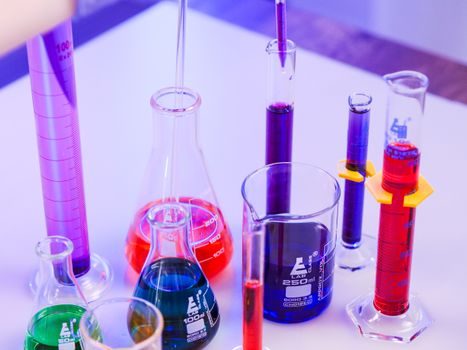
Four decision criteria separate usable reagents from catalog filler: assay/ee%, impurity profile, documentation (CoA + SDS + traceability), and form-factor (solid/liquid, concentration, packaging). [S1]
Across the main reagent classes, the weighting shifts: for ACS inorganic salts, assay and trace-metal profile dominate; for chiral reagents, ee% and absolute configuration override everything else [S1]; for HPLC solvents, UV cutoff and residue-by-evaporation are decisive; for buffer salts, pH-stability data and chloride content usually decide the call. Documentation depth — lot-specific CoA, expiry date, manufacturing date, country of origin, and SDS aligned to GHS — is a tie-breaker that downstream audits (ISO 17025, GMP, FDA) will check regardless of the grade label on the bottle.
Supplier Verification and Sourcing Map
Supplier verification is the third pillar: a reagent is only as trustworthy as the audit chain behind the lot number, and Chinese suppliers now publish full CoA traceability alongside product listings on B2B directories [S2].
Specifiers should require lot-specific CoA download, manufacturing date, retest/expiry interval, and an SDS that matches the GHS classification current to the shipping year. For chiral reagents, the CoA must include a chiral-HPLC chromatogram or polarimeter reading with method reference, not just a stated ee% [S1]. For regulated use (pharma, food, environmental), confirm the supplier holds ISO 9001 minimum, and for pharmacopoeial work look for USP/EP/JP grade cross-reference. Catalog aggregator pages — such as the chemblink category index for chiral reagents [S1] — give a one-glance map of which suppliers publish ee% and which do not, which alone filters a meaningful share of weak listings.
Storage, Stability, and Failure Modes

Reagent failure is rarely the supplier's fault; it is almost always a storage envelope issue — temperature, humidity, light, oxygen, and shelf-life since the manufacturing date stamped on the CoA [S1].
Hygroscopic solids (CaCl₂, NaOH pellets, anhydrous salts) drift in weight and assay once the seal is broken; light-sensitive organics (nitrobenzene, silver salts, many chiral catalysts) degrade to colored impurities within days of ambient exposure; peroxide-formers (THF, diethyl ether, dioxane) must be checked for peroxide value before distillation. A documented first-open date on the bottle, paired with the supplier's retest interval, is the cheapest control in the lab. For materials-handling context where reagent contamination is a risk, a quick read of Industrial Rubber Selection Criteria: Polymer, Hardness, Service Envelope helps specifiers pick the right glove/seal polymer so the reagent never touches the wrong elastomer in transfer.
Standards, Documentation, and Regulatory Anchors
Reagent specifications anchor to a stack of standards rather than a single document: ACS Reagent Chemicals (current edition), ISO 6353 for reagent designations, pharmacopoeial monographs (USP, EP, JP) for regulated use, and GHS-aligned SDS per UN GHS Rev. 9 or later for hazard communication [S1].
For trace analysis, ISO 17025-accredited suppliers are typically required because the lab's own accreditation depends on it. For chiral reagents used in API manufacture, ICH Q3D elemental-impurity guidance and the relevant pharmacopoeial monograph govern the trace-metal spec on the CoA [S1]. When the reagent is consumed in a process step rather than an analytical method, the relevant ISO 9001 / GMP manufacturing standard takes precedence over analytical grade labels. The takeaway: a chemical reagent spec is a layered document, and skipping any layer is what generates the next deviation report.
Who This Criteria Stack Is For — and Who It Is Not

This selection logic fits QA/QC labs, R&D synthesis groups, process-chemistry scale-up, and regulated manufacturing (pharma, food, environmental); it does not fit commodity bulk chemicals purchased by tanker for non-critical plant use, where price-per-kg and dual-source supply dominate the call [S2].
Academic teaching labs and K-12 education are a borderline case: CP/LR grade is usually sufficient and the cost delta against AR/ACS is meaningful, but documentation must still support safe disposal. Hobbyist and small-business buyers without a CoA review process should default to AR/ACS grade even at higher unit cost, because the failure cost of an unverified reagent in a non-lab setting is disproportionate.
Track the supplier-side signal next: watch whether the chiral-reagent category continues to publish ee%-specific CoA as the default (not on request), and whether Chinese B2B directories expand lot-traceability filters on the standard product page beyond the basic buying-request form [S2]. A second trackable node is any 2026 update to the ACS Reagent Chemicals specification monograph, which historically retires legacy grades and tightens trace-metal caps every 3–5 years.
For component-level specifications, see chemical anchor, and pressure transmitter.