Titanium alloys are specified across aerospace, medical, chemical and marine builds because they combine a density near 4.5 g/cm³ with tensile strengths that routinely clear 900 MPa in common grades such as Ti-6Al-4V, giving a specific strength that beats most stainless and nickel alloys [S1][S2].
That same chemistry — a strong oxide passivation layer, low thermal conductivity around 6-8 W/(m·K) at room temperature, and high chemical reactivity at elevated temperature — is exactly what makes titanium alloys expensive to cut, hard to polish, and a real headache in any shop that runs high-volume machining [S1][S2].
Where Titanium Alloys Win: Specific Strength, Corrosion, Bio
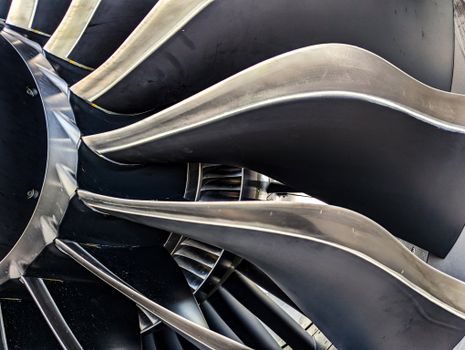
The single biggest reason titanium alloys stay on a BOM is specific strength: density is roughly 57% of steel, so the same component comes in nearly half the weight for equivalent strength [S1][S2]. This is why compressor discs, blades, stators and rotating hardware in aero engines default to titanium rather than nickel-alloy — the rotating mass is lower, the fatigue envelope is wider, and the operating-temperature ceiling of ~315-400 °C for Ti-6Al-4V covers most fan and low-pressure compressor stages [S2].
Corrosion resistance comes from a stable, self-healing TiO₂ passive film that resists chloride, seawater, oxidising acids and most wet-process chemistries that would pit 300-series stainless or attack alloy-steel grades [S1]. Biocompatibility rides on the same oxide layer: bone and soft tissue tolerate it, which is why hip stems, knee joints, dental implants and trauma plates have been titanium-default for decades [S2].
Where Titanium Alloys Lose: Machining, Polishing, Cost
The trade-off starts on the shop floor. Low thermal conductivity traps heat in the cut, so cutting temperatures at the tool-workpiece interface climb high enough to accelerate crater wear, edge chipping and catastrophic tool failure — drilling Ti-6Al-4V with uncoated WC/Co drills, for example, was dominated by non-uniform flank wear, chipping and catastrophic failure even with coolant applied [S4]. Tool-condition monitoring based on machine learning is an active research response to this problem precisely because manual monitoring cannot keep up with precision production [S1].
Polishing is the second pain point. Titanium alloys are classed as difficult-to-polish materials, and four families of process — mechanical polishing, high-energy beam polishing, chemical polishing and compound polishing — are documented in the literature, each with its own surface-quality, equipment and cost profile, and none of them trivial [S2]. Compared with an aluminum-alloy or mild-steel polish line, throughput is lower, consumable cost is higher, and the surface-integrity result is more sensitive to parameter drift. Material cost sits on top: titanium sponge and mill-product pricing is structurally above stainless and aluminum, so the bill of materials alone can rule titanium out of high-volume consumer hardware.
Comparative Read: Titanium vs Stainless, Aluminum, Nickel
For a spec engineer, the practical comparison is along four axes: specific strength, corrosion envelope, maximum service temperature and machining cost. Titanium leads on specific strength and corrosion, runs to roughly 315-400 °C in Ti-6Al-4V (lower than nickel superalloys at 700 °C+ but higher than most aluminum alloys capped near 150-200 °C), and pays for it in tool consumption, cycle time and per-kg material cost [S1][S2][S4].
Stainless and nickel grades win where temperature and time-on-machine dominate; aluminum wins where weight matters less than throughput and unit cost. Titanium wins where the operating envelope is hostile (chloride, oxidising media, cyclic fatigue) or where weight directly drives fuel burn, payload or implant success [S1][S2]. A useful sanity check: if the component runs cool, sees benign atmosphere, and the unit count is in the tens of thousands, titanium is usually the wrong answer.
Selection Criteria: When to Specify Titanium, When Not To
Specify titanium when at least one of these is a hard requirement: strength-to-weight critical, sustained fatigue loading in a corrosive environment, biocompatibility, or galvanic compatibility with carbon-fibre composites. A typical decision gate reads: temperature under ~400 °C, environment chloridic or oxidising, mass target aggressive, and willingness to absorb 3-10× the machining cost of mild steel [S1][S2].
Do not specify titanium when the part is a high-volume commodity, runs well below 200 °C in a benign atmosphere, or carries a unit-cost ceiling that machining economics will break. For those cases steel plate and aluminum remain the rational pick. The same cost discipline that pushes commodity steel selection also drives the question of whether a heavier but cheaper cast iron component can hit the service envelope — the lifecycle math often does, even when the strength-to-weight number on paper favours titanium.
Failure Modes and Shop-Floor Constraints

The three failure modes a spec engineer has to design around are galling on threaded joints, hydrogen embrittlement at high-temp processing, and the wear-geometry trap on machined surfaces. Low thermal conductivity drives the wear issue: heat does not evacuate through the chip, so localised temperatures rise, tool life collapses, and the surface integrity a downstream polish operation has to remove gets worse, not better [S1][S2][S4].
Empirical data from Ti-6Al-4V drilling shows that even TiAlN-PVD coated carbide drills suffer chipping and catastrophic failure when cutting speed and coolant strategy are mis-tuned, so the process window is narrower than the equivalent stainless envelope [S4]. Operations that ignore this typically see tool consumption 5-10× higher than on 304/316 stainless for the same material-removal rate, which is why accurate cycle-time quoting separates profitable titanium work from money-losing titanium work.
Process-Response Map: Cutting, Polishing, Monitoring
Three process tracks are converging on the same titanium problem. First, machine-learning-based tool condition monitoring — using force, vibration and acoustic-emission features to predict remaining useful life — is moving from research to production because manual operator-based monitoring cannot keep up with precision-manufacturing tolerances on titanium parts [S1].
Second, polishing is fragmenting into four families (mechanical, high-energy beam, chemical, compound) with documented trade-offs in surface integrity, equipment footprint and cost, and no single winner across all part geometries [S2]. Third, coated-carbide tooling with controlled coolant delivery and lower cutting speeds is the practical near-term answer for shops without an ML stack, even though tool wear and chipping remain dominant failure signatures [S4].
Standards, Sourcing and Trackable Signals

No single ISO or ASME standard governs "the advantages of titanium alloys" — instead, the spec environment is layered: material standards (ASTM B265 for plate/sheet, B348 for bar/billet, F136 for surgical implant Ti-6Al-4V ELI), aerospace process specs (AMS 4911, AMS 4928 for Ti-6Al-4V product forms), and machining guidance under NADCAP and OEM-specific process specifications. Material property values cited here — ~4.5 g/cm³ density, 6-8 W/(m·K) room-temperature thermal conductivity, ~900 MPa tensile for Ti-6Al-4V — are widely published in supplier datasheets and corroborate the qualitative picture in [S1][S2].
Two trackable signals to watch through the rest of 2026: continued research output on machine-learning tool-condition monitoring for titanium machining, which has been growing year-on-year [S1]; and incremental tooling-grade releases from the major carbide suppliers targeting titanium-specific geometries and coatings, which is the commercial response to the chipping and catastrophic-failure patterns documented in [S4]. For engineers cross-referencing with adjacent spec work, the same cost-vs-performance logic that drives silicon-steel installation and sourcing decisions applies to titanium: process discipline, not raw material price, decides the lifecycle number.