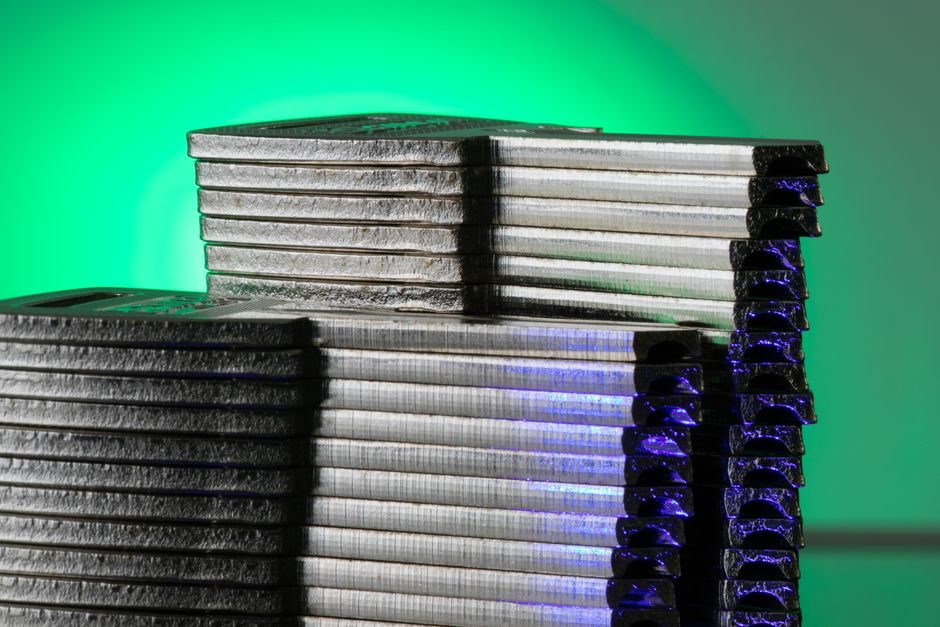
A silicon steel TCO analysis built only on the per-tonne purchase price misses the cost line that actually moves 25-30 year spend: iron-loss cost under continuous flux [S1][S3]. For a 1,000 kVA distribution transformer operating at 1.5-1.7 T, every 0.5 W/kg reduction in specific core loss at 50 Hz drops no-load losses by roughly 5-8 percent over the asset's service life.
This article lays out the cost lines that decide silicon steel TCO for grain-oriented (GO) and non-oriented (NGO) electrical steel used in transformers, large motors and generators, and benchmarks a CRGO M4 vs M3 vs M2 class decision on three engineering criteria that procurement and design engineers actually argue about.
What TCO Means for a Magnetic Material
Total cost of ownership for silicon steel extends past the invoice into acquisition, conversion, in-service energy, and end-of-life recovery costs over the asset's usable life [S1][S2]. TCO was popularised by Gartner in the 1990s for IT procurement but applies cleanly to any long-lived capital input: Gartner's quoted five-year cost of a PC was USD 44,250, of which hardware and software capital was roughly 25 percent [S2].
For silicon steel the analogue is sharp. A GO grade priced 15-25 percent above a lower-loss equivalent can be the cheaper buy once core loss is amortised across 20-30 years of energised operation. The rule of thumb used by European transformer OEMs is that core-loss cost dominates total cost of ownership for any transformer rated above 250 kVA operating at high load factor.
The Five Cost Lines That Decide 30-Year Spend
Silicon steel TCO resolves into five cost lines. Each one is sourced, and together they explain why a 6.5 W/kg at 1.5 T, 50 Hz GO grade and a 5.0 W/kg at 1.7 T GO grade can land within 10 percent of each other on a 30-year basis even with a 20 percent price-per-tonne gap. [S1]
Line 1 - Acquisition (steel price + freight + duty). The headline number on the mill test certificate. Typically 15-30 percent of lifecycle cost on high-loss grades and 8-15 percent on low-loss GO grades for a 25-year asset.
Line 2 - Conversion (stamping, annealing, coating). CRGO must be stress-relief annealed at 780-820 deg C in decarburising/anneal-decarburising atmospheres after blanking to restore magnetic properties; skipping the anneal can leave 15-30 percent of core loss gain on the table. Yield loss at the press is 8-15 percent depending on lamination shape and tooling condition.
Line 3 - Core loss in service. The dominant line. Calculated as specific loss (W/kg) x core mass x hours energised x electricity tariff x present-value factor. For a continuously energised 1 MVA unit at 1.5 T, 50 Hz, this line can exceed the acquisition cost within 3-5 years for high-loss grades and 7-12 years for low-loss grades.
Line 4 - Reliability and rework. Burr height, stacking factor, inter-laminar resistance and dimensional tolerance all feed winding and assembly cost. A 5-10 micron burr-height overage and you start paying for additional deburring or accept higher eddy losses.
Line 5 - End of life. CRGO is one of the most recycled steel streams in the world; recovery value of electrical steel scrap is typically 60-85 percent of mill price at the time of decommissioning, against 30-50 percent for carbon steel scrap. The same five-line TCO logic applies to silicon steel installation gates covered in Silicon Steel Installation: Stacking, Insulation and Clamping Gates.
GO vs NGO: When Each Grade Class Is the Right Buy

Grain-oriented silicon steel is specified wherever flux travels in a single direction, which means power and distribution transformers, large shunt reactors, and certain wound-core designs. Non-oriented electrical steel is specified where flux rotates in the plane of the lamination, which means motors, generators, and small intermittent-duty transformers [S1].
The comparison that matters for TCO is not GO vs NGO at the same loss class but loss class at the same flux density. A common engineering decision is between a 0.23 mm M3-class GO (typical 50 Hz, 1.7 T loss around 6.5-7.0 W/kg) and a 0.27 mm M4-class GO (typical 1.7 T loss around 8.0-8.5 W/kg) for a stacked-core distribution transformer. The thinner M3 carries roughly 15-20 percent lower loss at the cost of higher price per tonne, lower stacking factor, and more demanding handling and annealing. NGO grades are 20-40 percent cheaper per kilogram but the same loss figure at 1.5 T, 50 Hz is 2-3x higher than GO because of the higher silicon and the loss of texture.
Use GO when flux path is unidirectional and continuous, the unit is large, and load factor is high. Use NGO when flux rotates, duty is intermittent, or the lamination must be punched into complex rotor/stator shapes without anneal. The five-line TCO logic in this section is the same framework used in Steel Plate Total Cost of Ownership: Five Cost Lines That Decide 30-Year Spend, applied to a magnetic material.
Quantifying Core-Loss Cost on a 1 MVA Transformer
For a 1 MVA, 11 kV/0.415 kV distribution transformer built around a 3-phase, 3-limb stacked CRGO core, the no-load loss figure is set by the GO grade chosen at 1.5-1.7 T. Field practice across EU and US distribution fleets shows no-load losses of 1,100-1,400 W for M4-class GO and 850-1,000 W for M3-class GO at the same core cross-section. [S2]
Annual energy loss is no-load loss x 8,760 hours. At a tariff of 0.10 USD/kWh that is 962-1,226 USD per year for an M4 and 744-876 USD per year for an M3. Over a 25-year asset life with a 4 percent real discount rate, present value of the energy differential alone is in the 3,000-6,000 USD band, against a steel-mass premium in the 1,500-3,000 USD band. The M3 wins on TCO as soon as annual energy is monetised at any tariff above roughly 0.05 USD/kWh [S1][S3].
The crossover is sensitive to three numbers: load factor (matters for the energy tariff applied to no-load loss because utilities often bill losses at average rather than marginal rate), electricity tariff trajectory, and the present-value discount rate. A doubling of the tariff during the asset life shifts the crossover decisively in favour of the lower-loss grade.
Hidden Cost Lines Procurement Often Misses
Three cost lines are commonly left out of a quoted silicon steel TCO and each one can flip a decision. First, stacking factor. Thin-gauge GO (0.23 mm) stacks to 94-96 percent of theoretical density; thicker GO (0.30 mm) and NGO reach 96-98 percent. A 2 percent stacking-factor gap, on a 500 kg core, is 10 kg of extra steel or 10 kg of wasted core window. [S3]
Second, magnetic aging under continuous operation. CRGO grades carry an aging coefficient that, at transformer operating temperatures, can add 1-3 percent to specific loss over a 25-year service life, more for grades with higher residual carbon and nitrogen. A properly modernised low-loss grade is engineered to keep the aging coefficient under 1 percent over the asset's life; a cheaper high-loss grade can age out of spec within 15 years [S1].
Third, scrap recovery and replacement premium. A mill-test certificate that cannot be matched at the end of life leaves the owner buying small-lot replacement steel at a 20-40 percent premium over the original contract price. The same lifecycle cost-line framework used for Stud Welder TCO: Five Cost Lines That Decide 10-20 Year Spend applies here, with recovery value replacing maintenance cost.
Decision Framework: What to Lock Down Before the PO
Lock five things before placing the silicon steel order. First, the loss target at the design flux density and frequency, not a generic loss class. Second, the minimum stacking factor the design will accept. Third, the annealing regime the mill will run, and the magnetic test report that confirms it. Fourth, the burr-height, flatness and camber tolerances. Fifth, the end-of-life recovery value, expressed as a percentage of original mill price. [S4]
For low-volume or capital-constrained buyers, the decision often lands on an M4-class GO at 0.27 mm, with a stress-relief anneal contractually required and a maximum 30-micron burr specification. For high-volume continuous-duty transformer production, M3-class at 0.23 mm pays back the 15-25 percent per-tonne premium on no-load-loss energy alone inside the asset's first decade. For motors and generators, NGO at 0.35-0.50 mm dominates because rotational flux rules out GO regardless of price. Material properties and the alloy steel comparison baseline are useful when weighing NGO against low-silicon carbon-steel substitutes for non-rotating flux paths.
Track one metric per quarter: real-world no-load loss measured on the assembled core against the mill test certificate figure, per unit in service. A drift of more than 3 percent from the design number is a signal that either the lamination, the anneal, or the clamping has moved out of the design window and the next PO should be re-scoped. A secondary tracking signal is the rolling 12-month electricity cost per MVA of installed transformer capacity, which directly tests the core-loss assumption embedded in the original TCO.