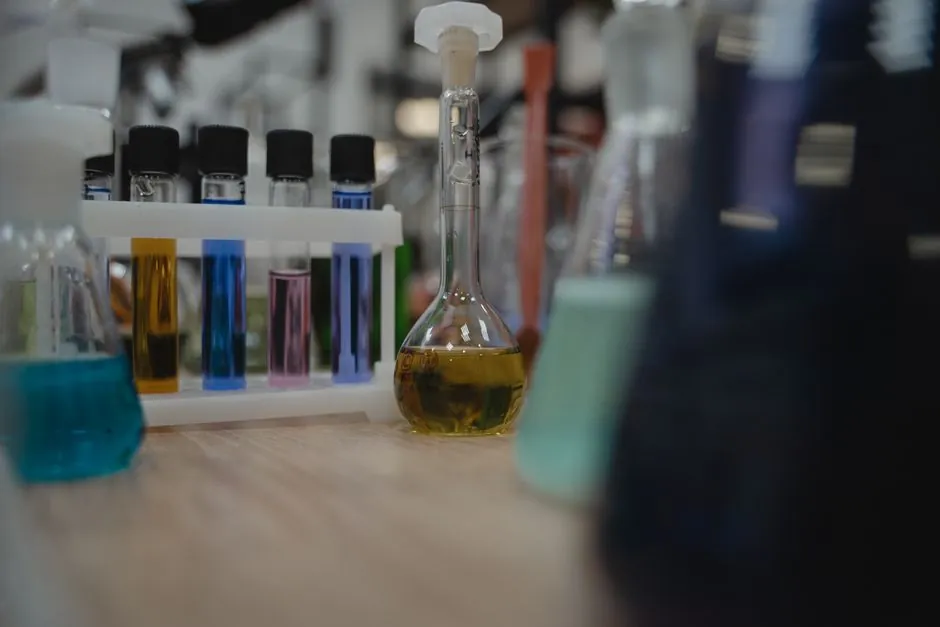
Chemical reagent selection is governed by two separate decisions that often get conflated: the purity grade, which fixes what contaminants and documentation you get, and the container format, which fixes how the reagent survives storage and dispensing on the bench.
ACS grade and Reagent grade are the analytical-laboratory benchmark, with both effectively set at a minimum 95% purity and aligned to the American Chemical Society's Reagent Chemicals monograph set, which covers almost 500 reagent chemicals and more than 500 standard-grade reference materials [S5][S6]. For industrial buyers, USP/NF, Food Chemicals Codex, and SEMI grades sit above or beside ACS depending on regulatory exposure [S4].
The seven common reagent grades and where each one actually fits
ACS grade is defined by the ACS Committee on Analytical Reagents, which publishes purity specifications and standard analytical methods used across academic, industrial, and pharma QC labs [S5]. Reagent grade is generally treated as equivalent to ACS grade (≥95%) and is acceptable for food, drug, or medicinal use, and suitable for routine laboratory and analytical applications [S6].
Laboratory grade is an in-house vendor label for chemicals that are pure enough for general lab use but do not carry ACS or USP documentation, while Technical grade targets manufacturing, cleaning, and synthesis where exact assay is less critical than cost per kilogram [S3]. USP or NF grade is mandatory when a substance is used as an active or excipient in a pharmaceutical product, since the United States Pharmacopeia and the National Formulary co-publish the joint USP-NF compendium that sets impurity limits and test methods [S4].
Food grade applies where the Food Chemicals Codex (FCC), now managed by USP, is the reference, and SEMI grade covers the high-purity acids, solvents, and etchants used in semiconductor wafer processing [S4]. For cell culture, Cell Culture Grade reagents are additionally tested to be sterile, mycoplasma-free, endotoxin-tested, and animal component-free, frequently meeting USP or ACS purity in parallel [S4].
Grade comparison against decision criteria: cost, purity, documentation, fit
The real choice is rarely between ACS and reagent grade, which are essentially interchangeable at ≥95% purity, but between that analytical tier and the lower-cost Technical/Lab grades or the higher-cost USP, FCC, and SEMI tiers [S3][S6]. A practical comparison the buyer can apply: ACS/Reagent grade costs 2 to 5 times more per kilogram than Technical grade, but ships with batch-specific assay, trace metal, and residual solvent data, while Technical grade typically ships with a single assay value and no impurity panel [S3].
USP/NF grade adds pharmacopeial method compliance and is required for any substance used as an active pharmaceutical ingredient or excipient, with documentation tied to the USP-NF monograph [S4]. SEMI grade is its own category: trace metal limits in parts-per-billion, particle counts per mL specified by tier, and packaging often in fluoropolymer-lined containers rather than standard glass [S4]. For routine industrial solvent selection the same purity logic drives the supplier shortlist, as mapped in industrial solvent suppliers 2026.
Container material: glass versus plastic and what survives what
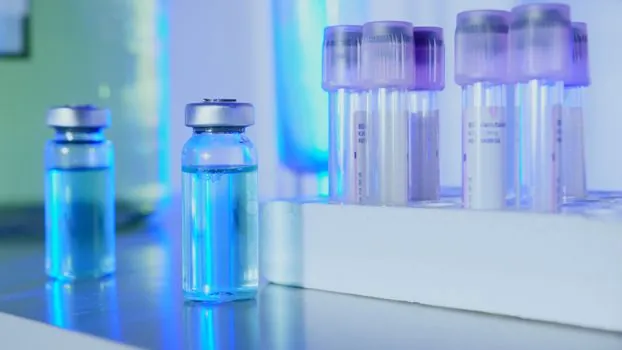
Borosilicate glass (Pyrex class) gives the best combination of thermal-shock resistance and acid compatibility, quartz is reserved for extreme heat and UV work, and soda-lime glass is cheap but vulnerable to strong bases and hydrofluoric acid attack [S1]. On the plastic side, polyethylene (PE) suits non-polar solvents and is flexible; polypropylene (PP) widens the temperature window and tolerates more acids and bases; polyethylene terephthalate (PET) is transparent for volume reading but is not suitable for aggressive reagents [S1].
For a deeper cross-reference between the reagent chemistry and the polymer compatibility, the chemical reagent encyclopedia entry lines up typical solvents, acids, and bases against PE, PP, PET, and borosilicate. A pre-purchase sanity check is to pull the manufacturer's chemical-resistance chart: Fisher Scientific publishes a free Resistance of Plastic Technical Bulletin covering common acids, bases, and solvents against PE, PP, PET, PTFE, and other polymers [S2].
Volume, neck, and cap: why shape matters as much as size
Standard reagent bottle volumes run from 10 mL up to 2 L, and the trade is straightforward: smaller bottles reduce waste on rarely used or expensive reagents, larger bottles cut the number of caps and labels a buyer has to manage [S1]. Wide-mouth geometries are easier to fill and clean with a brush; narrow-neck geometries slow vapor loss and reduce spill risk on the bench [S1].
Cap selection is a separate engineering choice. Screw caps with PTFE (Teflon) liners are the workhorse for corrosive liquids; stopper caps vent slowly and suit gases or reagents that build pressure; spray dispensers are reserved for volatile organics, with the pump elastomer matched to the solvent so it does not swell or leach [S1]. Amber borosilicate is the default for light-sensitive reagents such as hydrogen peroxide, silver salts, and many organometallics, and wrapping clear bottles in foil is an acceptable fallback when amber stock is unavailable [S1].
Who should and should not pick the mainstream ACS or Reagent grade

ACS or Reagent grade is the right pick for any analytical method where impurities can shift a baseline, interfere with a chromatogram, or compromise a titration, and for any method that needs to be reproducible across labs and over time [S3][S6]. It is also the right pick when the method or downstream regulator expects a documented batch certificate rather than a simple assay number [S5].
ACS grade is the wrong pick for bulk process chemistry where the reagent ends up as a raw material in a non-pharma product, where Technical or Laboratory grade delivers acceptable yield at a fraction of the cost [S3]. It is also the wrong pick for cell-culture work, where Cell Culture Grade is required for sterility, mycoplasma, and endotoxin testing even when the underlying chemistry is similar [S4]. For electronics fabs, ACS is insufficient: SEMI grade chemicals with sub-ppb metals and specified particle counts are mandatory [S4]. The same discipline of matching grade to duty cycle shows up in adjacent process equipment, as laid out in the industrial gas selection spec map.
Storage, segregation, and labeling: the part that decides if the reagent survives
Storage temperature, light, and humidity each have a defined effect on reagent stability. Refrigerated reagents belong on the back shelf away from the door to avoid warm-air spikes on every opening, and freeze-sensitive chemicals need a cryogenic locker with temperature logging [S1]. Light-labile reagents go into opaque amber bottles or get wrapped in foil and stored in a closed cabinet [S1].
Segregation rules are non-negotiable: acids segregated from bases, oxidizers segregated from organics to prevent runaway reactions, and flammable liquids stored in fire-rated cabinets that meet local fire codes [S1]. Labels should use solvent-resistant ink (alcohol markers smudge on PE and PP), include chemical name, CAS number, concentration, and the date the bottle was first opened, and ideally carry a QR code linking to the live Safety Data Sheet so anyone on the bench can pull the current document [S1]. For heavier inventory and process chemistry, the same cabinet-and-spill logic that drives chemical anchor and shelf selection shows up at the reagent storage layer as well.
Sourcing and standards: who publishes the rules
Two organizations effectively own the analytical-reagent purity book in North America. The American Chemical Society's Committee on Analytical Reagents sets the spec for high-purity laboratory chemicals and publishes the ACS Reagent Chemicals reference, which is updated twice per year and contains purity specifications for almost 500 reagent chemicals and more than 500 standard-grade reference materials [S5]. The United States Pharmacopeia, jointly with the National Formulary (USP-NF), sets purity and test-method requirements for substances used in pharmaceutical products [S4].
Around those, the Food Chemicals Codex (FCC, now under USP) governs food-grade purity, ASTM International publishes standard specifications for chemicals used in industrial testing and manufacturing, and SEMI sets the high-purity standards used across the semiconductor and electronics supply chain [S4]. AR (Analytical Reagent) is a separate vendor-defined label widely used outside North America for general analytical use and is comparable in intent to ACS grade, though the spec is set by the supplier rather than a published monograph [S7]. For documentation depth, the ACS Reagent Chemicals online edition releases supplements twice yearly and is the easiest single source for batch-traceable spec sheets and method links [S5].
Trackable signals for the next quarter: monitor the ACS Committee on Analytical Reagents update cadence (twice-yearly monograph releases), watch USP-NF revisions for any new impurity limits in common solvents, and confirm with suppliers that SEMI grade chemicals are still on allocation for the relevant electronics tier.
Spec-level background on the components involved: linear guide.