
China-based aluminum extrusion manufacturers listed 785+ active suppliers and 2,355+ stock SKUs on Made-in-China.com as of 2026-07-22, with the Wuxi/Jiangsu and Foshan/Guangdong clusters leading both volume and custom-extrusion depth [S4][S8].
The two dominant alloys across the supplier base are 6063-T5 for architectural profiles (windows, curtain walls, heat sinks) and 6061-T6 for structural and load-bearing applications, with 6005, 6082, and 6060 specified for specialised mechanical or transport use [S2][S5][S7].
Alloy and Temper Bands
Alloy 6063-T5 with 0.8–1.2 mm wall minimum and widths up to 300 mm is the default spec for construction and decoration-grade profiles; 6061-T6 is the workhorse for industrial, machinery, and high-load framing where yield strength above 200 MPa matters [S5][S7].
Yield strength of pure aluminium sits at 7–11 MPa, while aluminium-alloy extrusions span 200–600 MPa, which is why 6061-T6 replaces mild steel in many framing and conveyor applications [S2]. For reference, a deeper overview of how aluminum alloy grades map to application is published in the spec reference.
Custom-special alloys including 6082-T5 (transport frames), 6005-T5 (truck bodies), and 6060 (complex thin-wall architectural sections) are routinely quoted on the same platforms, with 6081-T5 listed explicitly for industrial-grade supply [S5].
Surface Treatment and Finishing Options
Surface finish drives the visible value-add: anodising (including bright-black and natural silver), electrophoresis, powder coating, PVDF, wood-grain transfer, and matt brushing are all offered as in-line options at major extrusion plants [S2][S6][S9].
For a window-and-door-grade architectural profile, the aluminum window and door finishing stack typically pairs anodising Class 15 or AAMA 2603 powder coat over chromate-free pre-treatment, with PVDF reserved for exterior curtain-wall panels. The aluminum veneer panel reference covers the PVDF coil-coated alternative used for cladding where extrusion geometry is not required.
Length capability is a real spec: coating lines run to 6.5 m, anodising lines to 6.5 m, and mill-finish extrusions to 5 m — relevant for curtain-wall mullions, ladders, and long transport framing where on-site welding must be avoided [S2]. Anodised T-slot and industrial aluminum ladder sections sit on the same 6.5 m anodising line in the larger plants.
Custom Extrusion Sourcing: MOQ, Pricing, Lead Time
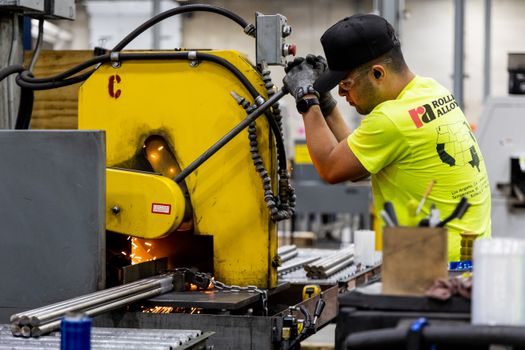
Made-in-China.com listed 2,355 custom-extrusion products with 785 manufacturers, of which a substantial subset offered US$2.98/kg at 10 kg MOQ — the floor of the small-batch custom segment in mid-2026 [S8].
FOB Shenzhen/Guangzhou is the default quotation incoterm, with CFR and CIF also offered, and payment terms of 30% TT deposit with L/C at sight are standard [S2]. Lead time for finished-and-coated custom profile runs 15–20 days after deposit clearance.
For heavy-press work (container-side beams, large cross-sections, railway interiors) buyers typically escalate from the small-batch custom tier to a dedicated press house, where gas aluminum melting furnace capacity gates the supplier's maximum billet size, and the aluminum die-casting machine line is a separate cell used for non-extruded die-cast brackets that share the same supply chain.
Plant Scale and Supplier Tiers in 2026
Huike Aluminum Products Co., Ltd. (Ligang Industrial Zone, Guanyao, Nanhai, Foshan) is a representative mid-tier custom extruder registered in 2009, covering automotive, construction, electrical, furniture, and consumer-electronics segments [S3].
Longxin (Zhouzhuang, East China) has been operating since 1993 and supplies finished aluminium frames and profile assemblies, illustrating the older full-service tier where billet-to-assembly integration is done in-house [S1]. At the high-volume tier, suppliers list 2,000+ plant-area employees, 1.48 Mil USD annual revenue, and 21-staff R&D cells, with response times under 3 hours and ODM/OEM branding on the same line [S4][S8].
The stainless steel coil 2026 sourcing map shows an analogous tier structure — primary mill, service centre, custom processor — and the same buyer-side audit logic applies: plant area, employees, in-house die-shop, and surface-line ownership are the four flags that separate a trader from a vertically integrated extruder.
Standards, Testing, and Compliance
Architectural curtain-wall profiles must satisfy the Chinese GB/T 5237.1-2008 series, and the FAQ in the S2 listing explicitly enumerates the fastener and hardware tests: GB/T 9296 (land spring), GB/T 9298 (flat open-window handle), GB/T 9300 (stainless-steel slide), GB/T 9297/9299/9301/9302/9303 (bolts, blocks, handles, locks), and GB/T 9305 (door closer), with fastener testing under GB/T 5277, GB/T 818, GB/T 3098.1, GB/T 3098.2, and GB/T 3098.4 [S2].
Mechanical-property certification is a routine requirement on Tier-1 architectural orders, and most Foshan and Wuxi extruders offer third-party mill certificates per order. For European buyers, EN 12020-2 governs 6063-T5 precision profiles and EN 755-2 sets the mechanical-property test methods that map onto the GB/T 5237 series; specifying both is the cleanest way to pass cross-market audit.
Where surface durability matters — coastal architectural, transit, and signage — PVDF coatings (AAMA 2605 equivalent) and anodising Class 15/20 are the two reference standards. Buyers should request the exact GB/T 5237 sub-clause (anodising, electrophoretic, powder, PVDF) be printed on the mill cert rather than left as a generic "coated" line.
Selection: When to Pick 6063-T5 vs 6061-T6 vs Custom
Use 6063-T5 when the priority is surface finish quality, complex thin-wall geometry (under 3 mm wall), and architectural appearance — windows, doors, curtain-wall mullions, LED heat sinks, light fixtures. The alloy extrudes cleanly, anodises to a uniform silver, and is the lowest-cost stocked grade in the China supply base [S2][S5][S7].
Move to 6061-T6 when the priority is mechanical strength: machined brackets, transport frames, solar racking, marine hardware, and any section carrying a fatigue or impact load. Yield strength 240–290 MPa (T6) versus 6063-T5 at 130–160 MPa is the deciding margin [S2].
For high-volume custom profiles under 10 kg per design, the US$2.98/kg tier is the price floor but enforces higher per-kg tooling amortisation; the per-kg price falls noticeably at 500 kg+ order quantities where full-press production runs apply. The perforated metal sheet selection guide is a useful parallel — it shows the same MOQ-vs-unit-price tradeoff logic that drives custom-extrusion sourcing decisions.
Failure Modes and Common Pitfalls
The most common buyer complaint in 2026 remains surface inconsistency: colour drift between batches on powder-coated lots, anodising film thickness below 15 µm on cost-cut orders, and wood-grain transfer delamination on exterior-grade curtain-wall panels. The fix is a Class 15/20 anodising spec or AAMA 2603/2605 powder/PVDF reference on the PO, not just "anodised" or "powder coated" [S2].
The second pitfall is tolerance on thin-wall profiles: a 0.8 mm wall with ±0.15 mm tolerance is a 19% wall-thickness band, and a 0.2 mm drift on an anodising line that drives ±0.05 mm downstream is enough to fail assembly. For close-tolerance work, EN 12020-2 tolerance bands should be referenced and the supplier's press-tonnage and billet-log capability confirmed in writing [S2].
Third, MOQ inflation on small custom dies: a $2.98/kg list price with a $800–1,500 die cost only makes sense at 300+ kg of that SKU. For prototype or low-volume work, shared-die or standard catalogue profiles cut the effective per-piece cost dramatically.
For buyers weighing 2026 sourcing options, the two trackable signals are: (1) GB/T 5237-2008 sub-clause printed on the mill certificate vs. generic "coated" stamp, and (2) press-tonnage disclosed per supplier — a 2,000-ton press handles 250 mm circumscribing circle sections while an 800-ton line caps at 150 mm. These two data points, on a single page, separate the architectural extruder from the small-batch custom shop. For buyers building parallel process lines, the wire mesh panel sourcing reference follows the same audit logic — supplier scale vs. part complexity is the deciding axis in both categories.