
Stainless steel coil supply in mid-2026 is dominated by Chinese mills and trading companies offering AISI 201/304/316/316L/430 cold-rolled coil at US$1,077–1,220 per ton and hot-rolled 201/304/316 coil at US$1,200–2,400 per ton on minimum orders of 1–5 tons [S6][S9].
Slit-coil processing, ASTM A240 / AISI grade coverage (201, 304, 316, 316L, 409L, 430, 904L, 316Ti), and downstream tank/vessel fabrication form the dominant 2026 supply chain, while the 27th China (Guangzhou) Stainless Steel Industry Exhibition is scheduled for May 16–18, 2027 at the China Import and Export Fair Pazhou Complex [S3][S5][S6].
Grade 304 vs 201 vs 316L: a price-and-application comparison
ASTM A240 AISI 201 cold-rolled stainless steel coil is offered at US$900–1,100 per ton with a 2-ton MOQ by Shandong Hongcheng Steel, positioning 201 as the budget grade for decorative and indoor applications [S5]. Grade 304 and 304L cold-rolled coil from Shandong Guojie New Material runs US$1,077–1,220 per ton on a 1-ton MOQ, the common workhorse for kitchen equipment, architectural trim, and chemical processing tanks [S6]. Hot-rolled 201/304/316 from Lingchuang Iron and Steel Group is listed at US$1,200–2,200 per ton on a 5-ton MOQ, the typical entry point for structural stainless plate-coil applications [S9]. Polished SS316 coil with a Ba 8K mirror finish from Shandong Huazhu Metal commands US$1,500–1,800 per ton on a 1-ton MOQ, targeting elevator panels, luxury appliance cladding, and pharmaceutical cleanrooms [S8]. The price gap from 201 ($900/ton) to polished 316 ($1,800/ton) is roughly 2:1, and that ratio is the most actionable number for a buyer writing a sourcing budget today [S5][S6][S8][S9].
For an engineer choosing between stainless steel grades, the decision reduces to three criteria: corrosion environment (316/316L for chloride exposure, 304 for general atmosphere, 201 for dry indoor service), formability requirement (304L/316L for deep-draw and welded tanks, 201 for simple bending), and surface finish (2B cold-rolled stock vs BA/8K polished for visible architectural surfaces) [S1][S5][S6]. Buyers should note that 904L and 316Ti cold-rolled coil also appear in the same Made-in-China catalog search results, confirming that super-austenitic and titanium-stabilized variants remain orderable in 1-ton MOQs through the same trading-company channel [S6].
Stainless steel coil slitting and slit-coil processing capability
Coil slitting is the dominant value-added service offered alongside mill shipments, with service centers such as Combined Metals Company operating five US locations (Bellwood IL, Ann Arbor MI, Hampshire IL, Elgin IL, Sycamore IL) plus Bristol CT, and providing precision cold rolling, slit coil, edging, coil-to-coil polishing, blanking, and wire drawing from a single integrated footprint [S1]. Slit-coil widths in the precision-strip market typically range from sub-25 mm narrow ribbon up to full master-coil width, and the same processor supplies stainless, nickel, cobalt, and titanium strip on shared slitting lines, an arrangement that lets a buyer consolidate multi-alloy orders under one quality clause and one mill test report format [S1].
Material testing, supplier quality clauses, and code-of-conduct documentation are listed as standard deliverables alongside the slit coil, which is the practical differentiator between a pure trading company and a service-center processor when a buyer is auditing to AS9100 or IATF 16949 expectations [S1]. The market verticals these slit-coil processors explicitly serve — aerospace, automotive, chemical processing, medical, oil and gas, power generation, electronics, defense, and consumer goods — define the grade-and-tolerance band a buyer should expect: tighter thickness and width tolerance than mill-direct coil, with documented traceability from melt source to slit width [S1]. For a spec writer building a stainless pipe fabrication BOM that also draws strip for formed heads and jacketing, this dual-grade supply from one processor is the single most useful 2026 sourcing fact.
China cold-rolled coil pricing and MOQ structure in 2026
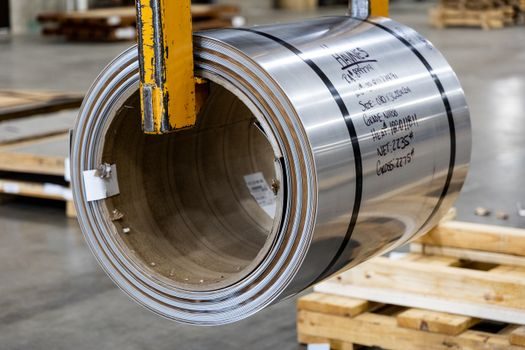
Made-in-China.com listings updated in May and June 2026 show cold-rolled stainless steel coil in the US$570–1,800 per ton band depending on grade and finish, with 1-ton MOQs standard for trading-company Diamond Members and 5-ton MOQs for mill-direct offers [S5][S6][S8]. The lowest entry, US$570–600 per ton from Shandong Ruida Steel, sits below the typical 304 band and is consistent with a 201 or 430 grade cold-rolled offer rather than a true 304/304L [S6]. SONCAP certification appears on a 201 cold-rolled listing, which is the documentation signal that a buyer shipping into Nigeria must check before placing a PO, since SONCAP is the mandatory conformity assessment programme for imports into that market [S5]. CE certification appears on a polished SS316 listing, marking the product as compliant with the relevant European conformity framework for finished industrial components [S8].
Minimum order quantity is the practical procurement lever in 2026: a 1-ton MOQ unlocks the widest grade and finish menu including 904L and 316Ti, while a 5-ton MOQ unlocks the lowest hot-rolled pricing on 201/304/316 [S6][S9]. For prototype runs, R&D samples, and small-batch fabricators, low-MOQ channels (1–2 tons) are available, with per-ton prices on these small orders—typically in the $900–1,800/ton range—running notably above the ~$570–600/ton quoted for 50-ton lots, reflecting the cost of flexibility in this market segment [S5][S6][S7][S8]. A spec engineer sourcing carbon steel coil for comparison should expect a separate grade-and-MOQ band entirely, and the two should not be mixed in the same BOM line without explicit grade isolation on the drawing.
Polished and surface-finished coil: 2B, BA, 8K, and brushed
Surface finish has become a primary procurement criterion, with the 2026 Made-in-China listings distinguishing four cold-rolled finishes at distinct price points: 2B (mill standard, cold-rolled, pickled, smooth) anchoring the lower band at US$1,077–1,220/ton for 304/316L, BA (bright annealed) and No.4 brushed commanding mid-band pricing, and 8K mirror polished at the US$1,500–1,800/ton ceiling for 316 grade [S6][S8]. Width range for polished and brushed coil is typically 500–2,000 mm, which matches the standard cold-rolled master-coil width and confirms that surface finishing is a downstream service-center operation rather than a mill capability [S8]. A buyer writing a finish specification should reference the finish name (2B, BA, No.4, 8K) plus the Ra value where the application demands it, since 8K mirror polished for architectural cladding typically targets Ra ≤ 0.05 µm while 2B for tank fabrication accepts Ra 0.2–0.5 µm [S8].
Applications follow the finish ladder: 2B for chemical tanks, dilution tanks, and general fabrication; No.4 brushed for kitchen equipment and elevator interiors; BA for pharmaceutical and food-grade vessels; 8K mirror for luxury architectural panels and reflective trim [S2][S8]. The Jiangsu Junye V116 stainless steel dilution tank with inner coil, listed at US$6,000–9,700 per piece, is a representative downstream product that consumes cold-rolled coil in 2B or BA finish and ships into the chemical, oil refining, metallurgy, and light-industry verticals [S2]. For a buyer cross-referencing against alloy steel coil for higher-temperature service, the finish hierarchy is the same, but the underlying base material changes — and that distinction belongs on the drawing, not the purchase order.
Exhibition calendar and raw-material data resources
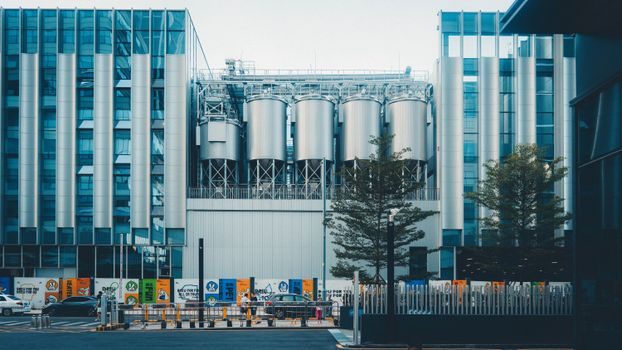
The 27th China (Guangzhou) Stainless Steel Industry Exhibition is confirmed for May 16–18, 2027 at the China Import and Export Fair Pazhou Complex, with move-in on May 14–15 and move-out at 1 pm on May 18 [S3]. The 2026 edition, the 26th in the series, ran May 16–18, 2026 at the same venue, and the registered exhibitor list includes XINGHUA XINGUANGJIE METAL, Hubei Ge Tie, TXD Steel Group, YIHO GROUP, Jiangsu Kaiyu Stainless Steel, Foshan Xinmaituo Metal Technology, Xiamen Xinhonghua, Zhejiang YOEO New Materials, XIAMEN CASEY, and Dongguan Zanten Metal, covering the mill, trading, and downstream-fabrication layers of the China stainless supply chain [S3]. For a buyer planning a 2027 sourcing trip, the May window aligns with the post-Q1 inventory restocking cycle and is the practical moment to lock second-half 2027 coil contracts.
Stainless Steel Club (stainless.club) provides daily stainless steel and raw material news, supply/demand and import-export data for 75 countries, raw material prices, end-use segment analysis, and bottom-up demand forecasts built from individual end-use trend data [S4]. The platform is a useful second-source for cross-checking the Made-in-China spot price points against European and North American benchmarks before issuing a mill-direct RFQ [S4]. For a sourcing analyst benchmarking 304 nickel-bearing coil against solenoid coil copper or silicon steel coil for electrical applications, the two material families are not substitutable and the comparison belongs in adjacent rows of a cost-of-materials worksheet, not in a single BOM line.
Trackable signals to monitor through Q4 2026: the LME nickel price as the primary 304/316 cost driver (every US$1,000/ton nickel move shifts 304 coil cost by roughly US$150–200/ton given the 8% nickel content), and the Shandong province mill operating rate, which is the leading indicator for spot coil availability out of the dominant Chinese production cluster [S4][S6]. For buyers evaluating additive manufacturing cost as an alternative to coil-based forming, the relevant comparison is part-volume vs coil-coil run length, not a like-for-like unit cost.