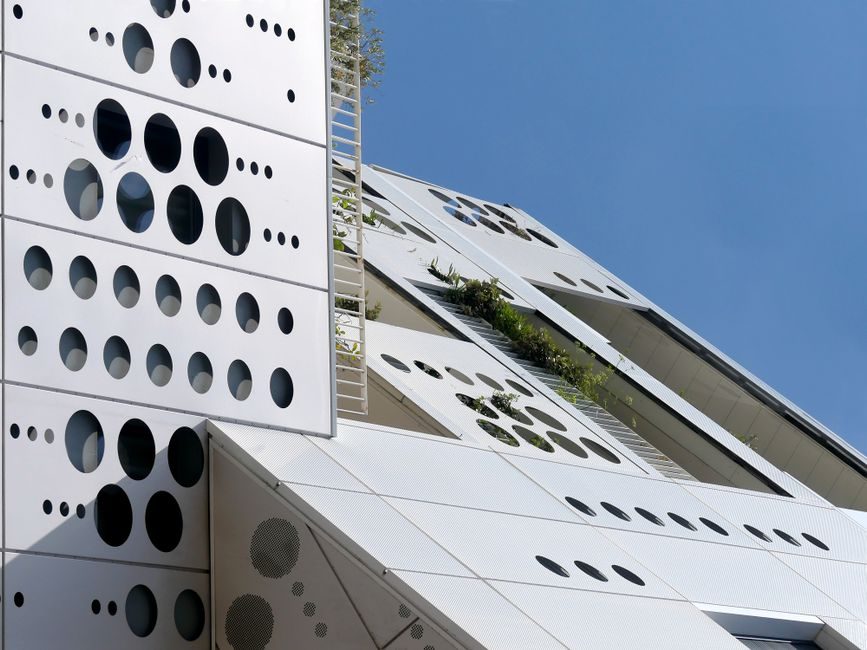
Specifying perforated metal sheet starts with three binding parameters — material grade, hole pattern, and open-area percentage — because they jointly control strength, airflow, acoustic absorption, and unit cost; 63 products across 6 manufacturers currently indexed on DirectIndustry show round (R), square (C), hexagonal (H), oblong (LR), rectangular (LC), and diamond (CD) hole geometries as the universal menu [S1].
For most industrial buyers the realistic supplier pool sits in Chinese mills and stockists (RMIG, GANTOIS, Sovatec, HLC, Metart, Quality Wire Products on the international index [S1]; Hebei Haofeng, Sanda Hardware, ShunHengLi, and a wide cluster on Made-in-China and Go4WorldBusiness [S4][S6][S7][S8]), with FOB China pricing bands of roughly US$1.90–9.90/m² for aluminum/galvanized architectural sheet at 10 m² MOQ [S7] and US$5.00/m² for low-carbon decorative/filter mesh at the same MOQ [S9].
Hole Pattern and Pitch: How Geometry Drives Function
Round holes in a 60° staggered (T) or in-line (U) pitch are the default for screens, filters, and architectural facades because they give the highest open area at a given structural margin; RMIG's R series documents the convention with the suffixes T, U, Z, and M mapping to staggered, in-line, and centred arrangements [S1]. Hexagonal (H) and square (C) patterns raise the open-area ratio by 8–12% versus round at the same web width, which is why they dominate vibrating-screen media where throughput matters more than aesthetics [S1].
For architectural envelopes, oblong (LR) and rectangular (LC) slots — and the diamond (CD) pattern — are chosen to control sightlines and rain-screening rather than flow; Sovatec, GANTOIS, and the Chinese suppliers (Sanda, Haofeng) all list these patterns as catalog standard [S1][S4][S8]. A useful rule: open area under 30% reads as a solid plate, 30–50% is the architectural sweet spot, and above 50% the sheet starts to behave like mesh, not panel — pick the metal curtain wall panel reference for facade-specific load and deflection limits.
Material Selection: Mild Steel, Galvanized, Aluminum, Stainless
RMIG and Sovatec both publish the same material menu — hot-rolled mild steel, pre-galvanized sheet, aluminum, stainless 304, and stainless 316 — with Sovatec noting 316L as the chemical/ coastal default [S1]. Sanda Hardware's vibrating-screen line specifies stainless for oilfield drilling mud screens, mine screening, and grain sifting, where corrosion and abrasion couple [S4]. Made-in-China stockist pricing confirms 304 and 316L command roughly a 4–5× premium over aluminum in the same hole pattern: 304/316L perforated at US$8.90–9.50/m² vs US$1.90–9.90/m² for aluminum/galvanized at 10 m² MOQ [S7].
For food, pharma, and offshore decks, 316L over 304 is the correct first cut (better chloride resistance); for indoor architectural cladding, anodized 3003/5052 aluminum is the standard and what the Foshan cluster (ShunHengLi, ornamental sheet OEM/ODM) actually ships in volume [S6]. Carbon and low-carbon steel perforated sheet remains the cheapest path for guards, machine enclosures, and speaker grilles, with low-carbon steel decorative/filter mesh listed at US$5.00/m² at 10 m² MOQ [S9]. For a side-by-side on aluminum tempers used in facade versus industrial sheet, the Aluminum Sheet vs Aluminum Window & Door: Spec Decision Map lays out the same grade logic from a different cut.
Thickness, Open Area, and Load Capacity
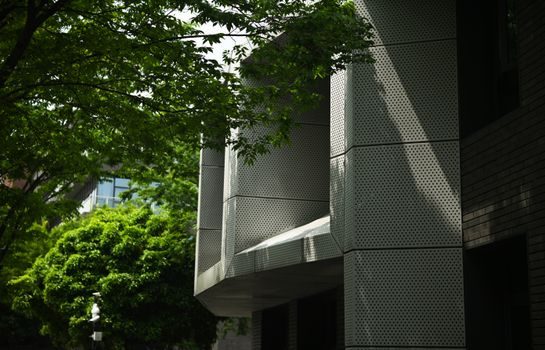
Thickness and open area interact mechanically: as open area rises, the remaining web between holes shrinks, so a 2 mm aluminum sheet at 60% open area has roughly half the load capacity of the same sheet at 30% [S1]. Sovatec's industrial line extends to special high-strength steel up to 500 HB for vibrating-screen decks and trommels, supplied either flat (with or without tensioning hooks) or rolled [S1]. For most architectural specs, 1.5–3 mm aluminum and 1–2 mm galvanized/304 stainless covers 90% of demand; industrial filter and screen duty commonly steps up to 3–6 mm.
When the duty is purely decorative on a ceiling or facade, the Shengqi / Hengda cluster supplies custom patterns from 5000 m²/day capacity, with sheet, expanded metal, and fabricated perforated assemblies under one roof — useful when you need a metal powder compatible finish or a matched expanded-metal infill [S2][S3]. A practical buyer rule: declare thickness and open area together on the RFQ; the open-area figure should come from the pattern formula (e.g. 60° staggered round at 5 mm hole, 8 mm pitch = ~40% open area), not from a generic catalog guess.
Pattern Codes, Tolerances, and Edge Finish
The RMIG pattern code (R/C/H/LR/LC/CD for shape; T/U/Z/M for arrangement) is the de facto international shorthand and is reproduced by GANTOIS, Sovatec, and most Chinese stockists [S1]. Edge finish is a separate line item: perforated areas can be left with raw shear edges, blank margins (no holes at the panel border), or hook-edge finishes for vibrating-screen tensioning — Sovatec lists these as selectable options with or without tensioning hooks [S1]. For screens that bolt into a frame, blank margins of 5–10 mm around the perimeter are the common ask and cost very little in tooling.
Tolerances on hole diameter and pitch are typically ±0.1 mm at hole sizes under 10 mm and ±0.2 mm above 10 mm for stockist-grade product; tighter tolerances require dedicated tooling and add 10–20% to the per-square-meter price. This is the same tolerance regime that pressure sensor and flow meter diaphragm perforation runs adhere to in instrumentation.
Common Use Cases and Who Should NOT Use Plain Perforated Sheet
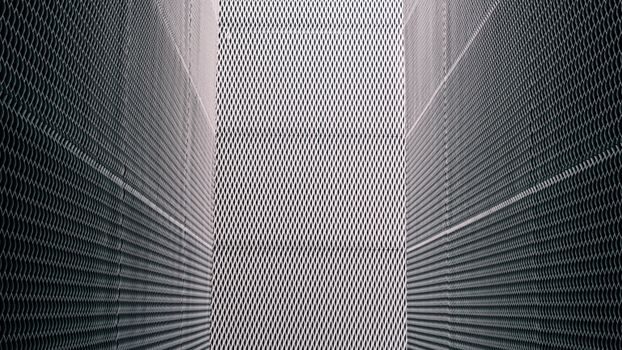
High-volume use cases fall into four buckets: (1) vibrating screens and trommels for mining, aggregates, and oilfield mud (Sovatec 500 HB steel, Haofeng round/square [S1][S8]); (2) architectural facades and ceiling panels (RMIG, Metart, ShunHengLi, Foshan cluster [S1][S6]); (3) filtration and sieving of grain, plastic pellet, and chemicals (Sanda [S4], low-carbon stockist [S9]); (4) acoustic panels, speaker grilles, and machine guards where appearance is secondary [S5].
Do not pick perforated sheet when you actually need: (a) a structural deck or walkway — spec checker plate or bar grating; (b) high-percentage open area above ~70% — spec woven wire mesh or expanded metal instead (Shangqi's expanded mesh catalog covers this gap [S3]); (c) fine filtration below 0.5 mm aperture — spec sintered mesh, not perforated; (d) a decorative-only sheet where the holes are aesthetic, not functional — specify laser-cut or ornamental sheet from the Foshan cluster, not perforated [S6]. For light industrial fabrication workflows around perforated stock, the Magnetic Base Drill Types, Spec Bands, and Industrial Applications reference covers the hole-making side that often gets paired with this buying decision.
Sourcing, MOQ, and Standards Discipline
MOQ is 10 m² for most stockist-grade architectural perforated sheet (aluminum, galvanized, 304/316L) on the Made-in-China and Go4WorldBusiness marketplaces [S7][S9]; 5000 m²/day production capacity is the high-volume tier at mills like Hengda and Shangqi [S2][S3]. Payment terms on the stockist tier are typically L/C, T/T, D/P, or Money Gram [S9], and lead times cluster at 15–30 days ex-works China for stock patterns, 30–45 days for custom tooling.
On standards: perforated metal is sold against pattern code + material grade + thickness, not against a single harmonized international standard for the product itself; ASTM A1008/A1011 covers the underlying cold-rolled steel substrate, EN 10025 covers hot-rolled mild steel, and ASTM B209 covers aluminum sheet — buyers should call out the substrate standard and the perforation tolerance on the PO, rather than asking for a "perforated sheet standard" that does not exist as a single document. For architectural acoustic duty, reference ASTM C423 or ISO 354 for the NRC rating; for food-contact duty, specify 304/316L plus an Ra ≤ 0.8 µm surface finish. Hengda, Sanda, and Haofeng all accept pattern, material, gauge, and finish as the four-parameter RFQ, which is the right shape for a clean inquiry [S2][S4][S8].
Track these next signals: (1) the 2026 DirectIndustry index showing 6 manufacturers / 47 metal products and 6 facade cladding listings — a useful baseline to measure stockist coverage changes quarter-on-quarter [S1]; (2) the Foshan cluster (Guangdong) continuing to add OEM/ODM ornamental sheet capacity in 2026, which keeps Chinese decorative lead times under 30 days at MOQs as low as single-sheet [S6]; (3) any move by Chinese stockists to publish tighter ±0.05 mm perforation tolerances for under-5 mm hole sizes, which would close the gap to European mill stock and likely pressure per-m² pricing on the architectural tier.