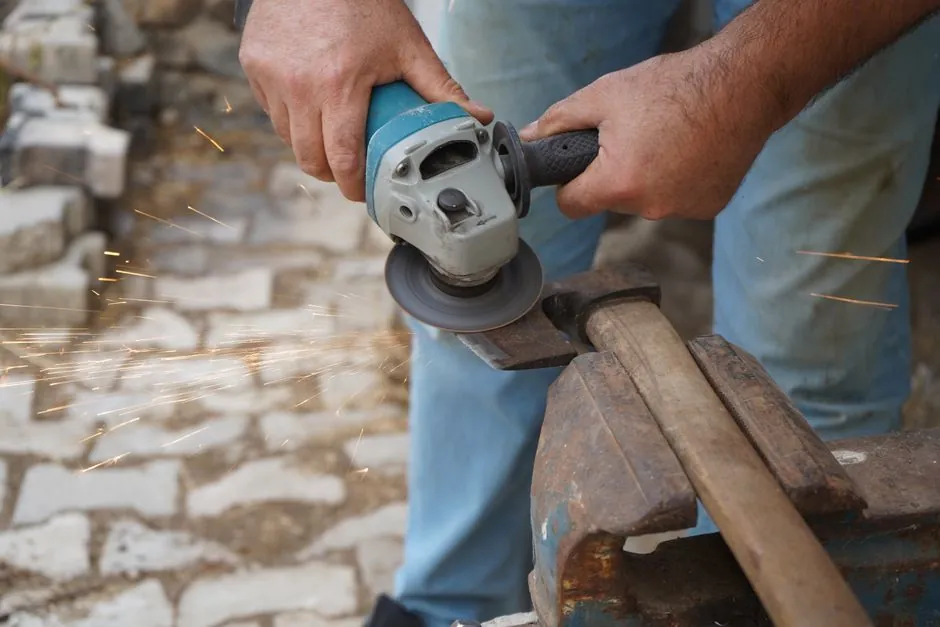
General-purpose chisels commonly target Rockwell C 58–62, while harder Japanese-style chisels are often near HRC 65.
Rockwell C is the usual scale for hardened tool steel, and the rating must be read together with steel grade, heat treatment, edge geometry, and impact duty.
Rockwell C scale for hardened steel
The Rockwell system compares the penetration of an indenter under a major load with the penetration produced by a preliminary minor load. For steel, the commonly used Rockwell scales are HRB and HRC, with HRB serving for softer materials such as copper, brass, and some soft steels, and HRC serving for harder steels, including hardened tool steel [S8].
Reference values illustrate why the scale letter matters: copper is listed at about 10, brass at 55, low-carbon steel at 65, tool steel at 92, and 304 stainless steel at 70 [S2]. Those values cannot be compared directly unless they use the same scale and test procedure, because Rockwell readings depend on the selected scale, indenter, load, specimen geometry, and measurement position.
For an industrial purchase specification, write the scale explicitly, for example “HRC 58–62,” rather than using an unqualified “Rockwell 60.” A supplier could otherwise interpret the same number against a different scale.
Hardness targets by tool type
Good-quality Western chisels commonly fall in the HRC 58–62 range, and Japanese chisels are typically harder at around HRC 65 [S3]. A broader archive of measured chisels recorded values from HRC 58 for a Robert Sorby chisel to HRC 64 for Blue Spruce butt chisels [S6]. Stanley FatMax chisels, models 16-973, 16-974, and 16-975, are specified at HRC 57–62 [S7].
A practical specification can therefore be built around three bands: HRC 57–62 for general woodworking chisels and the specified FatMax products, approximately HRC 63–65 for harder chisels requiring stronger edge retention, and a lower band for tools where impact toughness takes priority. A target must be tied to the steel and heat treatment rather than copied from a generic hardness chart.
For punches, the same HRC framework is more demanding because the working portion may receive concentrated impact, shock, or edge deformation. No universal punch hardness was established in the supplied research, so a punch drawing should specify a verified hardness range for its specific steel, treatment, geometry, and service condition.
Comparison across chisel construction and duty
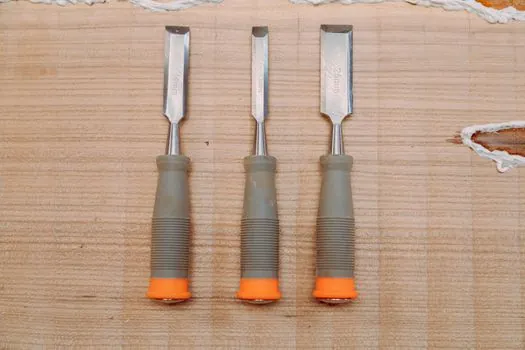
Western and Japanese chisels are not equivalent hardness options.
On four decision criteria, the practical comparison is clear. For edge retention, the Japanese construction has the numerical advantage at approximately HRC 65 versus HRC 58–62 for common Western chisels [S3]. For shock tolerance, the Japanese two-piece construction is specifically designed to let the softer body absorb impact [S3]. For stock consistency, the measured archive spans HRC 58–64 across manufacturers [S6]. For maintenance, lower-hardness steel is generally easier to sharpen and less prone to chipping, while higher hardness improves edge retention but can increase brittleness [S5].
This comparison does not make HRC 65 automatically superior. A harder edge can chip or fracture if the tool is struck against an unsuitable object, while a softer edge can roll or deform. The correct choice is determined by the operation, not by chasing the highest number.
For cutting tools, not for impact tools
Rockwell C is suitable for hardened chisels and other cutting edges, but hardness alone does not establish toughness, impact resistance, fatigue life, or edge retention under every condition [S1]. The same steel can be heat-treated to different Rockwell values, and each heat-treatment result creates a different balance between hardness and toughness [S5].
Rockwell testing causes relatively little damage compared with more destructive methods, but the result still depends on procedure [S5]. NIST identifies adherence to good measurement and calibration practice as a means of reducing measurement error, which matters when procurement tolerances have tightened [S1].
Limits of a hardness-only specification
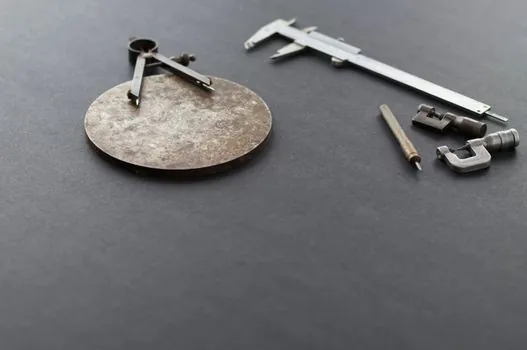
A numerical hardness requirement is incomplete without supporting process controls. At minimum, a purchase specification should identify HRC or another defined scale, state the required range and measurement location, define the steel grade or material standard, and require the supplier to identify the heat treatment.
Rockwell readings are not uniform across a tool even when it has one nominal hardness. Edge geometry, residual stress from grinding, section thickness, and the distance of the indentation from an edge can affect the result. NIST’s recommended practice explains the causes of variability in Rockwell results and emphasizes good measurement and calibration practice [S1].
For a chisel, checking away from the cutting bevel is generally necessary because the bevel is hardened differently and may be too thin for a valid indentation. For a punch, the test location should represent the working section without approaching a damaged edge. These are procedure controls, not optional cosmetic details, because a misplaced test can make a correctly treated tool appear nonconforming.
Heat treatment and hardness verification
Heat treatment determines the Rockwell value and can be as important as the nominal alloy. The same base steel can be hardened or tempered to different hardness levels, so a grade designation alone does not guarantee the required rating [S5]. For purchased chisels and punches, request the supplier’s actual HRC results for the production lot or use an independently calibrated tester.
Typical comparison points include HRC 57–62 for the specified FatMax chisels [S7], HRC 58–62 for common Western chisels [S3], about HRC 65 for Japanese chisels [S3], and HRC 58–64 across the measured chisel archive [S6]. These figures are decision benchmarks, not universal acceptance limits.
For incoming inspection, require a repeatable test method and record the scale, tester identification, calibration status, material grade, heat-treatment condition, and individual readings. If the hardness range exceeds two points in a controlled production process, investigate the cause rather than treating the full range as acceptable by default [S5].
Specify the complete cutting-tool requirement
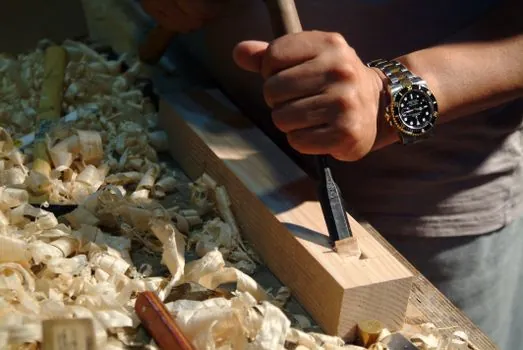
The defensible selection is HRC 58–62 for a general-purpose chisel requirement, approximately HRC 65 for a harder Japanese-style chisel design, and a product-specific verified range for a punch subjected to concentrated impact [S3][S6][S7].
Track hardness results against the drawing requirement, the steel grade, and the heat-treatment record. If a supplier claims only “Rockwell 60” without a scale or procedure, request HRC, define the test location, and require documented readings before accepting the lot.