
Select a 20–32 oz steel hammer head for driving framing nails into structural lumber, or a 12–16 oz head for controlled finish work that protects visible surfaces [S1][S2].
The practical choice depends on nail size, stock, strike count, handle length, face texture, and claw geometry. Framing favors impact energy and nail grip, while finish work favors balance, accuracy, and a smooth face [S2][S3].
Framing and Finish Head-Weight Limits
Steel framing hammers typically weigh 20–32 oz, with 20–22 oz serving as a practical range for repeated 16d-nail driving and heavier 28 oz options reserved for large stock or hammer-driven framing [S1][S2][S3]. Finishing hammers generally weigh 12–16 oz, giving the operator enough mass for small fasteners without the surface damage associated with a framing head [S1][S2].
A household curved-claw hammer commonly starts at 16 ounces, while framing hammers are built to drive 8d to 16d nails into lumber and are longer, heavier, and shaped with a straight claw and textured face [S2][S3]. The comparison is organized by task, distinguishing framing hammers that prioritize power and durability from finishing hammers designed for control and surface protection [S1].
Match Weight to Fastener and Workload
Use a framing hammer for 8d through 16d nails driven into studs, plates, joists, and rafters, as well as for pulling misplaced nails and shifting rough assemblies [S3]. A framing hammer should be heavy-duty enough to drive 8d to 16d nails, and an undersized finishing hammer for framing slows production and requires more swings per fastener [S3][S2].
Use a 12–16 oz finishing hammer for baseboard, crown molding, cabinetry, and other detail work where an oversized framing tool can mark or split the workpiece [S1][S2]. An undersized finish hammer used for structural framing increases the number of swings required per fastener, while a framing hammer used on trim increases marking, splitting risk, and fatigue [S1][S2].
Compare Framing and Finishing Configurations

On impact capacity, a 20–32 oz steel framing head is the stronger option; on control and surface protection, the 12–16 oz finish head wins; Framing hammers have straight claws and textured faces, while finishing hammers use a lighter head, a smooth face, and a curved claw [S2][S3].
Claw geometry must match the removal task. A straight or rip claw favors framing, demolition, and prying, while a curved claw favors controlled nail removal and general carpentry [S2][S3].
Select by Handling, Balance, and Grip
Choose the tool in hand before fixing a model designation, because head weight affects balance, swing effort, and fatigue while handle material and grip affect shock, slippage, and control [S1]. Framing hammers commonly pair a longer handle with an aggressive face for driving structural nails, while finishing hammers pair a shorter handle with a smooth face for accurate placement in confined areas [S1][S2].
For most finish work, a 16 oz curved-claw hammer is the general-purpose starting point, while a 12–16 oz finishing hammer is the more specialized choice [S2]. For framing, 20–22 oz steel is the common all-day selection, and crews handling heavy timber may accept 28 oz or greater when the reduced swing count outweighs fatigue [S3].
Use the Correct Tool for Each Operation
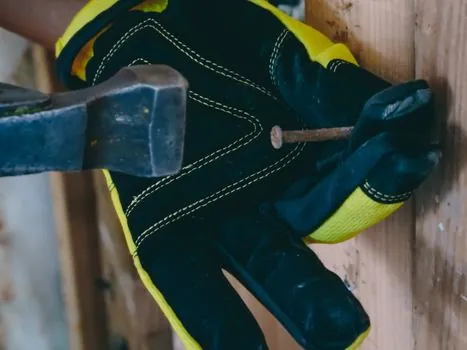
Frame walls, floors, roofs, and decks with a framing hammer because large fasteners and rough assembly justify the higher head mass [S2]. Set baseboard, crown molding, door hardware, and cabinetry with a finish hammer to limit surface marks and improve control around finished timber [S2].
Do not use a framing hammer as a general finish tool, and do not expect a finish hammer to equal a framing hammer on production framing. The failure pattern is asymmetric: excess mass can split trim, while insufficient mass creates extra swings and delays [S1][S2].
Set Weight Before Purchasing a Replacement Tool
Specify framing versus finish work first, steel versus titanium second, and head weight third. For a structural crew, start with a 20–22 oz steel framing hammer and move to 28 oz only when the lumber and fastening pattern justify the fatigue penalty [S2][S3]. For finish carpentry, choose a smooth-face hammer within the 12–16 oz range, with 16 oz as the practical starting point for general home repair [S2].
The next trackable checks are the actual nail size, the lumber dimensions, the number of strikes expected in one shift, and whether visible surfaces can tolerate a milled face. Those four inputs turn “heavy or light” into a defensible tool specification.