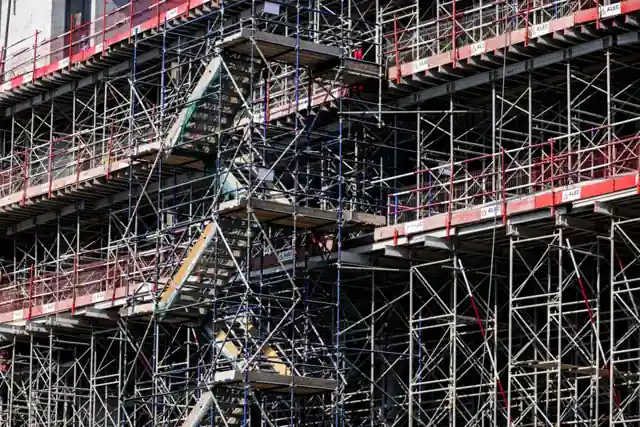
Renovation-grade welded steel mesh is typically specified as hot-dip galvanized or stainless steel welded panels in the A4 to A6 opening range, with wire diameters of 2.0–5.0 mm, selected after substrate, code and corrosion checks rather than on price alone [S1][S2][S3].
Three product families dominate the renovation supply chain in mid-2026: galvanized welded mesh, PVC/vinyl coated welded mesh, and stainless steel 304/316 welded mesh, each with distinct coating, opening and service-life behaviour, and each used in concrete slab reinstatement, partition plastering, security infill and façade repair on existing buildings [S2][S3].
Three Mesh Families You Will Actually Be Quoted
Galvanized welded mesh from Hebei-based export mills is offered in Welded Reinforcing Mesh and Galvanised Welded Wire Mesh grades with MOQs of 8–88 kilometres depending on the panel format, sized to international standard references [S3]. Welded mesh panels serve as robust barriers in commercial and residential renovation work, with installation and adaptability the main selling points versus roll mesh [S1]. Stainless steel welded mesh, made from plain steel wire and stainless steel wire, is offered for projects that need corrosion and oxidation resistance, typically using 304, 304L, 316 and 316L wires with openings tailored to the application [S2][S5]. Vinyl-coated welded wire mesh is also widely exported, with a black PVC over galvanized core used where the renovation calls for a dark architectural finish or extra corrosion margin in coastal retrofits [S3].
Wire Diameter, Opening and Panel Geometry
Renovation reinforcement panels are usually built from cold-drawn low-carbon steel wire, with mesh wires specified at tensile strength not lower than 4500 kgf/cm² where structural reinforcement is the function [S4]. Skeletal bars added between mesh layers are typically 2–5 mm in diameter for cold-drawn low-carbon wire and 6–8 mm for ribbed bar, a sizing rule from cement-mesh composite practice that transfers cleanly to slab and wall reinstatement in older buildings [S4]. Stainless crimped mesh complements welded panels in renovation work, with materials including 301, 302, 304, 304L, 316 and 316L, and is widely specified for acid/alkali screening, chemical and electroplating service, and architectural infill [S5]. Welded mesh sheets and panels in renovation are commonly produced in 1 m × 2 m, 1.2 m × 2.4 m and 4 ft × 8 ft formats, with square or rectangular openings from 1/4 inch up to 6 inch on standard lines, although project-specific tooling at Chinese mills lets buyers set custom pitch and diameter combinations [S1][S3]. For renovation work on existing masonry or concrete, the steel mesh product page maps the material families used in panels, rolls and lattice girders.
Coating Selection: Galvanizing, PVC, Stainless

Hot-dip galvanizing is the default coating for renovation welded mesh in non-coastal, non-chemical environments, with zinc mass typically 60–275 g/m² depending on the service-life target and the supplier's standard line [S3]. PVC/vinyl coated welded mesh adds a polymer jacket, normally 0.5–1.0 mm thick, bonded over a galvanized core, and is favoured for pool fence retrofit, garden boundary and school perimeter work where colour, safety and extra corrosion margin are required simultaneously [S3]. Stainless steel welded mesh in 304 is appropriate for indoor wet zones and food-adjacent retrofits, while 316/316L is the right pick for coastal façades, plant rooms and any location with chloride exposure; 316L is also preferred for welded joints that cannot be post-annealed [S2]. For comparison on substrate, weldability and temperature limits between the carbon and stainless welded grades, the stainless steel and carbon steel reference pages are useful starting points for spec writing.
Selection Criteria for Renovation: Code, Corrosion, Geometry
Specifiers should fix four gates before placing an order. First, code: confirm whether the mesh is structural reinforcement, partition plaster key, security infill or anti-crack bed, because each role pulls a different wire diameter, opening and lap-length rule [S1][S3]. Second, corrosion: map the chloride, sulphide and humidity exposure of the room or façade, then pick galvanized, PVC coated or stainless 304/316L accordingly [S2][S3]. Third, geometry: confirm the panel size, opening, wire diameter and edge condition (cut, selvedge, or framed) needed to lap with existing rebar, brick or drywall, since retrofit lap is the most common source of site rework [S3][S4]. Fourth, fabrication: welded mesh must arrive flat and square, with consistent weld nugget size at every intersection, so a factory audit on weld shear and zinc mass is worth more than a small price concession [S1][S3]. The mesh is also widely used in construction, decoration, petroleum, chemical, pharmacy, breeding, metallurgy, barrier and security fields, so the same four gates apply across most renovation sub-sectors [S3].
Who Welded Mesh Is For, and Where It Is Not
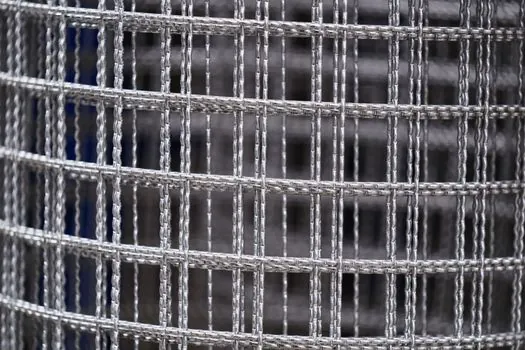
Welded steel mesh is the right call for renovation projects that need repeatable panel geometry, fast installation and predictable lap behaviour, including slab topping reinstatement, plaster anti-crack beds, partition framing, security infill panels, and pool or garden fence retrofit [S1][S3]. It is not the right call where the substrate moves significantly under live load, where vibration or impact will fatigue the weld, or where the visual finish must be a continuous architectural surface with no grid pattern showing through plaster; in those cases expanded metal lath or fibre-reinforced render is usually substituted [S1][S4]. It is also a poor choice for highly acidic process environments, where sintered wire mesh or alloy alloy steel alternatives outperform standard stainless welded grades [S2]. For specialist plant-room retrofits involving motors, transformers or silicon steel cores, mesh specification should follow the equipment maker's EMI/RFI shielding guideline rather than the renovation contractor's default.
Use Cases Drawn From Active Renovation Practice
Concrete slab topping in a 1990s office block is a textbook case: 4 mm wire at 150 mm × 150 mm openings, hot-dip galvanized, supplied as 1.2 m × 2.4 m panels, lapped 200 mm with existing rebar at the slab perimeter [S3][S4]. Plaster anti-crack on internal partitions uses lighter 2.0–2.5 mm wire at smaller openings, embedded in the cement skim, with stainless 304 reserved for kitchen and wet-room walls [S2]. Pool fence retrofit in a coastal villa uses black PVC-coated welded mesh on a galvanized core, with selvedged edges and a 50 mm × 50 mm opening to meet most domestic pool codes [S3]. For schools and similar public-sector retrofits, the related Welded Steel Mesh Selection for Schools spec map covers the same wire/coating gates with a child-safety lens. For hospital-grade and cold-room retrofits, the dedicated Welded Steel Mesh Selection for Hospitals and Welded Steel Mesh for Cold Storage articles line out the hygiene and thermal-cycle constraints. Where the renovation involves conveyor or process-line replacement, mesh belt conveyor systems can also use welded mesh as a continuous belt, although the duty cycle and temperature usually shift the spec toward stainless or alloy grades.
Limits, Failure Modes, and Sourcing Discipline
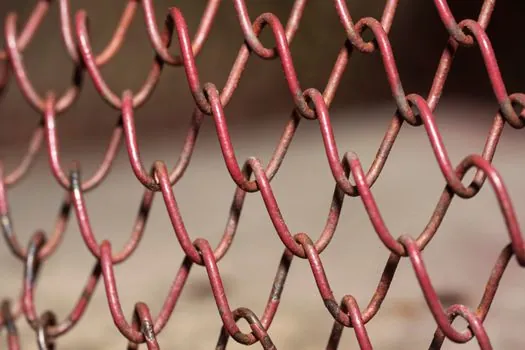
Welded mesh fails in renovation most often at three points: weld corrosion under the coating at cut edges, lap slip where new mesh does not tie to existing rebar, and alkali attack on zinc in fresh cementitious repairs where the coating was not specified for that pH window [S3][S4]. Cut edges on galvanized panels should be repaired with a zinc-rich primer on site; on stainless 316L panels, edges can usually be left bare if the chloride exposure is low, otherwise passivation is recommended [S2]. Sourcing should stick to mills that publish weld shear, zinc mass and wire tensile data, and that can show international-standard compliance, since welded mesh producers in Hebei range from small job-shops to export-grade plants with multi-line capacity [S1][S3]. A 10–15% overbuy on opening size and panel count is a sensible buffer on renovation orders, because existing substrates rarely match the drawing exactly and the cut-and-fit waste rate is materially higher than on greenfield work [S1].
For related selection work beyond mesh, the broader titanium alloy selection guide covers non-ferrous alternatives where stainless is over-specified for the duty.